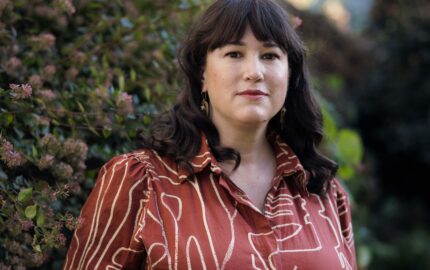
Irin Carmon would soon learn that she was pregnant for the second time as oral arguments were unfolding in the Supreme Court on Dobbs v. Jackson Women's Health Organization in December 2021. As it became clear that Roe v. Wade was likely to be overturned, Carmon fielded a call from the editor of her first book, “Notorious RBG: The Life and Times of Ruth Bader Ginsburg,” asking if she wanted to write a book on abortion.
Carmon, a Queens-based New York magazine reporter who has covered gender, reproduction, and the law, didn’t feel like she had much to add to existing or in-the-works coverage in book form. Her editor encouraged her to think big.
Tackling a new book project right before having another baby felt like less than ideal timing. But ideas kept percolating as Carmon covered Politico’s leak of a draft opinion in May 2022 indicating that the Supreme Court had voted to overturn the federal constitutional right to an abortion, which was confirmed in June.
“In reading the opinion in full afterwards, I was really struck by how Justice Alito completely disappeared the experience and burden of pregnancy,” Carmon said. She wrote an essay for New York magazine detailing a week-by-week account of how pregnancy changes the body, which won a Front Page Award from the Newswomen’s Club of New York.
“There was a lot more to say,” Carmon said. “Even though I was not seeking an abortion, I felt a deep sense of connection and rage and sadness about what was going to happen to anyone who was pregnant in this country, whether they wanted to be or not.”
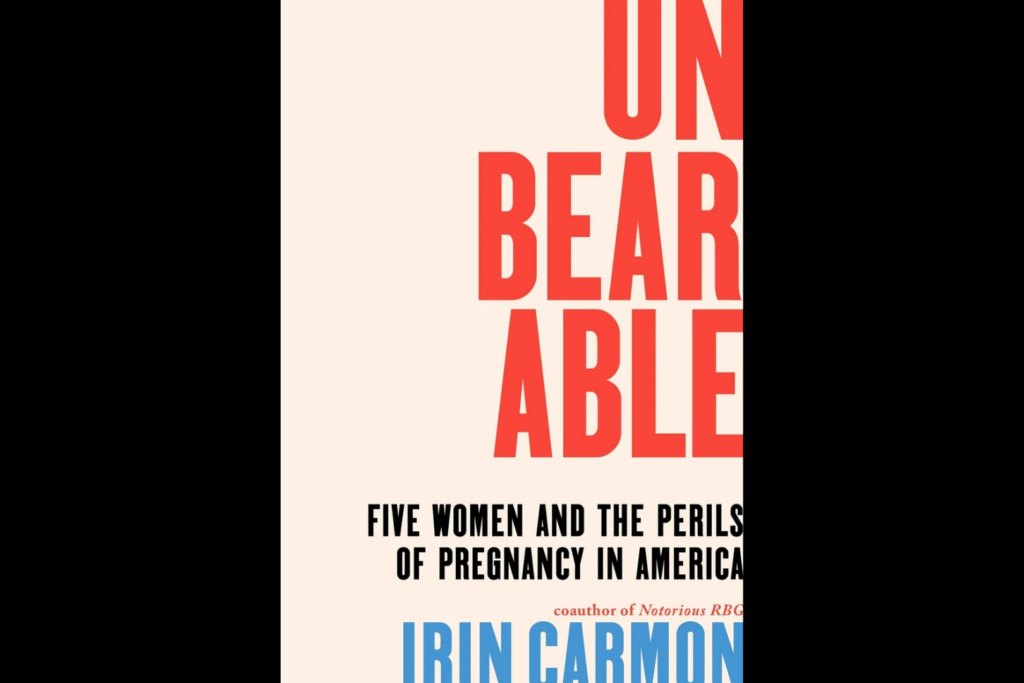
After giving birth in August 2022, Carmon scrambled to quickly finish and sell a partial book proposal in the fall while on parental leave from New York magazine. “Unbearable: Five Women and the Perils of Pregnancy in America,” published in October 2025, chronicles five women navigating pregnancy care in New York and Alabama. One of the subject’s stories unfolds at Woodhull Hospital, a Brooklyn hospital where Carmon herself had considered seeking care in 2020 during her first pregnancy.
Today, the finished product is broken into four sections: “Life at Conception,” “Taking Care,” “How Pregnancy Ends,” and “After.” Storyboard caught up with Carmon to delve into how she brought this work to fruition, and the thread that has animated her coverage for more than a decade. Our conversation, which has been edited for length and clarity, is followed by an annotated excerpt from the book.
Your first book was about the life and legacy of Justice Ruth Bader Ginsburg. Can you share a bit about how that book writing experience felt different from this one or influenced your approach this time?
That experience was different in every possible way. For that book, I was approached by Julia Cheiffetz, an editor at HarperCollins at the time, to write “Notorious RBG” after the moniker had already become a phenomenon. This was around November 2014. My co-author, Shauna Knizhnik, had started a [Notorious RBG] Tumblr. Our task was to figure out how to make this more than just a printed-out meme — how to tell a story, while also being true to the spirit of the Tumblr and phenomenon. It was a really fun collaborative exercise. We both did reporting and I did the writing.
We had about six months to write that book. I took six weeks off, so it was a real crash course in writing, and then it immediately became an enormous success. It sold well over half a million copies. But it was a completely different endeavor than a traditional reported nonfiction book, like this one.
My two books came out almost exactly 10 years apart. What the first book did is bought me some time to figure out what I wanted to do. I quit my job at NBC. I started working on another book proposal that I ended up not pursuing. I got swept up in the reporting on the #MeToo movement. I was a full-time freelancer at the Washington Post between 2017 and 2018, breaking the story of the Charlie Rose sexual harassment allegations and sexual harassment allegations at CBS. Then I got hired at New York magazine and immediately after Justice Kennedy retired, one of the first stories I was covering was Brett Kavanaugh.
How do you see these works in conversation with each other and your other coverage on reproductive care? How would you describe the throughline of your reporting over the last dozen years?
On a woman’s right to choose an abortion, Justice Ginsburg famously said, “When government controls that decision for her, she’s being treated as less than a full adult human being responsible for her own choices.” I've been really interested in the way that reproduction is such a core nexus of our ideas about gender and power. Justice Ginsburg was deeply committed to a vision where every person can decide their gender identity and way of being in the world, and their pregnancy, on their own terms. That’s certainly a throughline between writing a biography of her and writing about American reproduction as it’s lived in the world today.
Books of this scope and rigor are time-consuming. But there’s also the quality of timing in terms of when people are interested in a particular news cycle. How did you balance the speed and urgency of what was happening in the national climate with the reality that this would be a lengthy project, and toggle between those competing pressures?
This was a timeless story that became more salient to people — that they understood better — because the Dobbs decision was bringing everything to a head. To me, there was no particular rush. But I understood that there was a market reason to sell the proposal during this window because that was when publishers were interested in this subject.
I've been doing this for long enough to see the news cycle move on and come back. The pendulum swings. I don't think it's possible to time these things, given the amount of time that it takes to actually write a book. It’s more like luck. Unless you’re writing a crash. But for the first book, I remember people thinking, “Are people going to still care about Ruth Bader Ginsburg a year later?” And they did. Nobody has a crystal ball.
I wouldn't have done the mad scramble to put together this book proposal postpartum if there hadn’t been fear that people would lose interest in this topic. But I took my time on the reporting. It was three years between when the proposal was finished and the book came out.
Can you talk about your relationship with your agent and how that person plays a role in shaping your early conception of a project?
My friend and now colleague, Rebecca Traister, asked me sometime around 2013 if I wanted an introduction to her agent at the time, Linda Loewenthal, who had asked if we knew each other. I met with her and was impressed with the fact that when I told her that I had no ideas for books and wasn't sure if I wanted to write one, she patiently continued to take an interest in what I cared about and what I was working on. She really did that. She waited for me to be ready.
“Notorious RBG” had appeared because my former boss at Jezebel, Anna Holmes, was originally approached for “Notorious RBG” by Julia Cheiffetz. Anna asked me if I wanted to do it and recommended me to Julia because I was covering the Supreme Court and I was interested in the law. That honestly landed in my lap. I had to write my vision of it and interview for it, but I didn’t seek it out. The ensuing period, as I mentioned, I was really just deeply engaged in other reporting — none of which naturally seemed to lead itself to a book. I pursued a couple of other ideas but there was nothing that lit me on fire. Linda was incredibly patient and we kept having conversations. The greatest asset that I had with her as my partner is that she kept in touch with me. She would gently prod me, but she never encouraged me to do something just for the sake of selling a book. Given how draining and taxing writing a book can be, it really has to be worth it to you as a writer and a reporter.
How did you think about your presence in the story as a narrator, and ultimately what you wanted your presence to be on the page? What informed your choices about how much of yourself you wanted in this story, versus the other subjects you follow?
I was mostly reluctant to write about myself, in part because I don't think I'm that interesting. And I don't think my story is that interesting or unusual. But what I realized is that I wanted to explain to the reader how my thinking evolved from being a reporter covering abortion for over 10 years to someone being pregnant during Covid and when the Dobbs decision came out.
The book went through a lot of different drafts and formats. At one point, my editor had suggested a possible way to structure it as a journey into pregnancy in America, narrating my reporting in the first person and largely chronologically. It didn’t work for this book because I didn’t feel that consistently telling it through my eyes added much. Instead, the stories begin in the third person omniscient, the chronology guided by the characters’ experiences, and I come in only when absolutely necessary.
But I wanted the reader to understand where my own perspective and stakes came from. What was my sense of shock at experiencing pregnancy care in New York City? Why was I interested in the death of women at Woodhull Hospital, both as its own standalone outrage that told us something about New York City but also based on the feeling that this is my community? I almost went to that hospital for my own care and I understood why people would seek care there.
Journalists are traditionally trained out of the “I” and first-person. How comfortable are you, in general, with centering your perspective in your journalistic work or analysis?
Most of the time, I prefer to let the reporting speak for itself. But I also think that the nature of the book is so much about people's embodied experiences in the world — how they are different depending on who you are and where you live, but also a kind of universal throughline about the vulnerability of pregnancy and the potential power involved in making decisions about pregnancy. In that sense, I felt like I needed to lay all my cards out on the table. That involved both talking about my own privilege and my own values, because this was also a work of opinionated reporting that’s transparent about where I'm coming from. This is important when talking about a really contentious issue.
In some cases, the reporting and my own pursuit of it were impossible to leave out. I wound up meeting one of the five women I follow in the book at a picnic in the park a few blocks from my house. I think it's more powerful and interesting to say that I wasn't even looking for that story. It came to me. I could have written about two other subjects, Christine and Jose, without describing my own involvement. But it felt more honest and illuminating for the reader to experience what it was like to meet Jose, interview him and wind up having our daughters play together. He burst into tears at the dinner table. All of us were sitting down having a chicken dinner, and we talked about how my daughter had not had to learn about what death was at age three, but his daughter had.
How did you know when you’d found the right subjects, the five that you ultimately included in the book? What signaled to you that they were the people who would reflect and embody the story?
The book went through a few different drafts and structures. I worked with a freelance editor, Jane Fransson, during the process who helped me stay on track. At some point, Alessandra Bastagli became the editor of the book. She had the willingness to get in the weeds about structure in a helpful way. Because the book is so sprawling and ambitious, there were a lot of different ways that it could be structured. But it had to not feel jumbled or confusing.
The structure I laid out in my proposal was to follow women during their pregnancies. But what made it difficult to stick to that is one of the subjects, Dr. Yaschica Robinson, was such an important part of the book but is not pregnant during the course of the reporting. For another subject, Hali, most of what’s narrated about her happened after she was pregnant. I also had to figure out where all the history and policy should go. Nothing seemed to be working.
Then I reread “Evicted,” by Matthew Desmond, which had been one of my earliest inspirations for the book in terms of structure. I was also trying to figure out: How many people is too many people for a reader to follow? In Evicted, there are many different throughlines but you never feel lost in it. You feel fully immersed. What really inspired me about that book was that deeply reported narrative — in Desmond’s case, a totally third-person omniscient narrator — moves so gracefully between narration, history and the policy of why this is happening.
What surprised me is that “Evicted” has a character who’s a landlady, not a tenant. Everyone else is a tenant. The landlady is the lens through which you understand the industry and why it is the way it is. I realized that Dr. Robinson — although a much more positive, inspiring figure than “Evicted”’s landlady subject — was someone who was on the inside of pregnancy care. She was providing both abortions and OB-GYN pregnancy care, prenatal care and birth care. The fact that it was so hard to do what she did — she was constantly swimming against this tide of those who wanted to treat pregnant people as either not capable of making their own decisions, or put them on a conveyor belt towards physicians’ or hospitals’ or the state’s priorities — allowed me to tell this piece of the story. It also allowed me to tell a really important history of how the racial and gendered roots of pregnancy care in this country took place in Alabama.
Through each of my five subjects, you see a different part of the puzzle of American reproduction — whether that’s infertility and miscarriage, abortion, birth, the eradication of midwifery, the rise of the OB-GYN, the marginalization of abortion, or the criminalization of pregnancy. My hope was that all of these parts would end up naturally flowing from them.
What tips or insights do you have for reporters in the midst of a narrative book project where the reporting is so expansive?
I got this advice from the beginning, but I did not follow it and I hope others can follow it: write contemporaneously with the reporting. Keep writing even when you feel like you have no idea what’s in the book. I wish I had done this more. For me, the reporting flows so much more naturally. I find the writing excruciating. Not that reporting is easy, but I always feel the most connected to why I do this when I'm in a long conversation with someone about something that happened to them or that they experienced.
It's so easy to spend every waking minute reporting, especially because I was taking reporting trips to Alabama with a 2-year-old and an infant at home. Every time I went on the road, it was an additional lift at home for my husband and the web of child care we had been able to set up. I had to make the most of the reporting trips. I also took two spurts of unpaid book leave from my job at New York magazine.
What has the marketing experience been like since the book was released? What’s surprised you most about that leg of the journey?
I've been really grateful for the reaction so far because this is the first book that was entirely my own conception, so to speak. I had no idea what to expect in terms of how people would engage with it, but I feel honored that they’ve done so thoughtfully.
A lot of the progressive and feminist media and Twitter that helped make “Notorious RBG” a success simply don't exist anymore. It’s a different information environment, an environment with extreme billionaire backlash against these notions. Certain coercive and limited ideas about reproduction are being pushed on us. So in that sense, it’s more countercultural to tell a harder and more complicated story about pregnancy that’s not just, “You should be a Tradwife.”
Even though I miss the feminist blogosphere, I’ve had the opportunity to be in conversation with amazing feminist podcasts and newsletters that didn't exist 10 years ago, like Jessica Valenti’s Substack or Kate Manne’s. Despite that a bunch of billionaires intentionally dismantled a lot of mainstream media, and also progressive and feminist media, so far it feels like people who want to have these conversations are finding this work. There are powerful forces who don't want these stories told — all different kinds of stories, including the one that I chose here. The challenge has always been how to bring these works out in a way that's sustainable. I just feel really lucky to get to do this while it’s still possible.
***
Annotation: ‘Unbearable: Five Women and the Perils of Pregnancy in America’
Part One: Life at Conception
Chapter 5: Yashica Robinson
Huntsville, Alabama
One summer, when Yashica Robinson was fourteen, she kept delaying her return from Alabama, where she was staying with her grandmother, to Atlanta, where she lived with her mother. Finally, her mother called and said, “What’s going on, Chi-Chi? Are you pregnant?” It had to have been maternal intuition. A doctor back home in Atlanta confirmed she was expecting. Yashica doesn’t remember discussing abortion with her mother, just what her mother said: “We’re here for you. You’re going to be fine. We’ll get through this together.”Carly Stern: Why did you decide to open the chapter here and introduce Yashica through this moment?Irin Carmon: Unlike the other four women whose stories are narrated in “Unbearable,” Yashica’s trajectory is primarily about her vision and her work rather than a particular pregnancy experience. We see firsthand what a doctor who wants all pregnancy care to be better is up against. Even so, I wanted the reader to understand her as an actual living person, which means understanding how her mission was shaped by her early pregnancy experiences.
They’d gotten through plenty already. Her family had moved constantly. Yashica had a vague notion that her dad died when she was two, but she wasn’t quite sure, and she didn’t remember him. Everything was hard, and throughout the time Yashica was in middle school and high school, her mother drank too much, but Yashica was bright. She excelled in math and science, and teachers were impressed with her quiet seriousness.
Yashica noticed the disappointment in the other adults who learned that she was pregnant and planned to carry to term. They told her they’d thought she was so smart — with the past tense implying they no longer believed that about her. Yashica didn’t need any help feeling more ashamed or disappointed in herself.
Presumably you interviewed Yashica as an adult, but these memories of hers are from long ago. In your conversations, did she find it easy to recall specifics and emotions from this earlier time of life? And more broadly, how do you approach interviewing sources about personal details that happened so long ago?Yashica — I still find it hard not to call her Dr. Robinson — had spoken publicly about her two pregnancies in her teens, so I knew she’d be open to being asked about it. However, she’s a quite reserved person, who plainly hates talking about herself. And she’s one of the busiest people I’ve ever spent time with. Just following her around for a few days was exhausting, and while I was asleep some of that time, she was delivering babies. But in between the daily action of her life, we had some interviews just the two of us, or just her husband, Yashica and me, that were more unguarded — maybe because she began to trust me, or maybe because she was so exhausted. Those conversations led to some of the most illuminating details.
But the doctors at Grady Memorial Hospital in Atlanta were different. It was true that Grady was a place for poor people where you needed to plan to be all day, waiting in line for the pharmacy in the basement for hours and hours or to be seen at the ER. In those years, there were so many teen pregnancies at Grady that it had its own dedicated clinic for them. It wasn’t a guarantee that the doctors there would see Yashica as more thana statistic, just another pregnant Black girl. But they were kind. They treated her like a human being.
When her mother began having seizures, Yashica, now a mother herself and in her first couple of years of high school, found herself back at Grady, waiting again and again for their turn with the doctors. She didn’t understand until much later that her mother’s recurring seizures were caused by alcohol withdrawal, which in turn correlated to when the money had run out.
One of the nights Yashica had to call an ambulance to their home, one EMT attended her mother, while the other kept her company at the kitchen table. He handed her a cheap blue stethoscope and put it around her neck. As a kid, her dream for the future had been to work in a grocery store, which she saw as a place of abundance. She wanted to scan products and produce, listen to that satisfying beep again and again, put the brand-new items in the bag. In that moment with the EMT, though, she decided she could be a doctor. And not just any kind of doctor, but a doctor to girls like her. I really like how you framed this key inflection point in her life in this paragraph.There’s so much in “Unbearable” about the medical system mistreating vulnerable pregnant people. It was refreshing, and surprising to me, that Yashica’s origin story was actually being treated like a human being by medical providers, and how just a glimpse at something better made her want to be like them.
Defying everyone else’s expectations, Yashica returned to school. She didn’t stop dreaming of being a doctor even when she found out she was pregnant a second time, while still in high school. She considered abortion, as she had done with her first pregnancy. But both times she was young, trying to figure things out, and her mother was dying. Soon it was too late to even consider doing anything. Each time, she carried to term. At her mother’s funeral, she held a newborn, a mother of two while still in high school. Her grandmother, who had never been taught to read or write, did the preschool dropoff so her granddaughter could return to high school.
Yashica thought of herself as an obedient person. When the school counselor she worked for part-time told her to fill out college applications, she did it, even as she wondered how she would pay for it. When she was told she was good at science and math and should study engineering, she complied. Despite everything she had on her plate, despite it being the fifth high school she’d attended in four years, she managed to graduate as co-salutatorian of her class.
Yashica was offered a full scholarship to study chemistry at Talladega College, a historically Black college in Alabama just under two hours away. So that she could focus on her studies, her son’s paternal grandparents took in her older son, while her grandmother took care of the baby in her senior-citizen apartment complex. Soon enough, Yashica returned to Atlanta, this time to get one step closer to her dream: She’d been accepted to medical school at Morehouse. She had even saved up enough to buy a modest house, with her grandmother co-signing the deed, that would be big enough for Yashica to live under one roof with her boys. At night, she would fall asleep reading medical textbooks, and her sons would gently spread a blanket over her and her books. This is a lovely detail.The reader might begin this section with certain expectations — or attach stereotypes — about what they’re going to hear, based on how Yashica’s story begins. I tried instead to be as specific as possible, and that included the beauty of how Yashica’s community supported her.
Part Two: Taking Care
Yashica Robinson
Huntsville, Alabama
As a young resident at the University of Alabama at Birmingham’s medical school in 2004, Yashica learned how to perform abortions without thinking too much of it. In those days, UAB’s medical school had a designated day for abortion provision. A couple of years later, by then in private practice, Yashica casually mentioned to another doctor that she’d volunteered to fill in at the abortion clinic in Huntsville. Doctors had been rotating in at the clinic since the death of its longtime provider and owner, Dr. Carl Palmer, one of the very few Black OB/GYNs of his Alabama generation.
“Don’t ever say that again,” the other doctor hissed at Yashica. “What you do during your downtime is your downtime. But don’t ever say that out loud.” Yashica didn’t know you weren’t supposed to even say the word “abortion.” It was strange to her. Wasn’t abortion just part of obstetrics?
Dr. Palmer had thought it was. Why did this feel like the right place to delve into this new subject, Dr. Palmer, and his backstory?Through Yashica’s coming of age as a doctor, we see the dangers and the bureaucratic nightmares of providing abortion care in America. Dr. Palmer represents the first generation of legal providers after Roe; Yashica’s generation is living through Roe’s end. And both are Black doctors deeply committed to serving the Black community in the South, which adds another level of richness — and challenge — to their stories.
Born in 1949, he was just old enough to remember medicine when abortion was illegal, when an entire ward of a hospital would be given over to care for patients suffering complications from unsafe abortions. When people started offering abortion services in Huntsville, a few years after the Supreme Court struck down the abortion bans in 1973 Palmer started moonlighting at the local clinics, until the day someone threw a brick through his window. Then, in 1998, an anti-abortion zealot bombed a Birmingham abortion clinic, killing an off-duty police officer and maiming the registered nurse working there. Palmer decided he wouldn’t be scared off, and in 2001, after meeting a young and energetic college student named Dalton Johnson, the two decided to team up and step up for abortion care.
Dalton, a sturdy man with a thin mustache who grew up in Ohio, had thought of his mother’s experience when he’d heard of Dr. Palmer’s plans. I appreciate the way you illustrate how for many clinicians, particularly the ones you highlight, their decision to pursue medicine was rooted in an early personal experience.I met Dalton back in 2014 when I was reporting on the stakes for a Supreme Court case for MSNBC. That’s also when I met Yashica — she walked in halfway through our interview, and had an immediately arresting presence. Both of them could have had quietly successful lives doing almost anything else. I remain moved that they chose this much harder path, which is so connected to how their lives unfolded.
His mother, an educator, had dreamed of a larger family, but after having Dalton and his sister, she decided two was enough. At the hospital for a tubal ligation, the nurses were so abusive to her she ended up reporting them. Dalton wasn’t sure if they treated her that way because his mother was Black or because they wrongly assumed, based on her light complexion, that she was white. Either way, he was struck by the disapproval of what he thought should be someone’s choice. Having kids, he reflected, was a lifelong commitment until you hit the dirt, and it was a hell of a commitment for people under the best of circumstances.
At the time there were over a dozen abortion clinics in the state, two others in Huntsville alone, and you could still do terminations in a doctor’s office: a prenatal appointment in one room, a Pap smear in another, an abortion recovery a few doors down. Still, even then, no landlord wanted to lease to an abortion clinic. It took eighteen months to get a variance to provide abortions in the building on Madison Street where Palmer had his private practice. This detail is super interesting; I haven’t thought as much about the real estate component of establishing abortion clinics.I’ve been covering the legal and political battles over abortion for about fifteen years, and until the Supreme Court conservatives had the votes to actually ban abortion, almost everything was a proxy war, and it was often about zoning and regulations. The idea was to bury the motives in technical details, while also portraying abortion providers as sloppy and dangerous.
The book of regulations on abortion grew thicker and thicker, clinics kept closing, and by the time Palmer died, providing abortions had been fully divorced from all other reproductive care. But Dalton decided to keep going.
He needed a doctor, of course. At first, he was able to recruit OB/GYNs to fly in from as far away as Los Angeles. But Alabama’s laws at the time dictated that any abortion provider needed a backup physician with admitting privileges at a local hospital, which meant he needed someone right there in Huntsville. Dalton sent letters to every OB/GYN within thirty miles.
He found one, another friend of Dr. Palmer’s, who didn’t want to provide abortions but agreed to provide emergency coverage. Still, within a few months, the protesters were outside the man’s children’s school — a Catholic school. They soon had to change schools. The doctor not only didn’t back down, he started providing abortions after all.
Then came Yashica. After residency, she’d begun providing OB/GYN care in eastern Alabama, where she’d made a two-year commitment through a federal program to place physicians in underserved areas. A stint in a group private practice made clear there was too much opposition to her providing abortions alongside other care, so in 2010, she opened her own practice to be able to work on her own terms. In 2013, Dalton convinced her to put down roots in Huntsville, a growing city with a worldly streak thanks to aerospace and tech businesses. By then they had admitted to themselves they were more than just colleagues in the trenches; in 2021, they married. They complemented each other. She was guarded but propulsive; he was easygoing and chatty. She had the big ideas and the racing brain, and he was the practical one, the numbers guy. He was the one to say, “Well wait, we got to pay this off first. We got to do this and that . . .” She was the one to reply, “It’s never going to be perfect. Don’t tell me that we can’t do it.’”
The medical establishment in Alabama did not believe abortion was just a part of obstetrics, or if anyone did, they didn’t want someone else to find out. Yashica was treated as a pariah before she even arrived in Huntsville. She asked around fifty local doctors to serve as her required emergency backup. Some didn’t even bother to call back. There was the one who told her she would back her up, but on the day of Yashica’s orientation, a hospital official interrupted to tell her that the doctor had withdrawn and Yashica couldn’t start after all.
With the help of so many around her, Yashica had gone beyond what anyone had expected of her, and in exchange she determined she would try to give the patients she served—so many of them Black women on Medicaid — more than the system had ever allowed them to expect. Above all, she gave them the respect of assuming they knew what they needed to do with their own lives. If they wanted to have a baby, she would help them do that. If they didn’t, she would help them do that, too, on their own terms. What she didn’t expect is how hard both parts of that mission could be. What a powerful paragraph. I think it really effectively encapsulates the driving purpose and tension in Yashica’s story.Thank you. Yashica was one of the very first people I knew I wanted to write about in “Unbearable.” She was living and working the argument I was seeking to make: how abortion politics had impoverished all of pregnancy care and how deeply interconnected different pregnancy experiences are in people’s actual lives. There are a lot of reckless or cruel providers in the book, so it was also important to me to show someone working within the system to make it better.
An abortion has a beginning and an end, a predictable timeline. Above all, Yashica could feel like she had helped in a concrete way. Her patients’ biggest concern was that they had a pregnancy that it just wasn’t the time for. That was a problem she could do something about. And because abortion had always been hard, an entire infrastructure had sprung up around supporting ending a pregnancy. If a patient couldn’t pay for travel or childcare or the procedure itself, the clinic could connect them to abortion funds in Alabama and beyond. There were local escorts outside in pinnies to help patients walk through the protesters or even pick them up from the airport and take them to their hotels. They had become their own solution. They had to.
But even when women wanted to go through with their pregnancies, Yashica faced a challenge. What was she supposed to do when Alabama Medicaid, which covers at least half of births in the state, would cover only sixteen inpatient days during a pregnancy, no matter how sick or high risk a patient was, and it seemed like the patients were getting sicker and sicker? The reimbursement rates were pitifully low — $1,690 for an entire pregnancy, from the earliest prenatal appointment to delivery — and almost all of that was for the actual birth, which could incentivize doctors to quickly cycle patients through lest they miss their payday. Why did it feel important for you to connect the dots here between financial incentives and clinical practice?In America, healthcare is a business. Even doctors who want to make decisions based on both medical necessity and respect for patient autonomy face financial realities. That includes paying their own bills and facing pressure and second guessing from the hospitals they work with.
Outside the abortion clinic, protesters were warning of lifelong trauma from an abortion, but that wasn’t the reason women were bursting into tears during their first visits to Yashica’s office.
It was the general disrespect they’d felt getting routine pregnancy and birth care. Some felt bullied into C-sections by doctors who quickly opted for surgery rather than risk a lawsuit over a poor fetal outcome. Some spoke about nonconsensual episiotomies — incisions made from vagina to anus during delivery — once routinely performed and sometimes justified as preventing spontaneous perineal tearing. (Study after study has found it actually does the opposite, often causing worse lacerations and leaving untold numbers of women with painful recoveries, incontinence, and sexual dysfunction.)
The protesters outside the abortion clinic had initially left Yashica alone, probably because they didn’t realize that the young Black woman with the reserved demeanor was actually the doctor. But once they figured out who she was, they started showing up outside her other offices, where the state wouldn’t even let her provide abortions, to shout at women coming in for Pap smears or prenatal checkups, “Don’t you deserve better than an abortion provider? She murders babies all week.” What are some of your reporting techniques for extracting these kinds of details, like specific dialogue? Did this dialogue come from Yashica or the patients she treated?I heard these stories from Yashica, her husband Dalton, their staff, local activists and doulas, and patients.
More than one patient pulling out of the narrow driveway at Madison Street into traffic became so flustered by the protesters that she got into a fender bender.
Some of her nonabortion patients did balk when they found out she provided them. But sometimes they chose her precisely for that reason. “Well, you really took care of me when I was in a time of need, now I’m in a better position to continue this pregnancy,” one told her. Sometimes it went the opposite way. Two of her patients had come to the abortion clinic and then changed their minds. Yashica delivered those babies, and then continued to provide the patients with care. This framing as a two-way street is compelling.The anti-abortion movement promotes the notion that abortion providers only ever push patients to end their pregnancies, and also that abortion patients are somehow separate from others. The reality is far more nuanced.
It was only possible because she was one of a dwindling number of independent practitioners; working for a hospital or large group practice might be less arduous, but in Alabama they’d never stand for an employee performing abortions. Doing it all, abortions and births and all manners of gynecological care, helped Yashica see things other people didn’t. An abortion later in pregnancy is more complicated, because the patient’s cervix has to dilate enough to remove a larger fetus. The traditional method is laminaria, actual seaweed that is placed in the vagina and that slowly expands as it takes on fluid; later on, a synthetic version was developed. The procedure can take days, so as a result, some people ended up driving back and forth from as far as Mississippi and Texas for each appointment, sometimes even in the same day, because they couldn’t afford to stay in Huntsville or just needed to be home for their kids.
In her obstetrics training, Yashica had helped run a study for inducing labor in patients whose water broke prematurely, using a Foley catheter. She wondered if that cheap catheter couldn’t be combined with misoprostol to soften and then open the cervix far more quickly. She was right, and soon other clinicians in other states asked her to teach them how to do it. Yashica was then invited to write up her research and give talks about it. The new method allowed them to do more procedures in a single day and see far more patients more quickly.
But her willingness to listen to her patients — whether and how they wanted to have a baby, or whether they wanted an abortion — cost her institutionally. She already knew that the chief of the OB department at the hospital was the medical director of the local crisis pregnancy center, dedicated to talking women out of abortions by any means necessary.
Another nurse was always chatty when Yashica ran into her around town, but when she’d say, see you around, talk soon, the nurse would respond, “But not at the hospital.” She meant that she couldn’t risk being seen being friendly with someone like Yashica. She soon learned nurses had been instructed to watch her, to take note of what Yashica did and write up anything they found irregular. DidIt didn’t end up in the book because of the structure of the narrative, but at one point in our conversations, Yashica broke down in tears of exhaustion and frustration at how she’d been targeted simply for treating each patient like an individual who deserved control over her care.
The nurses at the hospital wrote her up whenever she did anything the other doctors might not do, even if it wasn’t actually against hospital policy, like attempting a vaginal birth instead of cesarean surgery when the fetus is breech, positioned feet down. But Yashica was experienced in vaginal breech birth and successfully attended several such births a year. Another time she got written up for not doing a C-section on a patient with preeclampsia, meaning her blood pressure got dangerously high, because the nurses thought she let the woman labor too long and that Yashica should have done a surgery, even though both mother and baby were doing fine and the official guidelines don’t specifically recommend a C-section for preeclampsia, though inducing labor might be indicated. Fed up by a series of frivolous investigations, Yashica told the doctor overseeing the latest one, “The next time you call me in here, you need to make sure that you have your facts straight and you have somebody in here that’s smarter than I am, that knows what they’re talking about, because this is a waste of my time.”
He responded, “I know you’re a very busy woman. And in the end, you may be right, but you would still have to justify why you’re operating against a community standard.” It didn’t matter that the actual case had just proven the “community standard” wrong.
Yashica was still upset about the treatment of the teenager who went into labor well before viability. The fetus had no chance of survival, but because it was breech, a doctor in a leadership position said either Yashica should do a C-section or they would. Doing so that early in pregnancy would consign the teen to future, riskier surgeries, but the family consented. The way Yashica saw it, they had this little Black person telling them one thing and then you had this whole team of white people that came in and said that she needed a C-section. The patient was Black, but Yashica knew even Black people felt like white people had more authority and more knowledge. Yashica wasn’t going to abandon her to another doctor. But after doing the surgery, Yashica left the hospital in tears. The baby died six hours later.
Around Huntsville, Yashica started getting a reputation as someone who would actually listen to her pregnant patients. She started agreeing to accept transfers almost up to a patient’s due date. One day, a pregnant woman sobbed in her office and asked Yashica if she would get her medical records for her. Yashica was baffled. “Those are your records. You hired that doctor. That doctor works for you. You don’t owe them anything.” The patient kept sobbing. She sighed. “I’ll get your records for you. But you know, you shouldn’t be afraid to get your records.”
Not that she blamed her. People, especially pregnant women, had come to believe that doctors had the power and authority and that there was no challenging that. She was mystified by the patients who asked if she would let her be mobile during their labors or keep them on their backs hooked to the bed. Let them? They were adults. Wasn’t this supposed to be about informed decision-making? I think the way you build up here to this underpinning question of autonomy is very effective.It was so striking to me how bodily autonomy is so central to the conversation about abortion, but gets jettisoned entirely in other pregnancy care conversations as “doctor knows best.”
Yashica wasn’t sure what made her different. Maybe it was that she had never believed the power was hers to give.
***
The story of how American reproductive care had become dominated by white-coated patriarchs had begun right there in Alabama, less than two hundred miles south of where Yashica lived and worked. In June 1845, Montgomery doctor J. Marion Sims was called to attend Anarcha, an enslaved seventeen-year-old. In terms of structure, what signaled to you that this was the right place to leap backward in time to provide historical context? How did you think about managing this transition from Yashica to Sims?An obvious way to structure the book was to begin with the history, but that felt inert to me. At a certain point it became clear that nesting the bloody and coercive history of medicine within the story of someone who was breaking with that tradition would be far more powerful. Yashica fully understands that history as a Black woman in the south — its effects are still being felt — and to the extent legally possible, her practice is the antithesis of what Sims did.
Born and raised in South Carolina, Sims had come to Alabama in disgrace. His first two patients in his hometown, both babies, had died under his care, which consisted of slashing the infant gums to try to treat diarrhea. (In fairness, the medical training of the day included a few months of book learning and no hands-on experience.) Sims meant to seek his fortune in the west, but got waylaid in Alabama.
Anarcha’s fetus had become compacted in three days of stalled labor. The ordeal tore a fistula, a hole in the vaginal canal that exposed it to either the rectum or the bladder, causing painful and embarrassing leaks, and Anarcha soon lost control of both her bladder and rectum. This patient visit would put Sims on the road to being recognized as the Father of Modern Gynecology, and Anarcha to immense suffering.
Black women’s wombs had become a matter of profound commercial interest to plantation masters after they could no longer bring in new captives to enslave, the transatlantic slave trade having been banned in 1808. “Black procreation helped to sustain slavery, giving slave masters an economic incentive to govern Black women’s reproductive lives,” reproductive justice scholar Dorothy Roberts observed. She quotes Thomas Jefferson’s letter to his son-in-law in 1820: “I consider a woman who brings a child every two years as more profitable than the best man on the farm.” What rendered these words doubly chilling was that sexual abuse of enslaved people was sickeningly common; Jefferson himself fathered at least six children with a woman he enslaved, Sally Hemings. It took him decades to free his own children.
As such, fistulas threatened the enslavers’ bottom line. They were a particular problem among enslaved women, claimed a friend of Sims and fellow doctor, because their births were attended by “the ignorant midwives of their own color.” While it’s certainly possible that untrained attendants were a factor, the doctor doesn’t mention the women’s lives of hard labor or malnutrition or the fact that according to Sims himself, when he was first called to help Anarcha’s stalled delivery, he applied forceps to the fetus, a decision at least one historian has speculated could have actually caused her fistula.
Sims didn’t even want to try to fix what ailed Anarcha, according to his own autobiography. “If there was anything I hated, it was investigating the organs of the female pelvis,” he later wrote. He said as much to other plantation masters who came to him reporting the same problem among two more enslaved women, Lucy and Betsey. By chance, though, Sims soon came upon a possible solution to access the unreachable organs — first a pewter spoon, then a type of speculum he became famous for inventing — and he decided to try his luck at operating on the fistulas. “I had a little hospital of eight beds, built in the corner of my yard, for taking care of my negro patients,” he wrote.
With this in place, “I made this proposition to the owners of the negroes: If you will give me Anarcha and Betsey for experiment, I agree to perform no experiment or operation on either of them to endanger their lives, and will not charge a cent for keeping them, but you must pay their taxes and clothe them.” Eventually, Sims purchased an unnamed enslaved woman directly in order to continue his experimental surgeries on her.
What Anarcha and Betsey and Lucy thought of what was to be visited on their bodies, often in front of audiences of white male doctors and other prominent citizens, is not in the historical record. Having a fistula was undoubtedly miserable; Sims asserted that “death would have been preferable” to the pain and stench they experienced. But they could not have anticipated what their masters had consented to on their behalf when they were handed off to Sims, in hopes of restoring their ability to produce new forced laborers. This whole section is so harrowing and horrific.It can be hard to read, but without confronting the roots of reproductive medicine, none of the current inequalities can be fully grasped.
Then as now, there was at least a stated notion that Black women didn’t experience pain as white women did, though it is probably truer to say that these doctors simply did not care. “Physicians described in their writings how and why they had to restrain their enslaved patients during childbirth and surgery,” notes historian Deirdre Cooper Owens. “Why would this practice be necessary if black women were impervious to pain?”
Sims himself was under no illusion that the subjects of his experimentation could not suffer. With Lucy, he tried to leave a sponge inside her body to soak up the urine, “a very stupid thing for me to do,” he conceded, because of course it caused a massive infection. “Lucy’s agony was extreme,” he wrote. She was near death. Of another surgery, Sims wrote, “That was before the days of anesthetics, and the poor girl, on her knees, bore the operation with great heroism and bravery. I had about a dozen doctors there to witness the series of experiments I expected to perform.” Did the backbone of this section all stem from Sims’s writings? How did you find those materials?I read Sims’s memoir, which is available as an ebook, as well as some important historical works: Deirdre Cooper Owens’s “Medical Bondage,” Harriet Washington’s “Medical Apartheid,” and Deborah Kuhn McGregor’s “From Midwives to Medicine,” to name a few. In fact, surgical anesthesia was introduced during the several years Sims was performing trial and error on the enslaved women. Its use was demonstrated during surgery in 1846, a year after Sims began his work, and in childbirth the year after that.
Sims pronounced the thirtieth surgery performed on Anarcha to be a success, four years after she had come into his custody. By 1849, Sims was operating upon wealthy white women’s fistulas using anesthesia and offering them the kind of privacy and discretion that the women in his experimental hospital were never granted.
Sims could not have cured what ailed the white women had it not been for what the enslaved women endured. “Black women were used not solely for healing and research,” Cooper Owens writes, “but largely for the benefit of white women’s reproductive health.” She points out another contradiction: Medicine at the time performed a validating function for the lie that there were fundamental biological differences between “the races,” used to justify slavery and, later, state-sponsored segregation. Practicing on Black women’s bodies to serve white ones was a tacit acknowledgment of fundamental human sameness.
Some of Sims’s peers regarded his experiments disapprovingly, not out of any special regard for his subjects, but because they preferred to experiment on pigs. The speculum he had invented also scandalized other doctors. The American Medical Association, newly formed in 1847 and eager to show how respectable professional medicine could be, was wary of a male doctor using his eyes, and not just touch, for a vaginal exam, lest he offend Victorian notions of modesty and gender separation. (They got over it: Sims later served as the organization’s president.) Images from the time show doctors in suits kneeling with their arms shoved under billowy skirts, or dispassionately an invisible hand as a clothed woman lay on a bed. No prurience here! Such delicacy, of course, was reserved for white women, whose newly reduced childbearing reproductive output particularly worried the new medical establishment.
Across cultures and geography, reproductive healthcare — the whole span of it, including ending and continuing a pregnancy — had long been a domain for and by women. The word “midwife” derives from the middle English for “with woman,” but the tradition is much older and broader, not all of it captured by surviving documents. Two Hebrew midwives, Shifrah and Puah, described in the book of Exodus, refused Pharaoh’s orders to kill the firstborns of their people in birth; when called to explain, they lie and say that unlike Egyptian women, Hebrew women are vigorous and give birth before the midwife can reach them. There are records of Muslim midwives in medieval Iberia caring for women in birth and even testifying in courts. In the Christian Europe of the Middle Ages, the church deployed midwives to surveil potential sin and policed the midwives themselves for possible witchcraft or using herbs to perform abortions. You’ve brought the reader even deeper into history now and we have departed from Alabama. How did you think about keeping the reader’s attention throughout this denser expository section that’s more scholarly and less character-driven?I was hoping to keep the voice as engaging as possible. These parallel histories of medicine and midwifery — and how one worked to crush the other — help us understand so much in the book: how obstetrics became so top down; the enduring racist disparity in reproductive medicine; why there are so many institutional barriers for Yashica when, as an obstetrician, she tries to collaborate with midwives for a safer alternative.
What has been recorded of the care midwives gave, which is surely not all of what they did, includes prescribing herbs to try to end a pregnancy, and attending birth and its aftermath, as other women of the community assembled around the woman to support her.
So foreign was the presence of a man at birth that early on, male doctors were sometimes simply called “man midwives,” the rare example in which a man wasn’t assumed to be the norm.
Surgery had been the province of literal barbers and “sow-gelders,” who spayed pigs and sharpened their tools for the occasional human amputation. Until the late nineteenth century, surgical birth in the western world was almost always a deadly last resort, either done on an already-dead woman or with the understanding that she would not survive the slicing of the abdomen and the uterus to remove a fetus. Women were the ones in the room, navigating life and death, and both church and state feared how they might use that authority, especially to terminate pregnancies. And eventually men wanted in.
In the United States of the nineteenth century, a new generation of doctors, including Sims, were eager to differentiate themselves as the true professionals. They had new medical schools and associations and journals. And they found two major mechanisms to do so — cracking down on abortions and on midwives, who happened to be their major competition.
These men had watched with consternation as women figured out, on their own or with unregulated help from midwives and self-proclaimed doctors, how to prevent, plan, or end pregnancies, such that the number of children, on average, that American women bore decreased from seven children at the dawn of the nineteenth century to three or four at its close.
Credentialed doctors, they declared of themselves, weren’t like the traditional midwives who had controlled birth — at the time, many of them immigrants or Black women — and who were known to help women “restore their menses,” or end pregnancies through herbal concoctions. In birth, these doctors promised better results than midwives through the use of instruments like forceps, which midwives in Europe were often banned from using.
And they weren’t like the alleged quacks outside the new official medicine, the ones who advertised in the papers for abortion under names like Hooper’s Female Pills and Dr. Ryan’sWorm-destroying Sugar Plumbs. These doctors claimed clandestine abortion providers were putting women in danger, which may well have been true, although according to historian James Mohr, then as now, childbirth was far more dangerous. Doctors knew how to perform relatively safe abortions, but they also wanted to leave the decision about which procedures were medically necessary in their own hands. This last line is a conclusion you draw from your reporting. How did you think about the balance between laying out facts you found for readers and weaving in your own analysis, including when and where to assert your perspective?The historical record actually shows doctors, many of them senior in the American Medical Association, being pretty explicit about all of this! But in general, I am transparent that the book has a particular perspective — unabashedly in favor of reproductive freedom and justice. To me, journalism is about process: reporting, research, challenging one’s assumptions, and putting as much of that on the page as possible. It does not require pretending that you don’t bring your own values and perspectives to what you’re writing about. Influential physicians also stoked racist, nativist fears of a changing country. They wrung their hands at the arrival of millions of European immigrants, many Catholic or Jewish. In the 1860s, Dr. Horatio R. Storer, a Harvard professor who launched the physician anti-abortion crusade, openly worried about whether the children of “aliens” — immigrants — would supplant that of “our women.” It wasn’t enough for doctors to supplant abortionists; they had to put them out of business, one way or another, and one way was to declare abortion not only unsafe, but murderous. Storer took it upon himself to offer a new definition of pregnancy, citing advanced science. “Physicians have now arrived at the unanimous opinion, that the fetus in utero is alive from the very moment of conception,” he declared in 1867, and as such, physicians should oppose abortion.
***
Carly Stern is an independent reporter and editor based in Brooklyn who covers health, housing and economic security. Her enterprise work has appeared in publications including The New York Times, Vox and The Guardian.