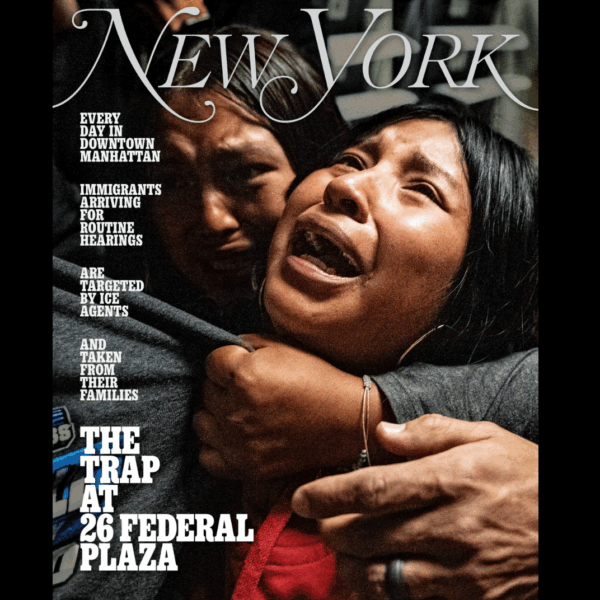
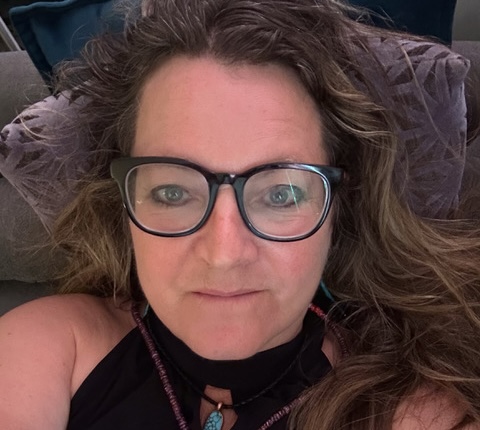
On the latest episode of the Nieman Storyboard podcast, photojournalist and Pulitzer Prize finalist Stephanie Keith joins Storyboard Editor Mark Armstrong to discuss her latest project, which became a powerful cover story for New York magazine: a series of photos taken in the corridors of 26 Federal Plaza in New York City, where undocumented immigrants showing up for routine hearings were being arrested by U.S. Immigration and Customs Enforcement (ICE) agents.
She captured the sudden and heartbreaking moments where people were separated from their families, or taken away without their loved ones even knowing what happened.
[ Follow us in Apple Podcasts, Spotify, or your favorite podcast app. ]
Keith, who was previously part of The New York Times team that was named a Pulitzer Prize finalist for coverage of a Bronx fire in 2022, embarked on her latest project without a paid assignment. She spent months covering the daily immigration hearings. “Any of the projects that I've done really successfully, it's because I went all in on the project,” she says. “You learn all about the people. You get into a rhythm, and it's not something that you can just drop in and out of.”
Keith discusses the challenges of monitoring ICE activity and explains the legal loopholes she and other photographers and press were able to find while documenting those in New York City detained by ICE, as well as the families they left behind.
The New York magazine cover features the daughter of a man being taken away by ICE at 26 Federal Plaza. When deciding which image to use to represent not only the series, but what was happening in the corridors of that building and all across the country, Keith says, “That is at the height of anguish. It's going to make people feel something. And that’s, for me, the whole point of doing photography. It’s to make people feel something.”
After graduating from NYU with a master’s in photography in 2003, and after having and raising two children, Keith started working for news organizations in 2015 as a freelance photojournalist in New York City. In 2016, Reuters assigned her to six weeks of the Standing Rock protests in North Dakota. In 2017, The Guardian shortlisted her as a top ten wire photographer of the year. In 2019 Reuters, Buzzfeed News and The Atlantic chose her photos for their decade lists. Pictures of the Year and the National Press Photographers Association also recognized her photos in 2024, 2020, and 2019.
The excerpts below are edited for length and clarity.
On 26 Federal Plaza and documenting ICE detentions:
I felt that just taking photos of a single detention of someone, them grabbing them and taking them was not doing it for me. I felt like it's important to show these people, it's important to witness what's happening to them and witness their humanity, and it's a sign of respect, too. But I wanted to do more of a story, to get people more involved rather than just detention, detention, detention. I wanted to have more going on. So when this family arrived and they were already crying and hugging, they seemed like a very close-knit family. I was like, okay, I'm just gonna stay here and see what happens with this one family and just tell their story — what happened on this day. I wasn't going to be distracted by other agents on a different floor and their different detentions. I just want to see what happens to this family.
On the role of photography in storytelling:
My personal belief in photography is that it's super important to show the emotions of what people are going through. Because you're there to show the world what's going on, because not everyone can be there. So I want to show the emotions so that the people looking at the photos can feel the same emotion. They can feel that outrage, they can feel that sadness, the humiliation, all those things, so that they can relate to what's going on. They can relate to the people who are experiencing this.
On becoming a photojournalist:
I always thought I was going to be a documentary photographer and do documentary stories. I have a degree in anthropology and I thought, “Oh, I would just be like an anthropologist with a camera.” But that's not really a thing, it turns out, and in order to make money, you have to work for newspapers. I was very fortunate that when I got out of photography school, I was able to start working for newspapers right away. And I pretty much learned about photojournalism on the job. I always had this thing like, “I'm there for the underdog.” If there's an injustice somewhere, I want to be there to show it, because I feel like I have a very strong moral code, and I feel that I want to use my camera to show what I think is right and what I think is wrong.
On documenting the truth and the importance of journalism:
When you photograph, you’re really photographing the truth. You're not setting things up or anything, so it's important to — even if things don't change right away — it's still important to create a record of the truth.
For example, on January 6th. If there had been no photojournalist there, can you imagine what the narrative would've looked like? Photojournalists are so important. People don't understand how important they really are for creating a history of just the truth of what happened in these situations. So I'm happy to be a part of that narrative, creating that narrative. And I hope that things change, but I'm also a realistic person. I know that we're living in the Trump era and it's going to take a lot for things to change. But inaction is a cop-out, you have to do what you can if you want to be invested in having a better future. So, I feel like this is my way of doing my part.
On collaborating with reporters:
When you're a photographer, you're not in the courtroom. You could go in the courtroom if you put your camera away, but then you don't have your camera. So the reporter doesn't have the camera. The reporter goes into the courtroom and can really hear the case, can hear what this person says, why they need to have asylum. And a lot of these asylum cases are very important and very real. As a photographer, we're in the hallways and we're not hearing that. We don't know about what's going on in the courtroom, so we're kind of cut off from that.
So when you work with a reporter, the reporter can be inside the courtroom and can find out what is going on with these people. They can find out the names, they can find out all this information. For me, I love that because I think it's important to know the backstory.
On photo edits and working with editors:
To photo edit a large body of work and be able to pick out the strongest photos and the quiet moments and then be able to string it together in a story, I feel like that is a whole art form, you know? I am not a photo editor, although I think if I did it more, I'd probably get better at it, but the photo editors who do that, that is their art form and they are so good at it. And I think [New York magazine creative director] Jody Quon is just an absolute master at that. And her edit of the New York magazine [feature] was fantastic and I felt so lucky and privileged to be able to have someone who's such a photo-editing artist look at my work and edit it. Her edit was definitely different than the edit that I had done, and I felt that her edit was definitely stronger than mine. So I felt like I learned a lot by looking at her edit.
Keith’s advice to journalists at all stages in their career:
Any of the projects that I've done really successfully, it's because I went all in on the project. Like Occupy Wall Street — I went down to Zuccotti Park every single day for months. At Standing Rock, I lived in North Dakota for six weeks straight. And for Federal Plaza I went down almost every day for like four months. So I think it's the “all-in” aspect that really produces results. You learn all about the people. You get into a rhythm, and it's not something that you can just drop in and out of.
You have to do this continuous coverage to get good results. So I think if you are really into a project, don't let any naysayers hold you back. Just believe in yourself and just go all in on your project.
Reading List: Authors, Stories, and Editors Mentioned
- Stephanie Keith
- “Portfolio: The Trap at 26 Federal Plaza” (Photographs by Stephanie Keith. Article by Andrew Rice and Paula Aceves, New York magazine, 2025)
- Keith's coverage of the Standing Rock protests (2016)
- Jody Quon
- Andrew Rice
- Paula Aceves
Show Credits
Hosted and produced by Mark Armstrong
Associate producer: Marina Leigh
Episode editor: Kelly Araja
Audience editor: Adriana Lacy
Promotional support: Ellen Tuttle
Operational support: Paul Plutnicki, Peter Canova
Nieman Foundation interim curator: Henry Chu
Music: “Golden Grass,” by Blue Dot Sessions (www.sessions.blue)
Cover design by Adriana Lacy
Nieman Storyboard is presented by the Nieman Foundation for Journalism at Harvard.
***
Subscribe to Storyboard
Get insights into the craft of journalism and storytelling in your inbox, delivered on Fridays.