We asked the Nieman Storyboard community — journalists, writers, storytellers, and readers — to share some of their favorite stories, podcasts, books, and documentaries of 2025. (Editor's note: We kept things casual. One of you picked a musician, and we also let you recommend anything that you discovered in 2025, even if it wasn't published this year.)
Thanks to everyone who shared their recommendations. Here's Part 2 (and you can find Part 1 here):
Stories
“Can Anyone Rescue the Trafficked Girls of L.A.’s Figueroa Street?” (Emily Baumgaertner Nunn, The New York Times, October 2025)
Selected by Sophie Culpepper, staff writer covering the evolving local news business for Nieman Lab:
I admire this reporting as a feat of yearslong trust-building, especially with Ana, and also with Officer Armendariz. Emily Baumgaertner Nunn's unflinching attention to detail, refusal to oversimplify intertwined systemic problems, and deft writing leave readers understanding not just how minors end up on the Blade and places like it, but why girls voluntarily go back after being rescued. The story is multiple things in one: essential accountability reporting with policy implications, an empathetic profile of a brave young woman, and a spotlight on the everyday heroism of the people trying, in different ways, to give her and others like her a shot at a better life.
“Selling Zohran” (Corey Atad, Defector, August 2025)
Selected by Neel Dhanesha, staff writer at Nieman Lab:
I love stories that make me feel like I'm peeking behind the curtains of a magic show, and there was no bigger magic show for me and my fellow New Yorkers this year than the rise of Zohran Mamdani. This story by Corey Atad showed us exactly how Mamdani managed to get the attention of everyone not just in New York but around the world, and it's clearly the work of both deep reporting and the keenly honed eye of a critic who can appreciate the effort that goes into getting the right shot.
“Grave Mistakes: The History and Future of Chile’s ‘Disappeared’” (Fletcher Reveley, Undark, February 2025)
Selected by Robert Sanchez, 5280 magazine's senior staff writer and adjunct professor at the University of Denver's Department of Media, Film and Journalism Studies (Sanchez was featured in Nieman Storyboard this year for his piece on psilocybin therapy):
Time is a luxury in this business, but taking the opportunity to follow a story for months (or years) can pay off in a big way. "Grave Mistakes" is both deeply reported and thoughtfully organized, a true example of a journalist who spends time with sources and then gets out of the way when it comes down to putting words onto the computer screen. This story is informative and elegantly written, without being overwrought.
“How to Fix a Typewriter and Your Life” (Kurt Streeter, visuals by Ruth Fremson, The New York Times, November 2025)
Selected by Andrea Pitzer, former editor of Nieman Storyboard, author of three books, and founder of the Degenerate Art newsletter:
With the deliberately plain language and transparent arc of "How To Fix a Typewriter and Your Life," Kurt Streeter has created an extraordinary portrait of concepts that are hard to say anything insightful about head on. He explores existential despair, the skills and experiences of elders, the beauty of mechanical things, how physical bodies gain their own knowledge, the saving of a soul, and the shoring up of a community. The danger of "old-timey stories" lies in how easy it is for them to veer into sentiment or nostalgia, but Streeter's deep respect for both men and awe at the passing of a vocation from one to the other give this story the weight of an almost religious experience.
Also selected by Mary Schmich, Pulitzer Prize-winning former Chicago Tribune columnist who wrote and narrated the 2025 podcast, “Division Street Revisited.” (She's also a 1996 Nieman Fellow and was a guest on the Nieman Storyboard podcast in April.)
This New York Times piece is the kind of feature story I rarely encounter anymore, one that carries you like a good short story does. No celebrities, no Trump, no Big Issues. Honestly, I skimmed past it on the NYT website — not newsy enough! — but then a friend sent it to me and said I had to read it, that she’d cried the whole way through. It’s a beautifully written exploration of a friendship and the passage of time. Plus — typewriters! I love stories with an object at the center.
“The Missing Kayaker” (Jamie Thompson, The Atlantic, November 2025)
Selected by Lane DeGregory, Pulitzer Prize-winning enterprise reporter for the Tampa Bay Times, co-host (with Maria Carrillo) of the WriteLane podcast, and July guest on the Nieman Storyboard podcast:
A dark lake. A meteor shower. A missing man, determined sheriff and diver who always finds the bodies. This story took readers on an irresistible detective hunt through murky waters, small towns and international border crossings — and delved into the depths of devotion, hubris, and faith. All of the characters were complicated; the reporting rounded out their desires and downfalls. I love the subheads detailing how many days the kayaker had been missing. It really brought home the urgency of the hunt and aftermath. This gem reminded me how compelling true crime stories can be.
“No-Parking Zone: The Perils of Finding a Spot in NYC” (Zach Helfand, The New Yorker, May 2025)
Also selected by Lane DeGregory:
I shared this story with so many people: A narrative about a dude who moves cars around the Big Apple for a living. Who knew? The details were delicious. The data was rich — and astounding. The monotony, uncertainty and futility were palpable. I felt like I was with the guy, waiting and wondering and thinking existential thoughts. It reminded me of why I could never live in New York City. And how wonderful it is to be dropped into worlds that surround us — but we know nothing about, especially in the talented hands of an immersive and thoughtful writer.
“Life in Beige” (Allison P. Davis, The Cut, November 2025)
Selected by Theo Balcomb, audio producer and journalist who created “The Daily” at The New York Times:
I've thought about this every day. Everyone needs to read it because every one of us will feel the impact of pharmaceutical companies creating lives devoid of pleasure. Someday, when we try to understand how we all became so much sadder than we needed to be, this will be the skeleton key: “Between the endless stream of soul-destroying bad news, giving up post-dinner cigarettes, endless app-matches, the slow creep of middle-age malaise, falling into a stupor after watching ‘The Shining’ in 37 parts on TikTok instead of going to a movie, and any of the other seemingly endless ways to disconnect from pleasure — maybe it doesn’t matter so much anyway.”
“How Israel erased a town of 200,000 people” (Financial Times)
Selected by Drew Harwell, Washington Post reporter covering tech and society, and guest on the Nieman Storyboard podcast in June:
Even in a year of so much powerful reporting from Gaza, this Financial Times story seared itself into memory by combining maps, videos, sketches, and interviews to document the annihilation of a refugee camp inside one of the hardest places to report on Earth. What made it so haunting is how it interwove the mass horrors of a military cleansing with the place's human moments: the "pistachio-stuffed baklava," the cafe music nights, the "romances blessed" at a now-flattened wedding hall.
“All by Himself” (Ben Terris, New York magazine, May 2025)
Also selected by Drew Harwell:
Reporting on the unseen mental health struggles of one of the Senate's most prominent members was a huge minefield, and yet Ben Terris pulled it off, delivering a dogged, sensitive and disturbing profile of John Fetterman and some of the best political journalism of the year. Every paragraph featured some new scoop or revealing detail about Fetterman's life. But between the newsiest bits, there was also an elegantly told and empathetic story about a man increasingly unrecognizable to the people who loved him.
“Awe Is Essential” (Peter Wehner, The Atlantic, September 2025)
Selected by Carly Stern, a Nieman Storyboard contributor and journalist based in Brooklyn whose work has appeared in The New York Times, The Guardian, and Vox:
At the start of each new year, I pick two words that I aspire to bring into my life. In 2025, one was “wonder.” After moving from California to New York, I wanted to be intentional about how to find and cultivate feelings of wonder and awe in my everyday life. This beautiful Atlantic piece by Peter Wehner meditates on why this hard-to-describe emotion is so essential: how awe humbles us, is a portal to feelings of transcendence, and can help us feel more grounded and purposeful in dark or chaotic times. His words have stuck with me.
“A beloved alley cat now lives in the Watergate. Was she kidnapped, or rescued?” (Andrea Sachs, The Washington Post, May 2024)
Selected by Laura Coffey, longtime editor, feature writer, author, and president of the Society for Features Journalism:
I discovered this 2024 Washington Post story when it bubbled up as a winner of the 2025 Society for Features Journalism’s Excellence-in-Features contest. From the contest judges: “The saga of the maybe-kidnapped, maybe-rescued alley cat comes alive through Andrea Sachs’ layering of neighborhood sources with nuanced details. And the writing is stellar.” So true! Set aside some time to savor this one if you missed it when it first came out.
Books
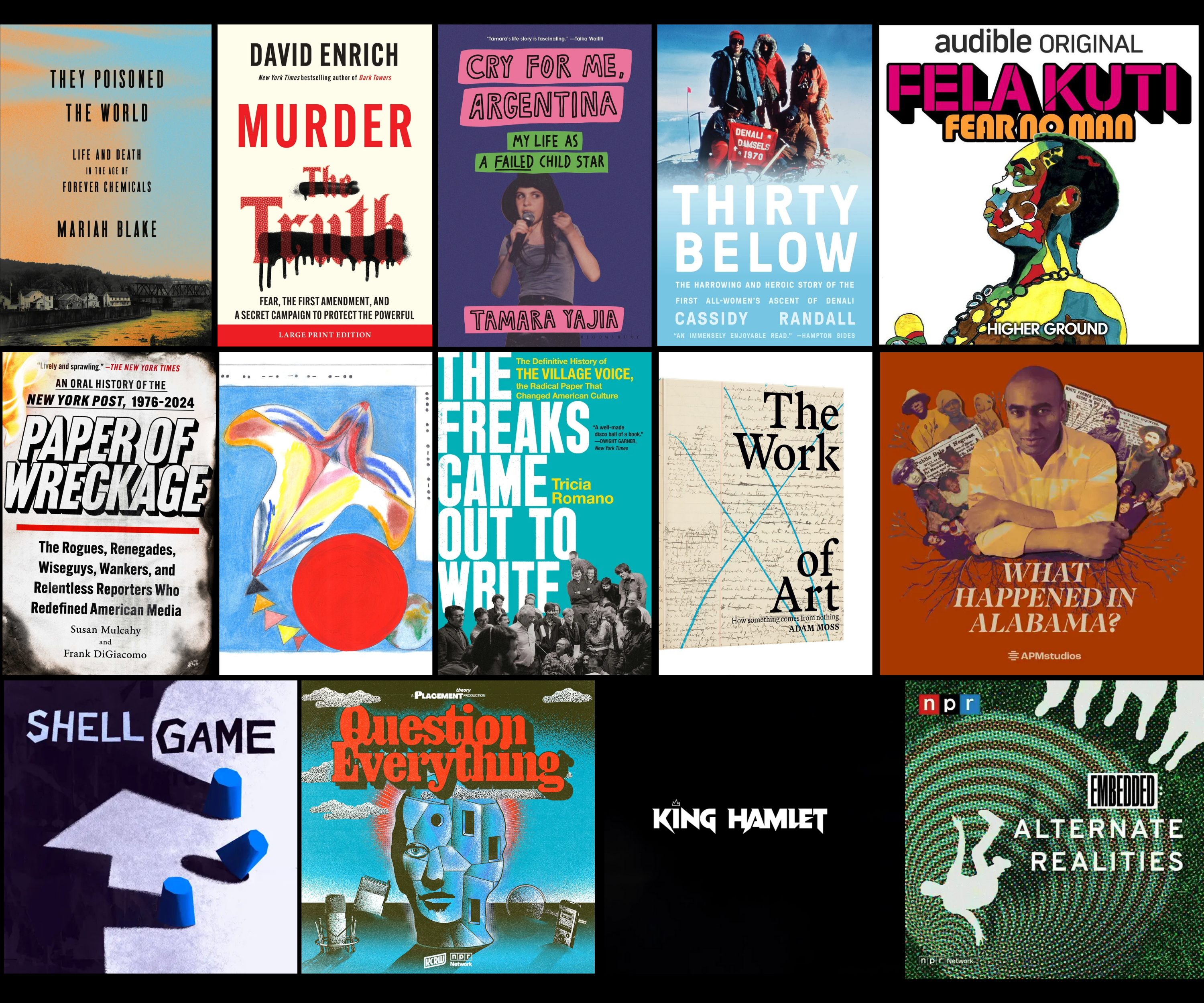
“Cry for Me, Argentina: My Life as a Failed Child Star” (Tamara Yajia, Bloomsbury, 2025)
Selected by Trevor Pyle, a Nieman Storyboard contributor and former journalist in the Pacific Northwest:
Comedian Tamara Yajia's memoir swings from bawdy to beautiful. In a nation where immigrants' stories can be reduced to clichés or wielded like political batons, it reminds readers that each such story has its own rhythms, surprises, and unexpected style of humor.
“Thirty Below: The Harrowing and Heroic Story of the First All-Women's Ascent of Denali” (Cassidy Randall, Abrams Books, 2025)
Selected by Brendan O'Meara, author of “The Front Runner: The Life of Steve Prefontaine” and host of the Creative Nonfiction Podcast:
Cassidy Randall's account of the "Denali Damsels" is riveting and suspenseful.
“The Freaks Came Out to Write: The Definitive History of the Village Voice, the Radical Paper That Changed American Culture” (Tricia Romano, PublicAffairs Books, 2024)
“Paper of Wreckage: The Rogues, Renegades, Wiseguys, Wankers, and Relentless Reporters Who Redefined American Media” (Susan Mulcahy and Frank DiGiacomo, Atria Books, 2025)
Selected by Samantha Henry, editor of Nieman Reports:
I've really enjoyed two recent books about game-changing newspapers: “The Freaks Came Out to Write: The Definitive History of the Village Voice,” and “Paper of Wreckage,” about the New York Post. I found the oral history compilation format — which both books used — incredibly compelling for telling these specific stories. They read much like the publications themselves: frenetic, boundary-pushing, wildly imperfect — and always a gripping read.
“Murder the Truth: Fear, the First Amendment, and a Secret Campaign to Protect the Powerful” (David Enrich, William Morrow, March 2025)
Selected by Daniel Drepper, 2026 Nieman Fellow and chairman of Netzwerk Recherche, the association of investigative journalists in Germany:
New York Times investigative reporter David Enrich gives us an intimate look into the coordinated campaign to weaken press freedom in the U.S. Through detailed stories of individual cases, Enrich explains how risky it already is to investigate the rich and powerful, especially for freelance reporters without big institutional backing. And how powerful legal scholars, lawyers, and politicians try to expand libel lawsuits to silence the press. I love all of Enrich’s books, but this one is especially timely.
“They Poisoned the World: Life and Death in the Age of Forever Chemicals” (Mariah Blake, Crown, May 2025)
Also selected by Daniel Drepper:
"They Poisoned The World" follows Michael Hickey from Hoosier Falls in his fight against one of the most dangerous chemicals in the world: PFAS, also called “forever chemicals.” PFAS are linked to cancer, obesity, infertility and a weak immune system, among others. Reporter Mariah Blake is one of the main journalists investigating PFAS and explains, after years of research, that big chemical companies knew about the risks for decades, but still decided to keep producing and using PFAS without appropriate safeguards. The book shows how hard it is for people who got poisoned to fight these big companies, get justice and keep going with their lives.
“The Work of Art: How Something Comes From Nothing” (Adam Moss, Penguin Random House, April 2024)
Selected by Kara Cutruzzula, Storyboard contributor and co-editor of The Hat:
If you’re interested in the creative process, this chunky book is a repository of inspiration and micro details. Dive into the minds of wide-ranging artists, from Suzan-Lori Parks to Sofia Coppola to George Saunders, each expertly shepherded towards revealing interviews by former New York magazine editor Adam Moss. “The Work of Art” somehow accomplishes the impossible: it encourages you to marvel at the effort involved in making great art, yet convinces you to chip away at the effort yourself.
Podcasts
“What Happened in Alabama?” (Lee Hawkins, APM Studios)
Selected by Sharon Broussard, veteran editor and writer:
A podcast that talks about how you can take the traumatized family out of the South but you can't easily take the source of the trauma out of the family. Lee Hawkins unpacks his family's violent history and exposes America's brutal history, which still lingers in all of our bones. I was surprised by the depth of this podcast and Hawkins's honesty about his family situation. Part journalism, history, and memoir, and always a compelling listen.
“Fela Kuti: Fear No Man” (Jad Abumrad, Higher Ground / Audible / WNYC Studios)
Also selected by Sharon Broussard:
I have long listened to Fela's music and even saw the Broadway play, but this historical podcast filled in a lot of holes. I discovered that Fela's activism came from his mother, who challenged a monarch, and that an American woman helped guide him in his musical career. Fascinating history and a painful story about a (flawed) hero who paid a high price for opposing his government.
“No Easy Fix” (Ethan Brooks, The Atlantic)
Three-part Radio Atlantic series on homelessness and addiction in San Francisco. Selected by Chris Bannon, podcast and public radio veteran exec:
Vivid, personal, emotionally rich storytelling about a complex problem.
“Alternate Realities” (3-part “Embedded” series, NPR)
Selected by Alison MacAdam, audio story editor and 2014 Nieman Fellow:
At a time when — in the genre of "limited series" narrative podcasts — there's a glut of overwrought, over-produced true crime, this show is beautifully minimalist: a son, a father, and a bet, with stakes as big as the crisis facing American democracy right now.
Selected by Neel Dhanesha, staff writer at Nieman Lab:
Signal Hill takes two of my favorite journalistic forms — magazines and audio documentaries — and mashes them together. The result, a podcast with "issues" rather than seasons, structured around a table of contents (complete with editor's notes), is beautiful, weird, and mesmerizing. There's nothing else like it out there, and at a time when it feels like there's less and less space for longform, craft-obsessed work of any kind, it's a true breath of fresh air. This is the kind of stuff that made me want to be a journalist in the first place. I hope it lives forever.
“Shell Game” (Evan Ratliff)
Selected by Mary Schmich:
“Shell Game’s” first season was released in late 2024 but I didn’t discover it until 2025 when I was reading a story about the rocky future of narrative podcasts. That story raved about “Shell Game” so, having just written and narrated a podcast myself, I sought it out. And wow. Evan Ratliff, a tech journalist, makes an AI voice clone of himself and then sets his clone loose in the world to chat with friends, family, phone scammers. It’s a hugely entertaining and unnerving look at a vital phenomenon that many of us are struggling to understand.
Selected by Joni Deutsch, award-winning NPR veteran and SVP of Marketing & Audience Development at the podcast services firm The Podglomerate:
What if we could stabilize the future of media, journalism, and the internet? The solution could take the form of 26 words known as Section 230, buried in a much bigger act that Congress passed in 1996. And with that quest in mind, host Brian Reed embarks on a podcast journey to get to the heart of press freedom and what it'll take to recapture it.
Documentaries
“King Hamlet” (directed by Elvira Lind)
Selected by Franklin Leonard, founder of the Black List and June 2025 guest on the Nieman Storyboard podcast:
Elvira Lind chronicles her husband Oscar Isaac's personal and professional journey as he prepares to play the lead role in a production of “Hamlet” at the Public Theater, at a time when his mother was ill and their first child is born. A remarkable piece of art about how we humans make art amidst the mess of being human.
Music
Selected by Megan Cattel, assistant editor of Nieman Reports:
I’ve been listening to singer-songwriter Jensen McRae for the past few months. There’s nothing quite like an artist who can capture the rapturous highs and haunting lows of a doomed relationship — all within a single song. Her work is lyrical storytelling at its finest. She is a writer’s writer, a compulsive diarist, and has a pretty cool Substack!
***
Subscribe to Storyboard
Get insights into the craft of journalism and storytelling in your inbox, delivered on Fridays.