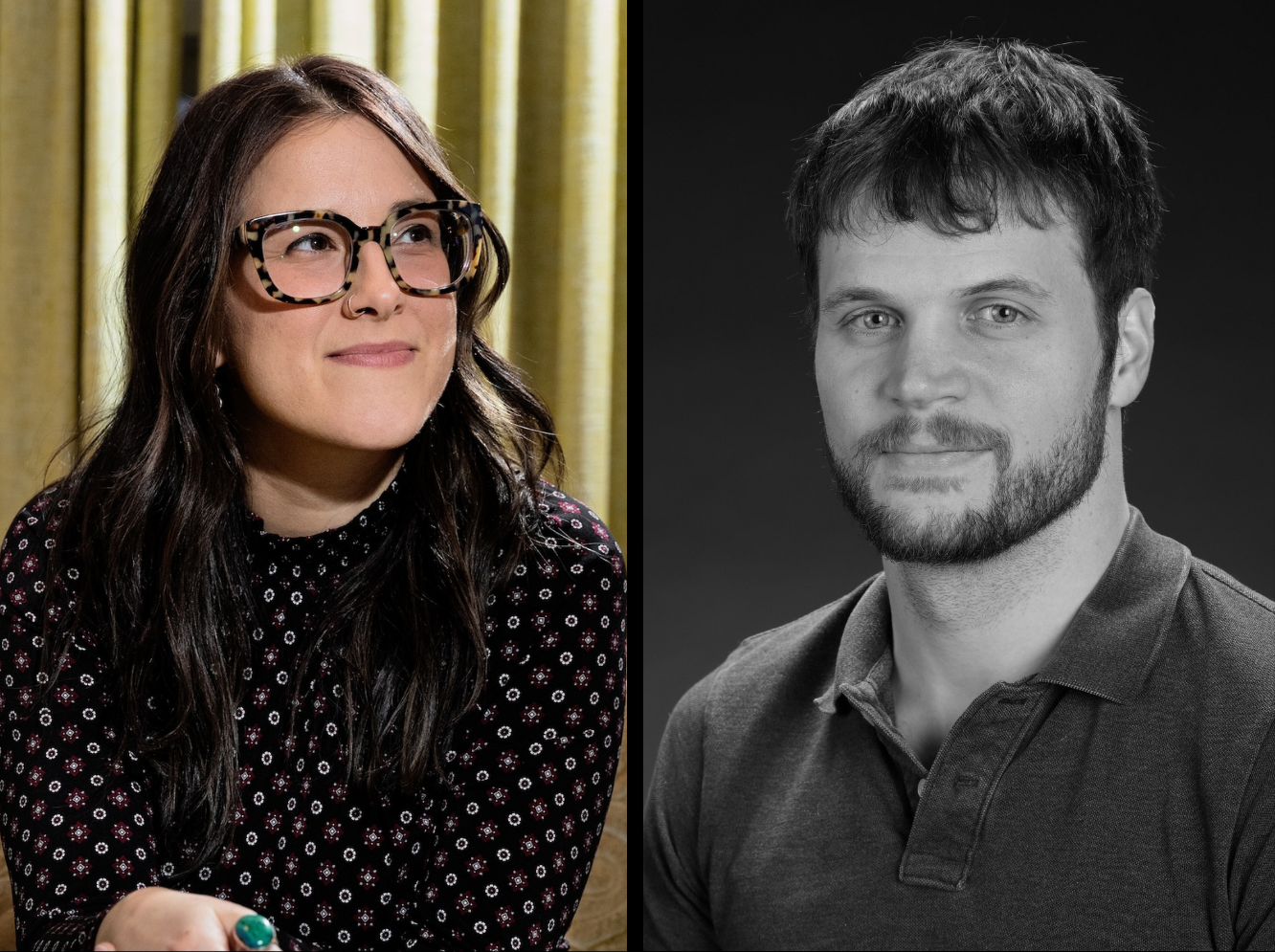
On the latest episode of the Nieman Storyboard podcast, journalists Leah Sottile and Ryan Haas join Storyboard Editor Mark Armstrong to discuss the second and final season of their serialized podcast “Hush,” from Oregon Public Broadcasting.
Sottile and Haas first began working together on the 2019 OPB/Longreads podcast “Bundyville,” and they've continued their collaborative work as journalists and podcasters ever since. This week, they've announced that they will be starting an independent publication called The Western Edge. (For updates, you can follow Sottile and Haas on Bluesky or on their individual Substacks.)
[ Follow us in Apple Podcasts, Spotify, or your favorite podcast app. ]
Season One of “Hush” investigated the case of Jesse Lee Johnson, a man who spent 25 years in prison, 17 of them on death row, in Oregon for a murder he did not commit. The second season investigates the case of Sarah Zuber, an 18-year old girl who was found dead just 400 feet from her front door in 2019 in the rural town of Rainier, Oregon.
Sottile and Haas use the second season to discuss the ethical questions around the entire genre of “true crime,” dating all the way back to Truman Capote's 1966 book “In Cold Blood.” When does covering a crime cross the line from public interest to sensationalism?
Sottile and Haas discuss how they address these questions in their own work, and how they use the principles trauma-informed reporting to interview family members who have experienced an unthinkable tragedy, and are seeking help from journalists to get answers.
They also explain their process as a producer-reporter team. “ If I'm going to come to [Ryan] with an idea, I really wanna make him excited about it,” Sottile says. “So I'm going to provide some audio that's like, ‘Check out what I got, dude.’ I tend to know from working with Ryan for a long time, some of the questions that he's going to ask as an editor. That's one of the beautiful things about working with somebody long-term is you're like, okay, he's going to want to know what sort of investigative documents we can look into, what kind of records we can do, what agencies we can hold to account, what's the place that we're going to be looking at?”
Sottile is the author of two books: “Blazing Eye Sees All” and “When the Moon Turns to Blood.” Her journalism has been published by The Washington Post, The New York Times Magazine, Playboy, Rolling Stone, Outside, BBC, The Atlantic and High Country News, where she is a correspondent. In addition to “Hush” and “Bundyville,” Sottile also hosted the podcasts “Burn Wild” and “Two Minutes Past Nine.”
Haas is an independent producer who worked with Oregon Public Broadcasting for more than a decade with a focus on government accountability in the Pacific Northwest, particularly in the criminal justice system. He has won numerous awards, including a National Headliner for the first season of “Hush.” He has also produced the podcasts “Dying for a Fight,” and the National Magazine Award-nominated “Bundyville.”
The excerpts below are edited for length and clarity.
On the ‘true crime’ genre in podcasting
SOTTILE: Both of us, probably me more than Ryan, bristles at that label of “true crime.” Particularly because I think it makes a lot of people ignore the work. I think if people don't like true crime, or they think true crime is just about lionizing serial killers or gazing into the abyss, then they're just going to disregard it.
So we had a lot of questions around: We do not feel that we make true crime, but how can we be sure that this show isn't seen as true crime? So what you realize pretty quickly in the show is that we directly interrogate what true crime is.
HAAS: There is a difference between what we as a society understand as true crime and journalism about crime. I think those are two distinct things. And there can be benefits to both, but I do think there is a lot of media out there that is reading Wikipedia pages about serial killers and it's like, OK, what is the benefit of both the people creating [it] and the people consuming it. What are we learning from that? I think if you're going to get into a crime and something that is tragic and has happened to a person, you should at least think a little bit about: what is the benefit of this? I think Justin St. Germain [an Oregon State University professor who teaches courses on nonfiction and true crime] puts it really well in our show and he says, “what's the benefit of this beyond your own careers?” And I think if you're being ethical, you should be asking yourself that question.
On pre-reporting and determining if a story is worth pursuing
HAAS: I think that's always our instinct. “Okay, this seems like a good idea. Let's do an interview” or “let's get some documents and look at them.” And I feel like even with this second season, after we did our first interview, we were like, “Oh yeah, there's material here, this is worth pursuing.” I think it's always hard because you don't want to overinvest in pre-reporting, but it often is that pre-reporting that's going to dictate whether something feels like there's enough there to pursue.
On their process for staying organized
SOTTILE: We do two things: We establish a timeline and a character sheet. The timeline can be an early tool that I think is good for anybody wanting to do any kind of narrative book or story or podcast where you're just literally going in and saying the order of how things happened, but critically, linking where you found that information, because anything of size, you're going to forget where the reporting came from.
So for us, especially, a year on, you think you're going to remember where you found this one thing about some boot prints. [You won't] remember later. That's a thing that we can kind of both collaborate on as we're chipping away at the project.
Then we start identifying who the critical people are to interview. So in the case of Season One, it was obvious we wanted to interview Jesse Johnson. We wanted to interview his legal team. We wanted to interview the police who worked on his case, and who's alive, who's available, can we find them?
On knowing when to finish reporting
HAAS: I think we're always open to changing things if something big enough came in. But I think that is the hard thing about this type of podcasting is there is a certain point where you have to cut it off or you'll just never get it done, because you could always be gathering more reporting. That's a conversation I have with reporters all the time as an editor. You have to know when to stop. You have to know when it's time to produce a story. And that's a hard thing to do. But if you don't do it, the public never hears your story.
On place as a character
SOTTILE: I think a big thing for us in all the work that we've done together is to really dig into place as character. So in the first season, we talk extensively about Salem, Oregon, as the capital and Marion County and its politics.
But I think that this was initially exciting for me even before we got into the nitty gritty of what happened to Sarah Zuber — just understanding Rainier and Columbia County. It's just kind of a place you pass through on the way to the coast for a lot of people. So it was sort of exciting to think about understanding the culture there.
On transparency and sharing your process with a non-journalist audience
HAAS: It can be hard as a journalist, because sometimes you're just like, “Does anyone actually give a crap about this?” But I hear feedback all the time [from] people [who] are non-journalists, like, “Wow, it's so interesting. It's great to hear you guys talk about how you're coming to these ideas and how you're pursuing your reporting.” So it always surprises me how interesting that stuff is to people.
I don't think I'm particularly charming, but I do appreciate that people are interested in that, and it does help. It helps us because I think we can just be transparent with people and I appreciate that. I think it gives us a lot of credibility when we do reach conclusions within our stories.
Advice to other journalists and the importance of journalism right now
HAAS: Leah and I are the type of journalists who are like, “Hey, we're willing to get in the muck and get dirty.” I don't need someone to transcribe my tape. I don't need someone to do all of that. I think we want to continue to do this type of work, whether that's at OPB or elsewhere or on our own. I think now is the time where journalists who are passionate about journalism should stand up, and commit to investing in that.
I read an essay over the weekend that really resonated with me, which was like, Look, so many journalists get criticized because we want financial stability like anybody else. I think any journalist wants financial stability and the people who run a lot of media organizations are not interested in investing in that. And so we need to figure out a way to just do that on our own. The importance of journalism matters now more than ever.
I think we are at a moment where people need to understand the world around them, and I think that's what's attractive to Leah and me, covering regional journalism and local journalism here in the Northwest. People deserve to understand this place where we live. And as Leah said, we can't wait for people from the East Coast who have most of the media control to be interested. We have to do it ourselves.
Reading & Listening List: Authors, Stories, and Podcasts Mentioned
- Leah Sottile: Bluesky, Substack
- Ryan Haas: Bluesky, Substack
- “Hush Season Two: The Case of Sarah Zuber”
- Justin St. Germain, Oregon State University professor
- “Dying for a Fight”
- “In Cold Blood,” Truman Capote
- Oregon Public Broadcasting
- “Hush Season One: The State of Oregon v Jesse Lee Johnson”
- “Bundyville”
- “Twin Peaks”
- Justice for Sarah Zuber Facebook Page
- “When the Moon Turns to Blood” (Leah Sottile)
- “Blazing Eye Sees All” (Leah Sottile)
- “A Living Manifesto on Journalism in 2026 and Beyond” (Leah Sottile, December 2025)
Show Credits
Hosted and produced by Mark Armstrong
Associate producer: Marina Leigh
Episode editor: Kelly Araja
Audience editor: Adriana Lacy
Promotional support: Ellen Tuttle
Operational support: Paul Plutnicki, Peter Canova
Nieman Foundation interim curator: Henry Chu
Music: “Golden Grass,” by Blue Dot Sessions (www.sessions.blue)
Cover design by Adriana Lacy
Nieman Storyboard is presented by the Nieman Foundation for Journalism at Harvard.
***
Subscribe to Storyboard
Get insights into the craft of journalism and storytelling in your inbox, delivered on Fridays.