
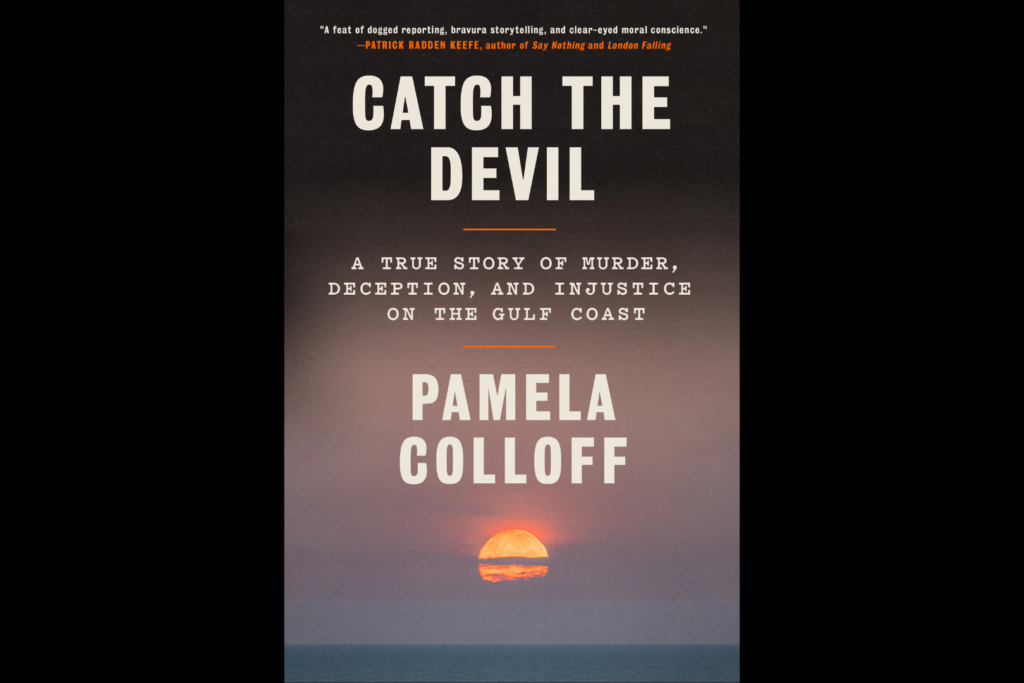
The Nieman Storyboard podcast returns for Season Two this week with Pamela Colloff, reporter for ProPublica, staff writer at The New York Times Magazine, and author of the new book “Catch the Devil: A True Story of Murder, Deception, and Injustice on the Gulf Coast.”
“Catch the Devil” tells the story of a con artist named Paul Skalnik who spent time in and out of jail for a string of crimes. He soon became a frequent jailhouse informant for prosecutors who were looking for confessions from people who were locked away and awaiting trial.
Skalnik ended up testifying in at least 37 cases in Pinellas County, Fla., alone. His testimony sent dozens of people to prison, four of whom were ultimately sentenced to death. Colloff’s book focuses on the trial of a man named Jim Dailey, who had been linked to the murder of a 14-year-old girl.
[ Follow us in Apple Podcasts, Spotify, or your favorite podcast app. ]
This is Colloff’s first book, after years of reporting award-winning longform narratives starting at Texas Monthly. Colloff talks about the origins of the idea, and breaks down the reporting, editing, and fact-checking process. We also discuss how true crime reporting has evolved toward an approach that is more trauma-informed and sensitive to the impact on victims and victims' families.
As a note upfront, this episode includes discussion of cases involving sexual assault.
The conversation excerpts below are edited for length and clarity.
On jailhouse informants and getting conned by the con artist
I’d been looking for a jailhouse snitch story for a long time. Whenever I would see cases that had a jailhouse snitch, it was a red flag that something was really wrong. If you have the evidence you need in a case, you don’t need a guy from the jail to come over and tell a story.
So that sort of began this journey, and I ended up visiting Paul Skalnik, who was the jailhouse informant, who at the time was in federal prison. He had led this very colorful life. He was a con artist with a long rap sheet, and he’d been married nine times — nine different women, some at the same time.
He told me that he would tell me everything. He conned me. I realized that he was not going to tell me anything, and that was the impetus for both the article and then later the book.
Tracking down victims, and a 12-year-old girl forced to take a polygraph test
[Skalnik] liked young teenage girls, and one of the most awful things to come out of all of this is that in exchange for his testimony, prosecutors let him go free. That allowed him to go back out there and commit crimes, and that included the sexual assault of two girls. … a 12-year-old and a 16-year-old. In the 12-year-old case, Karen Parker’s story was sort of the heart of the book. What I found so compelling about Karen is she was expendable at the time to police and prosecutors.
She reported that he had assaulted her, but he was such a valuable witness at the time that the quickest way I can explain it is that the state attorney’s office in Clearwater sort of made that case go away and basically found her to be not a trustworthy witness. And that was back in 1982 and ’83.
So when I tracked her down in 2019, and I, of course, believed her, I had to piece together from different police reports what had happened at the time. Just to give you a sense of things, there was not only her statement, but her polygraph examination — I should note that a 12-year-old girl was given a polygraph examination while Skalnik, a grown man, was not. I think that speaks volumes.
Writing a book versus longform story, and working to keep readers hooked
I always imagine that other writers have it all figured out when they do anything, including sitting down to write a book. Of course, I had a lengthy book proposal, I had an outline that my book editor had approved, I had a game plan.
As so often happens, it all looked good on paper, but there were years, really, of changing the structure, recalibrating what the storytelling was. One of the tricky things about this book is it really tells the story of two men, with other people woven in.
But there’s Paul Skalnik, the snitch, and then there’s Jim Dailey, who’s on Florida’s death row, mostly on the word of Paul Skalnik. So how do you balance how much of each person’s story there is? Who do you lead with? When do you come back to them?
One of the things that I realized writing a book is … you’re asking so much more of a reader. You’re asking so much more of their time and their attention. I tried to make this book both very rich and immersive, but also a quick read because I kept thinking of someone like me. I’ve got my job, I’ve got my book, I’ve got my kids, I’ve got a lot going on.
It’s the same thing with a magazine story, but I’m trying to write every sentence so you can’t turn away. Most stories at the Times Magazine are read on your phone. And when you’re looking at your phone, all this information is constantly coming in, right? The notifications and the texts. And so I’m always trying to write in such a way that you’re swiping those away and that you keep reading. It is a really high-stakes way of writing.
On fact-checking and navigating ‘error terrors’ as a journalist
I come from a tradition, first at Texas Monthly, now at The New York Times Magazine, where you have to annotate every sentence that you write, and I don’t think readers know that, but you cannot get anything into print literally without every sentence leading back to a document or a person or both.
So that’s how I approached the book, and I caught plenty of things, big and small, as always happens. It’s so overwhelming with a book, but you have to because it’s immortalized. You can’t make that change later on the website. I always think of something that my friend Maurice Chammah, who’s at The Marshall Project, talks about.
We always talk about that horrible feeling right before you publish, and he calls it “the error terrors.” And I love that term so much. Publishing a book is just like having the error terrors for years.
I tried to make it as bulletproof as possible. I also sent what I call “no surprises” letters to some of the key sources. This is something that I learned when I started at ProPublica, and I think that tradition originally came from folks there who had come from The Wall Street Journal.
But essentially the idea is that you write a letter to sources who are in the book who have not spoken to you, or who you tell difficult truths about. And so what that letter does is it lays out everything that’s in the book.
Reading List: Books, stories, writers, and editors mentioned
- “Catch the Devil: A True Story of Murder, Deception, and Injustice on the Gulf Coast” (Pamela Colloff, Knopf 2026)
- “He’s a Liar, a Con Artist and a Snitch. His Testimony Could Soon Send a Man to His Death” (Pamela Colloff, ProPublica and The New York Times Magazine, 2019)
- “96 Minutes” (Pamela Colloff, Texas Monthly, 2006)
- “The Innocent Man” (Pamela Colloff, Texas Monthly, 2012)
- “Story Annotation: Pamela Colloff and the innocent man, Part 1” (Paige Williams, Nieman Storyboard, 2013)
- Pamela Colloff stories at The New York Times Magazine
- Pamela Colloff stories at Texas Monthly
- Hilary Redmon
- Tracy Weber
- Ilena Silverman
- Maurice Chammah
- Skip Hollandsworth
- Gary Cartwright
- Mimi Swartz
- Michael Hall
- Margaret Brown
- Evan Smith
- “The Thin Blue Line” (Errol Morris, 1988)
- 2014 Louis Lyons Award for Conscience and Integrity in Journalism: Pamela Colloff (Nieman Foundation, YouTube)
- “Covering failures in the justice system with patience for facts and sensitivity to victims” (David Tarrant, Nieman Storyboard 2019)
Show credits

Hosted and produced by Mark Armstrong
Episode editor: Kelly Araja
Audience editor: Adriana Lacy
Promotional support: Ellen Tuttle
Operational support: Paul Plutnicki, Peter Canova
Nieman Foundation interim curator: Henry Chu
Music: “Golden Grass,” by Blue Dot Sessions (www.sessions.blue)
Cover design by Adriana Lacy
Nieman Storyboard is presented by the Nieman Foundation for Journalism at Harvard.
***
Subscribe to Storyboard
Get insights into the craft of journalism and storytelling in your inbox, delivered on Fridays.