As journalists, we are often trained to keep ourselves out of the stories we report and write. This makes it that much harder when the question arises: What about when it’s time to tell our own story?
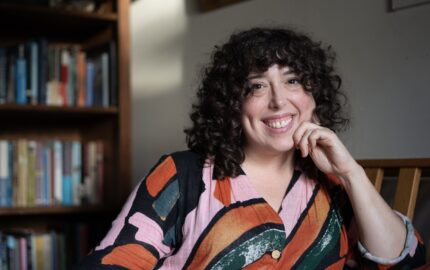
My guest on this week’s Nieman Storyboard podcast, editor and bestselling author Sari Botton, is an expert in the art of personal storytelling. Through her popular Substack publications, Oldster Magazine, Memoir Land, and Adventures in “Journalism,” and before that as essays editor for Longreads (where we worked together), Botton has shepherded hundreds of writers through the process of telling their stories — and doing so with a thoughtful eye for what makes personal essays connect with readers without being sensational.
“People are so concerned about whether they’re going to be a likable character if they tell the ugly truth,” she said. “[But] that’s what makes you a likable character. It makes you someone that people can relate to. It means you’re just human.”
[ Follow us in Apple Podcasts, Spotify, or your favorite podcast app. ]
Even after publishing so many writers, Botton herself struggled with whether she should write her own memoir, and the impact it might have on her family. Eventually, she found an approach that allowed her to speak her truth while being mindful of family members' privacy, and her book, “And You May Find Yourself…Confessions of a Late-Blooming Gen-X Weirdo,” was published in 2022.
Botton also was the editor of two bestselling anthologies, “Goodbye to All That: Writers on Loving and Leaving New York,” and “Never Can Say Goodbye: Writers on Their Unshakable Love for New York.”
This week, her magazine Oldster celebrated its fifth birthday, sharing stories that "explore what it means to travel through time in a human body, at every phase of life.” Botton is now working on an Oldster anthology and podcast, and her newsletters now have more than 125,000 subscribers.
The excerpts below are edited for length and clarity.
The primary job of the essayist or memoirist (an excerpt from Botton’s memoir)
While there’s definitely room for sensational essays and memoirs by people who have had outrageous experiences or who are famous for one reason or another, that’s actually not the meat and potatoes of the first-person category, and it’s not what dedicated fans of this kind of writing seek in it.
No, the primary job of the essayist or memoirist is to use the craft of writing to illuminate and make meaning of the ordinary, to name or crystallize experiences that are incredibly common in such a way that readers understand their own versions of those common experiences anew.
On grappling with whether to write her own memoir
I was so fraught with fear. I was overcome with fear about writing this memoir, putting it out in the world. I had had a lot of experiences where I hadn’t made the best choices about what I revealed about myself and other people. I had arrived at a new idea about how to do this that felt more ethical, but I was still scared.
Every night, at like 3 in the morning, I would say, “You know, you don’t have to do this,” and I would let myself off the hook, and I would say, “You know what? I’m just not gonna do it.” And then I would wake up at 7, and I was like, “Of course I’m going to do it. Of course. I have to do it.” Something I’ve learned about myself is it’s an unfortunate part of my creative process that I have to ruin things for myself before I can go through with them and enjoy them.
On her early column, ‘Conversations with Writers Braver Than Me’
Just the title tells you so much. I started that column because I had really hurt some people with things that I wrote, about myself and about them. And so I wanted to figure out, ‘How do you do this’? How do you tell your story in a way that doesn’t blow up other people’s lives or make them so disappointed in you for revealing things about yourself that are very human, but not flattering [to] the people who love you?
I really meditated on that, and I had conversations about it, and I researched it. It took me a good 10 years to arrive at what felt like the right way to do this. And I feel like I do know the right way to do this now, which is mostly to blur people to the best of your ability. It doesn’t matter what color the ex-boyfriend’s hair is, or what job he had, or where he lived. What matters is the story. And also, the bigger part that matters is, ‘What was I doing there’? Looking at my own behavior, my own choices. Yeah, he was a jerk, why was I there? Why did I keep going back? What did I contribute to the situation? That’s the more important thing than whether that person is identifiable by readers.
‘What is it you want to lie about?’
You know what it is you want to hide from. I think a lot about something that [writer] Kiese Laymon asks students: “What is it you want to lie about?” And then he says, “Write that.” The pay dirt of memoir and essays. People are so concerned about whether they’re going to be a likable character if they tell the ugly truth. [But] that’s what makes you a likable character. It makes you someone that people can relate to. It means you’re just human.
Reading list: Authors, books, essays, and publications mentioned
- Sari Botton’s website
- Oldster Magazine
- Memoir Land
- Adventures In “Journalism”
- “And You May Find Yourself…Confessions of a Late-Blooming Gen-X Weirdo” (Sari Botton, 2022)
- “When Life Gave Her Ageism, She Created Oldster” (Kasia Pilat, New York Times 2026)
- “Conversations with Writers Braver Than Me” (Sari Botton, The Rumpus)
- “After Fifteen Years, I Stopped Panicking, Started Declawing, and Finally Published My Memoir” (Sari Botton, Catapult, 2022)
- “Goodbye to All That: Writers on Loving and Leaving New York” (Sari Botton)
- “Never Can Say Goodbye: Writers on Their Unshakable Love for New York” (Sari Botton)
- Longreads
- Minda Honey
- Melissa Febos
- “My Life as a Villainess” (Laura Lippman)
- “The Night of the Gun” (David Carr)
- “To Grieve Is To Carry Another Time” (Matthew Salesses)
- Chloé Caldwell
- The Reported Essay newsletter (Erika Hayasaki)
- Taffy Akner
- Susan Orlean
- Kiese Laymon
- Anne Lamott
- Joan Didion
- Cheryl Strayed
- Hope Edelman
- Dani Shapiro
- “The Happy Grownup" podcast (Hal Rubenstein)
- Michael A. Gonzales
- “Rediscovering My Voice in Midlife” (Mark Armstrong, Oldster, 2024)
- Carolita Johnson
Show credits

Hosted and produced by Mark Armstrong
Episode editor: Kelly Araja
Audience editor: Adriana Lacy
Promotional support: Ellen Tuttle
Operational support: Paul Plutnicki, Peter Canova
Nieman Foundation curator: Henry Chu
Music: “Golden Grass,” by Blue Dot Sessions (www.sessions.blue)
Cover design by Adriana Lacy
Nieman Storyboard is presented by the Nieman Foundation for Journalism at Harvard.
***
Subscribe to Storyboard
Get insights into the craft of journalism and storytelling in your inbox, delivered on Fridays.