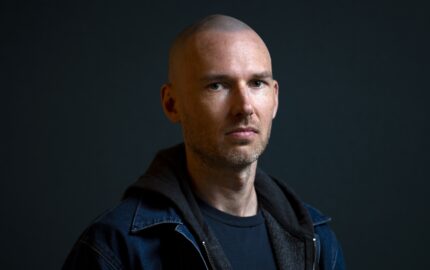
In an era of AI shortcuts and productivity hacks, the idea of simply “hanging out” feels like a nostalgic throwback. But it’s easy to forget that one of the best ways to connect with the people in our lives is to just… hang out with them.
Kurt Streeter came to this realization early in his journalism career, first working in documentary films, and now as national correspondent for The New York Times. He called it “the fine art of hanging out.”
“It’s basic reporting layered with patience, empathy, curiosity, and really not rushing, not forcing things — definitely not forcing things, which is maybe a little bit different then when you’re doing quick-hit stories that are one- or two-day or even one-week turnarounds,” he said.
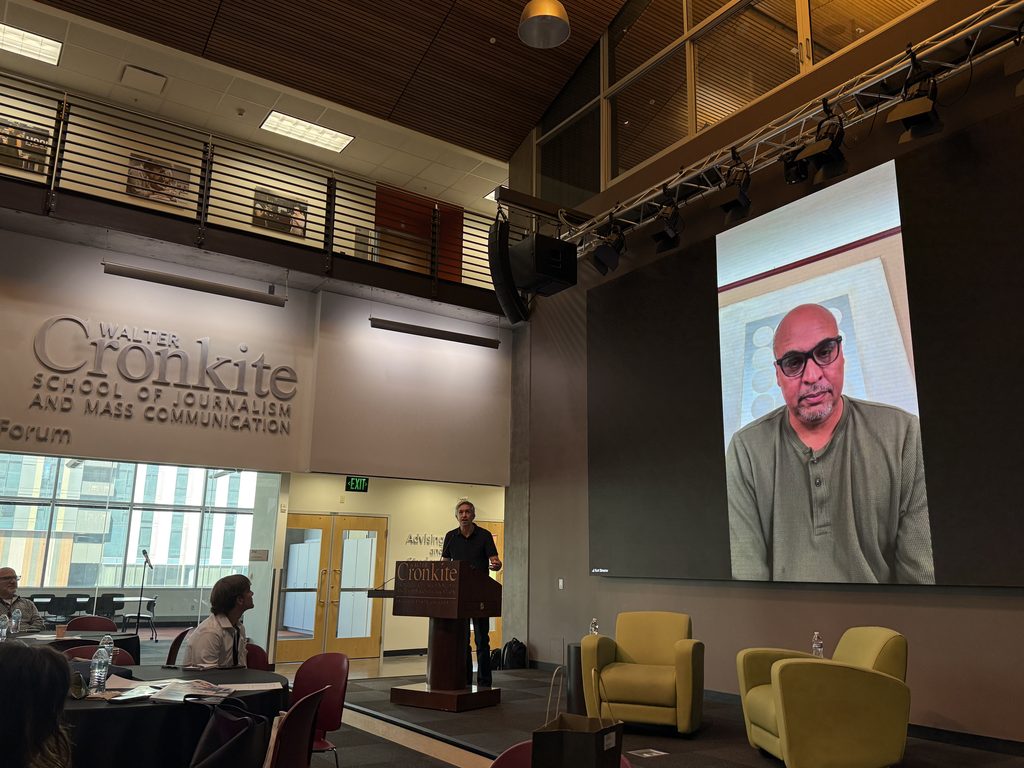
Streeter shared his experiences with Nieman Storyboard Editor Mark Armstrong during a live edition of the Storyboard podcast at the 2026 Society for Features Journalism conference on Oct. 23 at Arizona State University’s Walter Cronkite School of Journalism and Mass Communication. He talked about his method, the stories and characters he discovered by slowing down to take the time to look for them, and how other journalists can apply it to their own work.
[ Follow us in Apple Podcasts, Spotify, or your favorite podcast app. ]
“It’s amazing how many times, just by keeping your notepad open, keeping your ears open, your story subject will mention something that they consider absolutely to be not interesting at all, and it’s the golden nugget that carries your story,” he said.
Streeter’s reporting career has included stints at the Baltimore Sun, ESPN, and Los Angeles Times, where he published one of his favorite stories, “The Girl,” a five-part series about an 8-year-old girl named Seniesa Estrada, who dreamed of becoming a professional boxer. Her dream eventually came true, and Streeter revisited her story for The New York Times in 2023.
Streeter was drawn to sports as an athlete himself. Streeter is a graduate of UC Berkeley, where he was the first African American to be a captain of the men’s tennis team and he helped lead the Golden Bears to the 1989 indoor national championship. He’s written frequently about tennis, including a moving story about lessons from his father at the U.S. Open.
Excerpts from the conversation are below and have been edited for length and clarity.
On building trust with story subjects
I lean into my strengths as a person. I think that it’s really important in this kind of work, no matter what you’re doing in journalism, to kind of understand your strengths. And I’m not a super pushy person. I’m not somebody who’s going to go in with sharp elbows — I’d probably be a terrible investigative reporter. But, I am somebody that does hold empathy in high regard, and I really try to understand people and have a feel for them. I really want to know them.
Finding Seniesa and and her father Joe Estrada for his five-part Los Angeles Times series
The story is really not a boxing story. I never conceived of it [or] thought of it as a boxing story. Boxing’s obviously a really central part of it, and that’s a really interesting aspect of that kind of life in L.A. This is a father-daughter story. It’s a story of a dad seeking redemption, a daughter working toward her dad’s redemption, understanding the stakes. And the fact that there was a lot at stake then made the story. You’re always looking for that as a super powerful energy source in a story.
The importance of having strong mentors
I’d been known for very strong 60-inch stories, but to have a series and to know how to end on a cliffhanger and how to ask questions that will lead the reader into basically wanting more, that stuff, really, that came from the prodding and pushing and cajoling along the way from [Los Angeles Times editor] Rick [Meyer], who I worked with very, very closely on this piece, and then from [late L.A. Times editor and 1972 Nieman Fellow] John [Carroll] sort of overseeing it. I can’t tell you how lucky that is. That’s beyond anything I could ever imagine, and it meant everything for my career.
My relationship with Rick Meyer was standing strong even today, and I’ve always considered him to be my main mentor and somebody who really taught me and many others really how to write. And so his fingerprints are really all over this story. I think I’m a pretty decent writer — sometimes terrible, sometimes decent, and sometimes really good. But definitely not as consistent as I would like. So to have somebody like Rick Meyer, especially early in career as a guide, those lessons, they stick with me to this day, and I try to pass them along when I can to other younger reporters now.
How to identify your main character, and how they can illustrate the story’s theme
If I can, I’m looking for the one character that’s going to jump off the page. The one character ideally that’s really just a ‘holy shit’ kind of character. That’s my ideal. But that could morph into two characters. Like Seniesa and Joe, I considered Seniesa to be Character 1, Joe to be Character 1A. It could be, say, a family could be one character, I’ve done stories like that.
Almost all my best stories have been just told through pretty much the one person or about one person and their lives. But not really just about them, much more than that. The story about the sisters in New York and Sister Mary Kay [“Will Sister Mary Kay Turn Out the Lights?”] — that’s a dying convent, literally dying. When the last nun dies — and their median age is like 87, 88 — then this order of nuns is going to cease to exist after 220 years or so in New York, and really helping build New York. But I really told that story through Mary Kay, and I didn’t harp too much on, ‘Oh, this order is dying.’ I let that kind of float a little bit in the background. Certainly I mentioned it, but the broader theme then that I took up was endings, death, dying, closure, because Sister Mary Kay is at the very end, to the point where she’s told me very upfront she wants to die. She’s totally ready. There’s a certain gracefulness about that, the acceptance of ending and how to do that well, that I thought, she just really exemplifies that. So she was just an amazing character.
On being in the background of your story
I don’t try to stay purely fly-on-the-wall, just act like I’m not here. I mean, I try to blend in the background as absolutely much as possible. But it’s impossible to, as you’re forming these relationships. They can’t ignore you, and that’s just the reality. You’re there. I might just stay on the side. If somebody asks me something, I might say something just really quickly and then kind of maybe reposition myself to try to be more or less obviously there. But there’s almost no way around that, I think, especially at this depth.
Reading list: Authors, editors, and stories mentioned
- Kurt Streeter
- “The Girl”: Five-part Los Angeles Times series (Kurt Streeter, 2005):
- “Notable Narrative: The Girl: A Surprise in the Ring” (Nieman Storyboard, 2005)
- “Making the Time Count” (Kurt Streeter, 2005)
- “I Gave Up on Boxing, Not on This Boxer” (Kurt Streeter, 2023)
- John Carroll (1972 Nieman Fellow)
- Rick Meyer
- “As a Coach and a Cop in Minneapolis, Where Would He Draw the Line?” (Kurt Streeter, 2020)
- “Running While Black” (Kurt Streeter, 2020)
- “To Honor His Indigenous Ancestors, He Became a Champion” (Kurt Streeter, 2021)
- “Told to ‘Find Arthur,’ I Stumbled Upon My Future at the U.S. Open” (Kurt Streeter, 2021)
- “Will Sister Mary Kay Turn Out the Lights?” (Kurt Streeter, 2026)
- “For Ailing Twins' Parents, Hope Vies With Anguish” (Kurt Streeter, 2006)
- “How to Fix a Typewriter and Your Life” (Kurt Streeter, 2026)
- “In a Typewriter Repair Shop, a Reporter Finds a Familiar Hum” (Kurt Streeter, 2026)
- “What a Hunchbacked Raccoon Teaches Us About Kindness in a Fractured World” (Kurt Streeter, 2026)
Show credits

Hosted and produced by Mark Armstrong
Audio engineer: Elaine Wilt
Episode editor: Kelly Araja
Show notes: Emilia Wisniewski
Audience editor: Adriana Lacy
Promotional support: Ellen Tuttle
Operational support: Paul Plutnicki, Peter Canova
Nieman Foundation curator: Henry Chu
Music: “Golden Grass,” by Blue Dot Sessions (www.sessions.blue)
Cover design by Adriana Lacy
Nieman Storyboard is presented by the Nieman Foundation for Journalism at Harvard.
***
Subscribe to Storyboard
Get insights into the craft of journalism and storytelling in your inbox, delivered on Fridays.