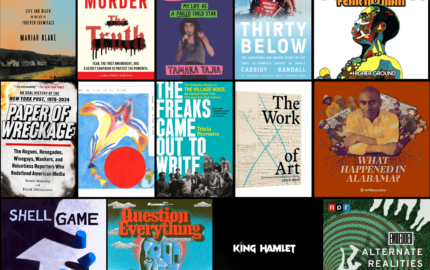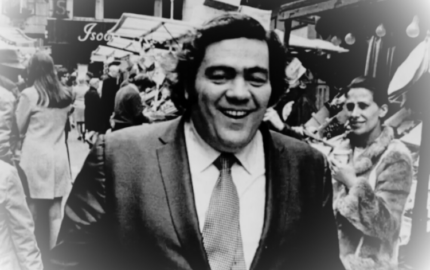
We asked the Nieman Storyboard community — journalists, writers, storytellers, and the readers who love them — to share some of their favorite stories, podcasts, books, and documentaries of 2025. (For books, we let you pick any book that you read in 2025, not just what was published this year.) Thanks to everyone who shared their recommendations. Here’s Part 1 (and you can read Part 2 here):
Stories
“The Rice Records” (Latria Graham, Oxford American, March 2025)
Selected by Minda Honey, Nieman Storyboard contributor, author of ”The Heartbreak Years” and writer at mindahoney.substack.com:
Latria Graham masterfully layers her personal history with the history of a region and Black oppression in America using a grain of rice as the vehicle, Carolina Gold Rice, specifically.
“‘It broke me’: Inside the FBI hunt for the online predators who persuaded a 13-year-old to die” (William Wan, The Washington Post, October 2025)
Selected by Trevor Pyle, a Nieman Storyboard contributor and former journalist in the Pacific Northwest:
The word I keep landing on is “unflinching.” William Wan’s haunting story of a Washington state teenager and the online community that encouraged his suicide is hard to read and harder to shake. But it teaches a sharp lesson about journalism: You don’t need to be showy or ornamental in your writing. The difficult truth is enough.
“The Nuns Trying to Save the Women on Texas’s Death Row” (Lawrence Wright, The New Yorker, February 2025)
Selected by Brendan O’Meara, author of “The Front Runner: The Life of Steve Prefontaine” and host of the Creative Nonfiction Podcast:
It’s so good I never want to ever do this kind of work again. There’s no point anymore. Law school, here I come!
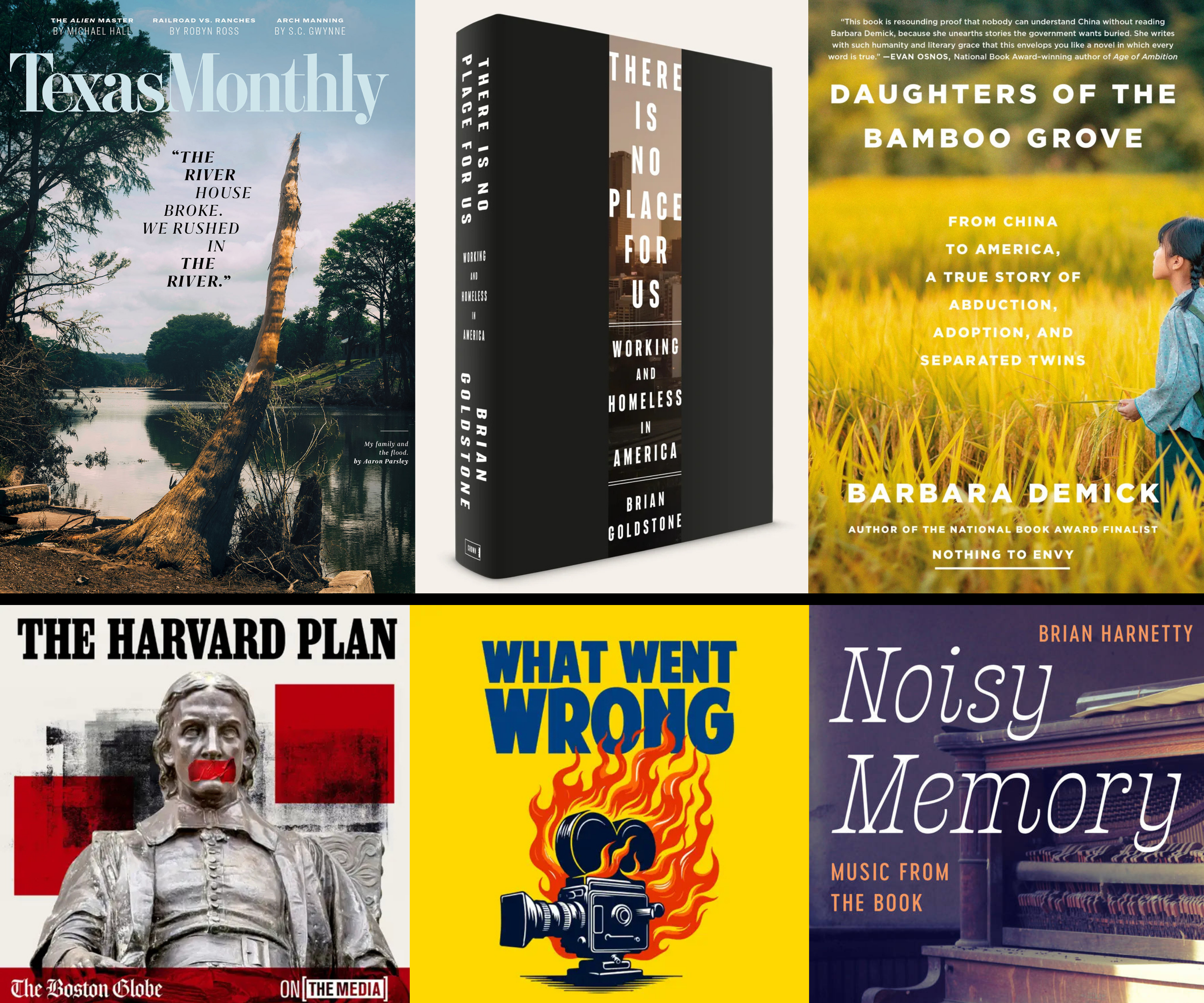
“The River House Broke. We Rushed in the River” (Aaron Parsley, Texas Monthly, August 2025)
Selected by Paige Williams, staff writer at The New Yorker and former editor of Nieman Storyboard:
I’ve been unable to stop thinking about “The river house broke,” by Aaron Parsley, of Texas Monthly. Parsley succeeded, with heart-sickening skill, at the journalistic ideal of documenting horror with appropriately visceral — yet unpretentious, unsentimental, un-self-pitying (a tough trick!) — detail and pacing. The piece goes on not a beat too long, ending, somewhat surprisingly, as a love letter to one particular survivor of the Guadalupe River flood. “River house” is a service; it can only contribute to our shared understanding of how the unthinkable unfolds, and, let’s hope, of how to spare others the same measure of suffering.
Editor’s note: Parsley’s family partnered with the Austin Community Foundation to establish a fund in memory of Clay Parisher, Parsley’s 20-month-old nephew who died in the flooding.
“Healing Is a Fluid Journey: How Hurricane Katrina Changed Me” (Melanie Dione, NewsOne, August 2025)
Selected by Deesha Philyaw, author of short story collection “The Secret Lives of Church Ladies” and the forthcoming novel, “The True Confessions of First Lady Freeman”:
Melanie Dione opens with a reflection on how she spent Friday night, Aug. 26, 2005, the day before she and her children fled New Orleans as Hurricane Katrina approached. She then pivots to the simultaneous flooding in Mississippi and how “we all share the kinship of being failed.” She writes of the years of displacement, rebuilding, and healing that followed, and concludes with her return to New Orleans and her advocacy work in climate justice. Melanie’s essay reminds us that Katrina was more than a catastrophic hurricane. She is an emblem of this country’s enduring racism and systemic failure to value and protect Black life.
“Playing Secretary” (Kerry Howley, New York magazine, June 2025)
Selected by Kevin Nguyen, deputy editor at The Verge and author of two novels:
New York magazine got raked through the coals for Olivia Nuzzi — OK, a lot of that is fair — but it overshadowed that the magazine still does some of the best D.C. reporting there is. This Pete Hegseth write-around by Kerry Howley is probably the most revealing piece about a figure in Trump’s Cabinet this year. What did I learn? Well, just a lot of horrible details about the person who runs our Department of Defense — I mean, Department of War.
“House Arab” (Ismail Ibrahim, Bidoun)
Also selected by Kevin Nguyen:
Inside baseball, but this piece just totally crackles on every line. I still have immense respect for The New Yorker (it’s the best English-language magazine, I don’t think anyone can meaningfully argue otherwise); still, this punctures quite a few holes in what they do there.
“Taylor Swift Turned Me Straight” (Lauren Theisen, Defector, August 2025)
Selected by Eva Holland, a Yukon-based writer and editor:
All the stories I read in a year tend to blur together as the months roll by, but this essay from Lauren Theisen stayed with me. It’s about a specific experience — a trans woman’s changing relationship to a particular flavor of American pop music — and a nearly universal one: what it feels like to fall in love. I have no doubt it will stay with me months into next year, too.
“She Despised Charlie Kirk. He Resolved to Make People Like Her Pay” (Eli Saslow, The New York Times, October 2025)
Selected by Laura Coffey, longtime editor, feature writer, author, and president of the Society for Features Journalism:
This is the kind of story that would make me break out in stress hives if I had to write it, but a calm, careful journalist like Eli Saslow somehow makes it look easy. By the time you reach the end of this story about a digital “civil war” after Charlie Kirk’s death, you come away with a deep understanding of all the players in it. It doesn’t mean you agree with every character — not at all — but you understand their thinking, and you feel an upwelling of empathy for them. This story is special because it illuminates the divisive world around us with such humanity and clarity.
“Investigating a Possible Scammer in Journalism’s AI Era” (Nicholas Hune-Brown, The Local, November 2025)
Selected by Andrew Deck, staff writer covering AI for Nieman Lab:
Nicholas Hune-Brown’s feature for the Toronto-based magazine, The Local, exposes a freelance journalist who published AI-generated fabrications in outlets like The Guardian and Dwell – a scammer Hune-Brown discovered the truth about only because he tried to commission her. Part investigation, part personal essay, Hune-Brown expertly weaves together shoe leather reporting with moments of heartbreak — the kind reserved for when your worst suspicions are confirmed. As a whole, the story illustrates the unsteady ground that journalists work on in this post-ChatGPT moment, one in which AI technologies are quietly chipping away at the credibility of the written word.
Also selected by Eva Holland:
Of course the subject matter is bleak: an editor investigates his own freelancer, and finds a web of lies and chatbot gobbledygook. But I still really enjoyed reading it, because Nick Hune-Brown is a great reporter and a great writer, and the feature he’s crafted from this mess took me on a journey. Ultimately I finished the story feeling hopeful: This is the kind of work that an LLM can’t replicate.
Books
“Daughters of the Bamboo Grove: From China to America, a True Story of Abduction, Adoption, and Separated Twins” (Barbara Demick, Random House, May 2025)
Selected by Laura Hazard Owen, editor of Nieman Lab:
After identical twin girls are born in China in 2000, the government snatches one from her loving family and she’s adopted by a family in Texas. Journalist Barbara Demick traces the girls’ stories (the book begins with her getting a Facebook message from the American twin’s brother) and helps make their reunion happen, while chronicling the shocking history of China’s one-child rule.
“Challenger: A True Story of Heroism and Disaster on the Edge of Space” (Adam Higginbotham, Avid Reader Press/Simon & Schuster, May 2024)
Selected by Alison MacAdam, audio story editor and 2014 Nieman Fellow:
As a kid who watched the shuttle explode on a TV at school, the Challenger has always had special significance. This book filled in all the (many) blanks in my knowledge — from the earliest days of NASA culture-building to the shocking cover-up that followed the disaster. And I couldn’t put it down; stayed up for hours reading.
“There Is No Place for Us: Working and Homeless in America” (Brian Goldstone, Crown, March 2025)
Selected by Shaun Raviv, an independent longform audio and print journalist based in Atlanta, and 2026 Nieman Fellow:
One of the most powerful books I’ve ever read. If you’ve read “Random Family” or “Evicted,” it hits a lot of the same notes, has the same level of minute-by-minute harrowing detail, and I’d argue it gains power by being more streamlined.
Also selected by Andrea Pitzer, former editor of Nieman Storyboard, author of three books, and founder of the Degenerate Art newsletter:
Brian Goldstone’s extraordinary book “There Is No Place for Us” spends years following the fates of five of unforgettable Atlanta-area families who are part of the often-invisible constellation of working homeless in America. He manages to bring to life the impossible quests these parents manage (or fail to manage) daily without romanticizing their suffering. Goldstone shows how deeply embedded the housing crisis is in modern society, and makes clear that the only way out out of our nightmare is to establish housing as a human right.
“Motherland: A Feminist History of Modern Russia, from Revolution to Autocracy” (Julia Ioffe, Ecco, October 2025)
Selected by Franklin Leonard, founder of the Black List and June 2025 guest on the Nieman Storyboard podcast:
It’s a herculean accomplishment of excavatory history, family memoir, and storytelling.
“Lost & Found: Reflections on Grief, Gratitude, and Happiness” (Kathryn Schulz, Random House, November 2022)
Selected by Carly Stern, a Nieman Storyboard contributor and journalist based in Brooklyn whose work has appeared in The New York Times, The Guardian, and Vox:
I came to this memoir in 2025 after hearing Kathryn Schulz on Ezra Klein’s podcast this year. I was moved by the eloquent way she spoke and wanted to dive into her mind. Schulz’s memoir is a thoughtful, reflective exploration on the plurality of human life and emotion — and how we can possibly hold love and loss, joy and despair, together at the same time. I found her prose to be lovely and meditative.
“Owner of a Lonely Heart: A Memoir of Motherhood and Absence” (Beth Nguyen, Scribner, 2023)
Selected by Megan Cattel, assistant editor of Nieman Reports:
I loved “Owner of a Lonely Heart” by Beth Nguyen. Her memoir retraces her childhood in Michigan, after her family fled Vietnam in 1975, leaving her mother behind in the chaos. Beth’s story isn’t guided by an ancestral archive or a treasure trove of documents; she builds meaning from fragments. She writes that family secrecy and silence “becomes a part of you … you almost forget that it wasn’t supposed to be there at all.” That willingness to confront what’s unknowable — and to shape a memoir from what’s left unsaid — is what stayed with me long after the last page.
Podcasts
“Noisy Memory” (Brian Harnetty)
Selected by Julie Shapiro, career listener, audio champion, and the co-founder of Audio Flux:
“Noisy Memory,” from the Ohio-based musician and sound artist Brian Harnetty, spans several mediums: a book, podcast, live performance, and a playlist. At the center of each are stunning archival recordings and oral histories from small Midwestern towns that share details of daily life in the mid-20th century, and rare recordings from luminaries Sun Ra and Thomas Merton. To my ears, Brian has invented a new way to document history through collaborative musical composition, while fostering deep relationships with the communities where his source materials emanate from. His work is both sincere and playful, feels both traditional and fresh, and dazzles across all forms.
“The Harvard Plan” (Ilya Marritz, On the Media / The Boston Globe)
Selected by Julia Barton, founder of RadioWright, writer at Continuous Wave, and 2024 Nieman Fellow:
Reporter Ilya Marritz, The Boston Globe, and On the Media teamed up for a second season to cover the Trump administration’s assault on higher education. What I really appreciated was the way this series interweaves three stories of academics who are living through this upheaval, including one who supported Trump (in the abstract at least). And there are some reporting bombshells as well about who is representing the administration in court.
Selected by Theo Balcomb, audio producer and journalist who created “The Daily” at The New York Times:
Talking about grief is not a thing that people want to do. As someone who’s in deep grief myself, I yearn for places where it’s OK to say how you really feel. Marc has brought grief into his listeners’ lives in a profound way simply by treating it as a commonplace topic. He talks about bringing the perfect hot water kettle to his hotel room, the fight his cats are getting into, who he saw at the Comedy Store last night, and his deep grief all in the span of five minutes. In this episode, he and Regina King support each other through just the kind of grief talk people shy away from. I’m grateful for it.
“What Went Wrong” (Chris Winterbauer, Lizzie Bassett, David Boman)
Selected by Sophie Culpepper, staff writer covering the evolving local news business for Nieman Lab:
“What Went Wrong” is a well-researched, accessible, narrative, and FUNNY deep dive into how impossible movies are to make. Its hosts, Chris Winterbauer and Lizzie Bassett (and producer David Boman), are passionate cinephiles who don’t take themselves too seriously. Through their yarns tracing how individual films made it from idea to silver screen, I’ve learned more about movies I love, but also the books they were adapted from, the time periods they were made in, and the push-and-pull between making money and making art. This podcast ostensibly about movies is a window into messy, creative people, how sausage gets made, and cultural history.
Standout episodes: “V for Vendetta,”“Snow White and the Seven Dwarfs”
***
Subscribe to Storyboard
Get insights into the craft of journalism and storytelling in your inbox, delivered on Fridays.