
When “Fela Kuti: Fear No Man” came out in the fall of 2025, I knew I would need to dedicate real time to listen. Produced by Western Sound and Talkhouse for Audible and Barack and Michelle Obama’s Higher Ground Productions, the series — which just won a Peabody Award — is a musical biography of the prolific inventor of Afrobeat, the Nigerian Fela Kuti, who died in 1997. It’s also a history of the tumultuous, often violent post-colonial powers he challenged, and what it takes for art to change minds.
The series was reported and hosted by Jad Abumrad, the creator of WNYC’s Radiolab who’s now an independent producer. Long ago, I got to report and help produce a piece with him and his team, so I know that Abumrad’s approach to narrative audio is like no one else’s. He doesn’t work from written scripts, but rather builds stories from interview tape and sound, working the connective tissue of narration around the more musical logic of characters, emotions, and ideas.
So when I finally started listening to this new series, I expected something good. What I didn’t expect was something you rarely hear much anymore in narrative podcasts: something daring and groundbreaking.
The sequence that lit up my brain occupies much of the third episode, “Enter the Shrine.” By this point in the series, we’ve learned a lot about Fela Kuti’s impact on Nigeria, and particularly on the musicians who played with him for years. We’ve learned some about his childhood in Abeokuta, in a Yoruba-speaking region north of Lagos. We’ve learned that he studied piano in London at Trinity College, before coming to Los Angeles in the late 1960s and getting exposed to the writing of Malcolm X and the Black Power movement. And we’ve learned how he returned to Nigeria in 1970 determined to bring these ideas home, setting up a housing compound and club called the Shrine that he declared to be an independent state within Lagos.
The episode “Enter the Shrine” broadens out — and slows down the plot. For more than 10 minutes in the middle of the episode, all narration falls away and we hear only a blend of voices, music and sound design that tries to replicate the “trance” that people say came over them listening to Fela Kuti’s live performances in his club. All this happens against an extended mix of his song “Army Arrangement,” a 1985 critique of Nigeria’s military junta.
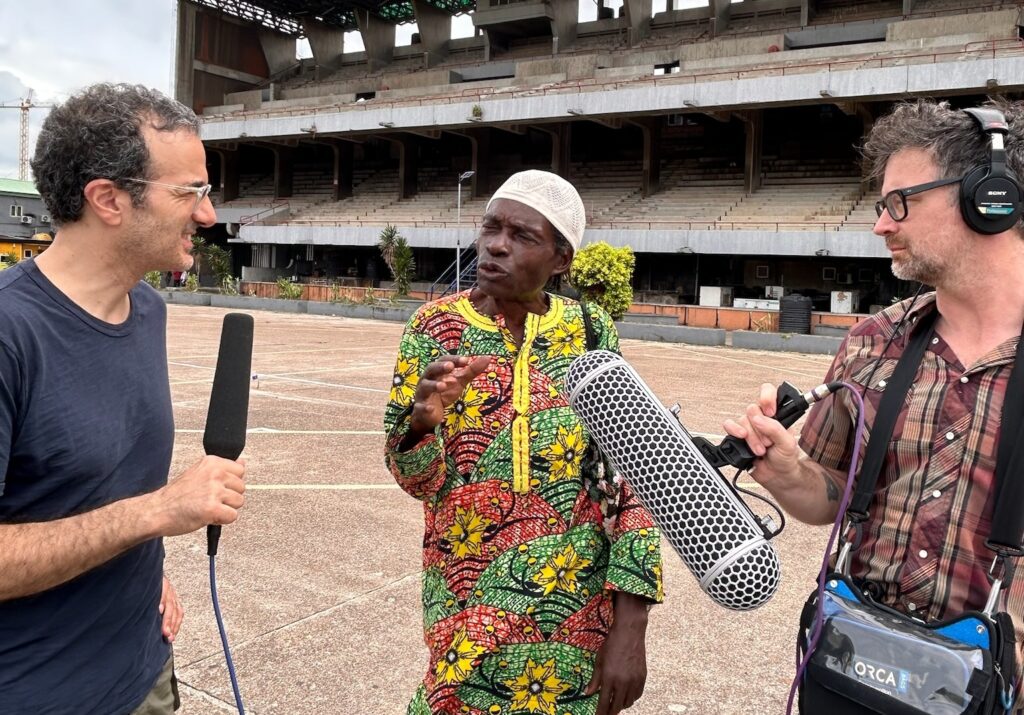
We do not hear the names of most of the people whose voices we hear swirling around us — rather they appear as a chorus, sometimes only repeating one word, at other times entire phrases. The longer this goes on, the more it infringes on a very old taboo in radio: that speakers must be identified whenever possible.
Yes, on radio we do hear the occasional “man on the street” interviews, and there are artistic “non-narrated” documentaries that flirt with unidentified speakers. Trailers and promotional clips might contain a flurry of voices to show off what a series has to offer. But generally in nonfiction audio, it’s considered rude not to identify who is speaking. That’s both for reasons of ethics, but also to avoid disorienting the listener.
There’s one more thing to add about montages: they are labor intensive. You have to comb through a ton of tape to find the clips that “pop.” Then you have to juxtapose them against one another, trimming and rearranging clips until everything sounds right. You may add music, you may subtract it. You probably should play each version of the sequence for others to make sure you’re not deluded about whether it works. All told, building an effective montage — especially a long montage — requires a lot alchemy, and acceptance that many of your attempts will fail.
I had to know how the montage sequence in “Enter the Shrine” came about — and more importantly, all the editorial arguments that surely went into its construction. So I called up Jad Abumrad and his editor, Ben Adair. (Full disclosure: in addition to reporting an episode of “Radiolab,” I once worked with Ben Adair at American Public Media and later gave notes on a series he produced with Pushkin Industries, “Lost Hills.” I’m also one of the editors on a forthcoming narrative series with Pushkin, Audible, and Higher Ground Productions).
Right away, Abumrad and Adair told me something I’d suspected — that the elaborate, sound-rich montage sequence that’s now in their third episode was originally intended as the start of the series.
“One of the big questions of the series was like, what is the first episode? Even as I say that question out loud, my stomach gets a certain layer of acid to it,” Abumrad said. “Because we lived with that question for so long.”
He built the montage set in the Shrine, but then the notes came back: this material was too confusing without context. Who was everybody? Why were they there? And where was Fela Kuti?
Abumrad and Adair took that feedback and moved the sequence further into the series.
Even within the episode itself, we get about ten minutes of preparation: we hear a sonic tour of Lagos, we hear where Fela’s Shrine was situated and how it’s spoken of today, and we hear about Fela’s elaborate preparations to go on stage each night — followed by a procession to the club, sometimes on a donkey.
What follows is a transcript of the montage sequence from “Enter the Shrine,” annotated with parts of our conversation. I’d advise listening to the episode (and ideally the two that come before it), and/or reading along as you listen. This transcript starts after the first ad break in the episode, approximately at the 11:25 mark.
***
Script Annotation: Episode 3, ‘Enter the Shrine’
[~11:25] Jad Abumrad: This is Fela Kuti: Fear No Man.
Before we go back into the Shrine — well first, let me give you a picture.
Jad Abumrad: I do remember we had an edit. We were sitting at my kitchen table downstairs and we had the script, and I think we had, at that point, decided this was the third episode. And Ben was like, ‘You need to talk about where (the Shrine) is in Lagos and the importance of the location.’ Ben always had a really good ability to think on the level of the series. And (about) what people need to experience at any given point of the series, so that they can go where you want them to go. This particular episode finally made sense (when) we put in context that people needed.
It is an open-air club, fits about 500 people. There’s this tin roof over the stage, but no roof over the dance floor.
And to either side of the stage are four Studio 54-ish “cages” where dancers dance.
Also to one side there is an altar, where Fela had a picture of his mother, a picture of Malcolm X, and a picture of Kwame Nkrumah, first president of Ghana.
But I’ll be honest, what’s most interesting to me is not so much the Shrine itself — I mean, it was a club — but rather what happened to people when they went inside of it.
Because — do you know how people talk about psilocybin now? Right, like we all have one of those friends who did some mushrooms and it changed their life and they can’t stop talking about it. And there is a way to explain those experiences — you can say, neurochemistry, right? There’s something about these drugs, they rewire your brain. Fine.
We ran into so many people who described listening to Fela’s music, at the Shrine, in the same way! That it had the same effect on them. Which is a little harder to explain. Though, I will try in a moment.
But first, let’s reenter the Shrine from their perspective.
(crowd noises)
Julia Barton: How many hours of tape did you have for this series?Jad Abumrad: At least 200… We used (the audio and video editing app) Descript to make very, very low-res builds, just string-outs of tape. Just to hear how the voices talk to each other, and if they like the order that you’ve put them in. Then there was a lot of ‘Ctrl+Fing’ as we zeroed in on certain keywords that people would use. It was really easy to figure out who in our many, many interviews had said what.
And as you’re listening, see if you can let yourself notice: What are you paying attention to? How does that change over time?
Julia Barton: Was this line about noticing part of the framing?Jad Abumrad: That (came from) my therapist! Because we had a whole conversation where he was like, ‘I think what you’re doing is a guided fantasy. And if you’re going to give people a guided fantasy, you need to instruct them about how and what to notice as they’re going through it.’
At one AM, Fela arrives on his donkey, takes the stage with 35 other musicians and he begins a riff … that will last most of the night.
Woman 1 (Marilyn Nance):
My experience in being in the Shrine was like, like the music was like inside of me. It was all around, it was just like, you know, being hypnotized. Like you are all inside the music.
Woman 2 (Nina Darnton):
A kind of hypnotic dancing.
Man 1 (Duro Ikujenyo):
React to music, dancing and listening. (repeats under)
Woman 3 (Lorraine Animashaun):
I remember being lost in music. All the people are smoking around me and they were in a mist. So you’re in a different world.
(Keyboard, chorus sings)
Woman 4 (Rosa Cuoto):
This idea of the spiral (spiral, spiral). And circles (circles, circles). It’s another way to deal with time.
Man 2 (Dele Sosimi):
I would describe it as in a swirl. You know, when, when you have a cyclone, it starts off as this little thing that builds up and it builds up. The more you allow it to circulate, it just starts to get bigger.
(Vocal montage mix begins, repeating elements from voices above)
VOICES:
(Spiral, spiral, spiral)
(Get bigger. Get bigger, get bigger, get bigger)
(Circle)
(Get bigger, get bigger, get bigger)
(Circle)
(Get, get bigger, get bigger, get bigger)
(music fades under)
Jad: It was really just trying to get into the internal mindscape of the people who would be lost in the trance. Like the way in which the building could start to breathe, you know, and everything could start to spiral and spin around your head. You lose track of where you end and someone else begins, which was an idea everyone kept talking about.
Man 3 (Bode Omojola):
Fela starts his music to enchant. This repetitive pattern, the power of the musical ostinato. It’s part of that enchanting strategy. You’ve been captured.
(Enter horn section, vocal montage interspersed)
Man 4 (Brian Eno):
I thought this is really an amazing new form of music. It was, it was almost like a field of sound that sits there for a long time. And you explore it. You kind of enter it, and live in it. This is a place, this isn’t a song.
Ben: In the case of this episode, I do think that the audience missed a few people (in the montage) who were really important. There’s a great quote from Brian Eno that comes right in the middle of it. Knowing that’s Brian Eno, I think it has a little more weight to it. In the bonus episode (Episode 13), he expands on that, and it’s super interesting to hear the huge effect that Fela’s music had on him as a musician and as a producer.
Man 5 (John Darnton):
And meanwhile the rhythm section’s keeping going (going, going, going).
(horn section reenters)
Man 4:
This is a place. And when you start listening to it, you are entering into that place.
Woman 1:
Hypnotized. Like the music was like inside of me, it was all around. And it was just like being hypnotized.
(Montage of multiple voices)
Man 6 (Michael Veal):
And so with Fela, you could tell that there was a different kind of intention behind this paradigm of groove. The music is so nasty, you have to dance. But that’s just the ground level. ’Cause why would you play a song for 30 minutes or 40 minutes unless you really have something to say?
(horn section mixed with full vocal montage)
Jad: One of the members of our team, Ruby Walsh, had made a draft where she had ‘Army Arrangement’ and a couple of people (speaking) on top of it. The moment that we both heard it, we were like, is this the first episode? It had a sparkle to it, an energy that felt inviting in a way. She really fought for us to make it the first episode and that spark was us recognizing that she was right.
Man 5:
And then suddenly —
(vocal montage repeats, begins to fade under)
Man 5:
After half an hour, 40 minutes…he starts singing.
Jad: The danger in this kind of thing would be to simply talk about the music, right? But the music itself is so pregnant with all of the ideas. You have to put people in it. So we had this idea of: the series was like a river, and each of the episodes was a little eddy in the river. The river was the music, right?
Ben: The producer in me was like, what? How? How is this gonna work? But we kept coming back to it, because it is exactly right: the music has to be the guiding force. Jad talks in a bunch of different moments in the podcast about this torrent of music that Fela was creating, that was just streaming out of him and around Lagos and around the world. So why not have that be the guiding principle?
(vocal section of “Army Arrangement” featuring Fela Kuti begins)
Whether you like or you don’t like
After you hear this true talk
Whether you like or you don’t like
After you hear this true talk
If you like it good (Ge ge)
If you no like it you hang (Ge ge)
If you like it good (Ge ge)
If you no like it you hang (Ge ge)
If you hang you go die (Ge ge)
You go die for nothing (Ge ge)
We go carry your body, go police station
You die wrongfully
(song pauses)
Man 7 (Saul Williams):
When his voice came in, I was like, what the hell? There are words too?
(Fela sings):
All of them Kirikiri
Ten to fifteen years in jail
After one year inside jail
Civilian government take over
(music continues under, partly blurred)
Man 7 (Saul Williams):
Hold up, hold up. What is this?
Man 5 (John Darnton):
He sings in a gravelly, low pitched voice — and sings about things that no one else ever even mentioned. Any newspaper, any columnist.
Woman 5 (Stephanie Shonekan):
He talks about the United Nations, he talks about Thatcher, he talks about Reagan. It’s really, everything is like a history lesson.
Man 5 (John Darnton):
You see it sinking in. You could see ideas in the air floating from the stage, like thought balloons, and then sinking into somebody’s skull.
(Music transition to celeste-like notes)
Woman 5:
I just felt, Where has my mind been all, you know, all, all my life? Complete surprise. Like —
Man 8 (Moses Ochonu):
I, I was immediately captivated.
Woman 5:
— why did we not know this? Why aren’t we thinking about this stuff?
Man 9 (Lemi Ghariokwu):
When Fela sang into a microphone, I saw the — the light.
Woman 5:
I was just like, you know, like —
Man 8:
It sucks you in. And then it has that lightbulb effect on you. You come into yourself, and you know, it’s a moment of, uh, introspection too, because you, you realize that you haven’t been as attuned as you probably should have.
Woman 5:
All the stuff he was singing was just new to me. You know, I was just learning so much about Nigerian history through Fela, that I had not learned in school.
(music, celeste-like to an ad break)
Jad: It was a real frustration through the process. I felt like we were circling, and we couldn’t get close enough. We couldn’t get in his head. (After building the first episode) I realized I should stop thinking of Fela as a psyche that I need to get inside of. He’s an energy source that is flowing through people. And this series is about watching the energy.
[ad break]
This is Fela Kuti: Fear No Man. Before we go on, the voices you just heard before the break, in addition to Michael Veal and John Darnton, were Stephanie Shonekan and Bode Omojola, both professors of ethnomusicology at the University of Maryland and Mount Holyoke, respectively. Afrobeat musicians Dele Sosimi, and Duro Ikujenyo. Activist, filmmaker, musician Saul Williams. Musician and producer, Brian Eno. Artist Lemi Ghariokwu. Photographer Marilyn Nance. Designer Lorraine Animashaun, and our advisor, Moses Ochonu, who’s a professor of history and my colleague at Vanderbilt University.
He was one of the last voices you heard, and I asked him –
Jad [in tape]: You said that the music made you feel like you needed to tune into things you hadn’t been tuning into. Like what?
Moses Ochonu: Uh, you know, when I was growing up in Nigeria, you know, we would hear about corruption, about thousands of naira being embezzled by some politician or government officials. And we would open our mouths in shock because our brains couldn’t compute how one person would make off with thousands of naira. How would the person carry this money? What, what would they put it in? In some boxes and in some cars? You know, physically, how would they move this money? You know, we just couldn’t fathom it.
And then over time we started hearing about millions, not thousands anymore, then billions. And now, as we speak, the corruption numbers have entered the trillions.
That over time has had a numbing effect, a dulling effect. The shock value, the kind of shock that I felt as a child growing up in Nigeria, the moral outrage that I felt, that’s gone, that’s long gone.
Jad: And that is what would come back when you heard his songs.
Moses: Right. Exactly.
Moses said that Fela’s music would remind him of the insanity that he had been sane-washed into believing was normal. And I think there’s something really interesting about how the music can move him to that thought.
Music is all about structure, right? Structuring the relationship between notes and chords and melodies. But here, you have structure on an entirely different level, almost like a phenomenological structure.
Jad: I was talking to my therapist and I was trying to tell him the story of this episode — and he was like, ‘So why? What did they all experience?’ We ended up getting into a whole thing about that, and I was like, ‘Oh, I need to put this in.’ … This sort of music lecture, about the ostinato, that sort of unpacks what you’ve just experienced.
For the first 15 minutes, it’s just loops, ostinatos going round and round.
Bode Omojola (Man 3): The power of the musical ostinato.
“Ostinato”in Italian by the way, means basically “stubborn.” The loops stubbornly repeat, and at first it’s not so bad. It’s kind of grounding, actually. But then, the natural response is then to want some change. Like, “can we go to the next section now? Please. Please? No?”
This is what the Buddhists call our monkey mind. Our monkey mind wants distraction. It wants anything to keep us from having to live with our own thoughts. But the music doesn’t give us that. It doesn’t change. It only builds.
Layers get added, piece by piece, instrument by instrument. And at some point, a few minutes in,
(repeating music resumes)
You arrive at this mysterious moment where you stop wanting it to change. This is phase two. Now that part of you that wants novelty starts to notice things like, “Whoa, listen to all the interlocking parts of this groove.”
Ben: One of the first very first conversations that we had about making this show, Jad had this desire he expressed about wanting to do something that sounded just so different. And the way he put that, even in the early meetings, was: Making a documentary that you could dance to. I think that becomes the most palpable in this episode, Episode 3.
Dele Sosimi (Man 2): Whoa, the ostinatos — they’re like machine gears. They don’t grind. The gears are timed in between each other, so they just subtly lift fit into the little gaps and holes like Tetris.
The way that the conga plays off the shaker, call and response, the way that the three guitar lines spin around endlessly like gears in a higher-level clock. My God, this groove is a whole world.
(musical transition, celeste re-enters)
This is the trance state. Usually when we talk about trance, we mean a kind of dulling of our senses, but actually it’s the opposite. It’s the state of hyper focus.
You are noticing things. You’re hearing things you’ve never heard before, because your neurons are rewired. You are open. And it is at this very moment that Fela begins to sing.
Saul Williams (Man 7): I was like, what the hell? There are words too?
In comes his voice booming like the voice of God. This is phase three. And because you are open, you really hear what he is saying.
John Darnton (Man 5): You see it sinking in. You could see ideas in the air floating from the stage like thought balloons and then sinking into somebody’s skull.
And in that way, as the final piece of this progression, he gives you a new conception of what your life can be —
Lemi Ghariokwu (Man 9): I saw the light.
That you can now dance to.
(“Army Arrangement”/vocal montage up for several beats, then running under low)
Fela Kuti: My music, my main… my main preoccupation right now, music is a small part of it.
This is a clip from an interview Fela gave in 1988 where he describes his musical form, almost as this vehicle designed to move people, step by step by step, so that they can hear what he has to say.
Interviewer: Is your music kind of a tool?
Fela: It’s a weapon. It’s a weapon to say, so I can talk when I have the chance to. consider music to be effective like a weapon, to inform people. My music is like an attraction to inform people. It is the information side of the music that is important.
Jad: That was one of the best moments, where you really feel like he was philosophically addressing the thing that we had just built with music. Where he’s extremely insightful is when he talks about the ‘musical contraption,’ as he called it — the thing built with his music. He knew what he was doing, you know?
(Music out, replaced by a swirling sound)
In that same interview, he suggested there’s something else going on here too. That has to do with time itself.
(voice: Circle, circle, circle…)
Fela: If anyone tells me 20 years is a long time, I would tell them no. Time is meaningless unless you want to understand what time is about. There is time for everything.
***
Julia Barton is a longtime audio story editor and author of a newsletter about broadcast history, Continuous Wave. She’s worked with nonfiction authors including Malcolm Gladwell, Michael Lewis, Jill Lepore, and Michael Spector to create original podcasts and audiobooks. Barton completed a Nieman Fellowship in 2024. Her work can be found at RadioWright.com.
Subscribe to Storyboard
Get insights into the craft of journalism and storytelling in your inbox, delivered on Fridays.