In 2012, Lorraine Boissoneault noticed her hands quivering while sitting in class at her master’s program at Columbia University’s School of Journalism in New York. Dizziness and shortness of breath soon followed, and a doctor eventually diagnosed her with Hashimoto’s thyroiditis, an autoimmune condition affecting her brain, heart, muscles, metabolism, and ability to regulate body temperature.
That same year Boissoneault found herself interviewing survivors after Hurricane Sandy pummeled the region, flooding blocks and subway lines, destroying homes, and killing 44 New York City residents. In between interviews, Boissoneault noticed another kind of storm developing too—this one in her heart. It turned out, she’d been experiencing arrhythmia for years. Her doctor determined she also had supraventricular tachycardia, an electrical malfunctioning of the heart.
Outside, weather conditions intensified, as 2012 became the hottest year on record in the U.S. Meanwhile inside, Boissoneault’s illnesses raged. Her partner called it “a bit of body weather,” which became a way to describe, as she writes, “the turbulence inside me.”
The term, Boissoneault told me in a recent interview, was “useful for just trying to understand the patterns of my body.” She started thinking more metaphorically and realized it was a “way to conceptualize climate change, and everything happening outside of my body and inside of my body at the same time.”
A decade went by, during which time Boissoneault published her first narrative nonfiction book, “The Last Voyageurs,” about a group of young men who discovered themselves by pretending to be French explorers. She’d worked on that proposal and signed with an agent after taking professor Sam Freedman’s book proposal class at Columbia, which has led to 113 book contracts and 95 published books.
Boissoneault wrote a second book proposal that went out on submission in late 2019, which involved reporting trips to Europe and China. Then, the Covid-19 the pandemic hit. That book project did not get picked up. Meanwhile, Boissoneault’s ailments worsened, as her body became more inflamed.
Boissoneault, whose background is in traditional science and history reporting, had been thinking about writing a journalistic account about the increasing prevalence of autoimmune diseases, similar in style and voice to her first book. But her attempts at writing a third book proposal centered on the topic faltered. “I realized holding myself out of the narrative was keeping me back from being able to write it,” she said, “because I do have personal stakes in issues, but I hadn’t done very much personal writing in the past.”
She decided to pitch an essay to an editor at The New Yorker. The story, “Learning to Live with a Broken Heartbeat,” was published in the magazine’s Personal History section in 2022, and it gave Boissoneault more confidence to write comfortably in first person, and pitch a book in the same vein.
It was an ambitious and creative idea: braiding body systems with weather systems. Temperature and thyroid. Storms and the heart. Floods and the uterus. Fire and joints.
Given this approach of blending reporting with personal essays, her agent asked her to write a new book proposal, with longer sample chapters. “She wanted the publisher, the editor, whoever was looking at it, to really have a sense of what I was trying to do with this story,” Boissoneault told me, “and that was very different than other proposals I’ve written.”
An editor at Beacon Press embraced the vision. Boissoneault signed a contract. But now she had to find a way to manage her chronic illnesses, doctors appointments, and a full-time job, all while reporting and writing a book. It wasn’t possible. Then, in what turned out to be a fortunate turn of events, Boissoneault got laid off.
She’d already asked for an extension from her book editor. “If I hadn’t gotten laid off,” she said, “I would not have finished it for that deadline.”
Along the way, Boissoneault took a writing class with Esmé Weijun Wang at the Unexpected Shape Academy, designed for nonfiction writers living with limitations, where she learned to create a writing life in a field that is not always suited to providing accommodations. “There were speakers who came in to talk about their own writing and classes on different techniques for talking about traumatic experiences without retraumatizing yourself.”
The class helped her realize there are many “more people that have to deal with limitations in some form or another than we might think.” She also learned to be flexible, because if you’re disabled or chronically ill, you can’t always do the on-the-ground reporting you want to do, but there are now many ways to talk to people long-distance.
She also took an essay class with Sarah McColl, focusing on experimental forms in personal narrative. Boissoneault has worked as a staff writer for Smithsonian Magazine and freelanced for publications like National Geographic and The Washington Post. She had a wealth of journalism and narrative nonfiction training, but not much experience writing essays. Taking a class with McColl “was just so helpful in seeing that there are many different strategies that you can use to create interesting, dynamic, multi-layered essays.”
Midway through finishing the book, Boissoneault submitted her book proposal and sample chapters to the J. Anthony Lukas Work-in-Progress Awards, from the Columbia Journalism School and the Nieman Foundation for Journalism at Harvard. It requires applicants to already have secured a book contract, awarding two $25,000 prizes annually to aid in the completion of a significant work of nonfiction on a topic of American political or social concern.
In 2024, Boissoneault’s proposal won.
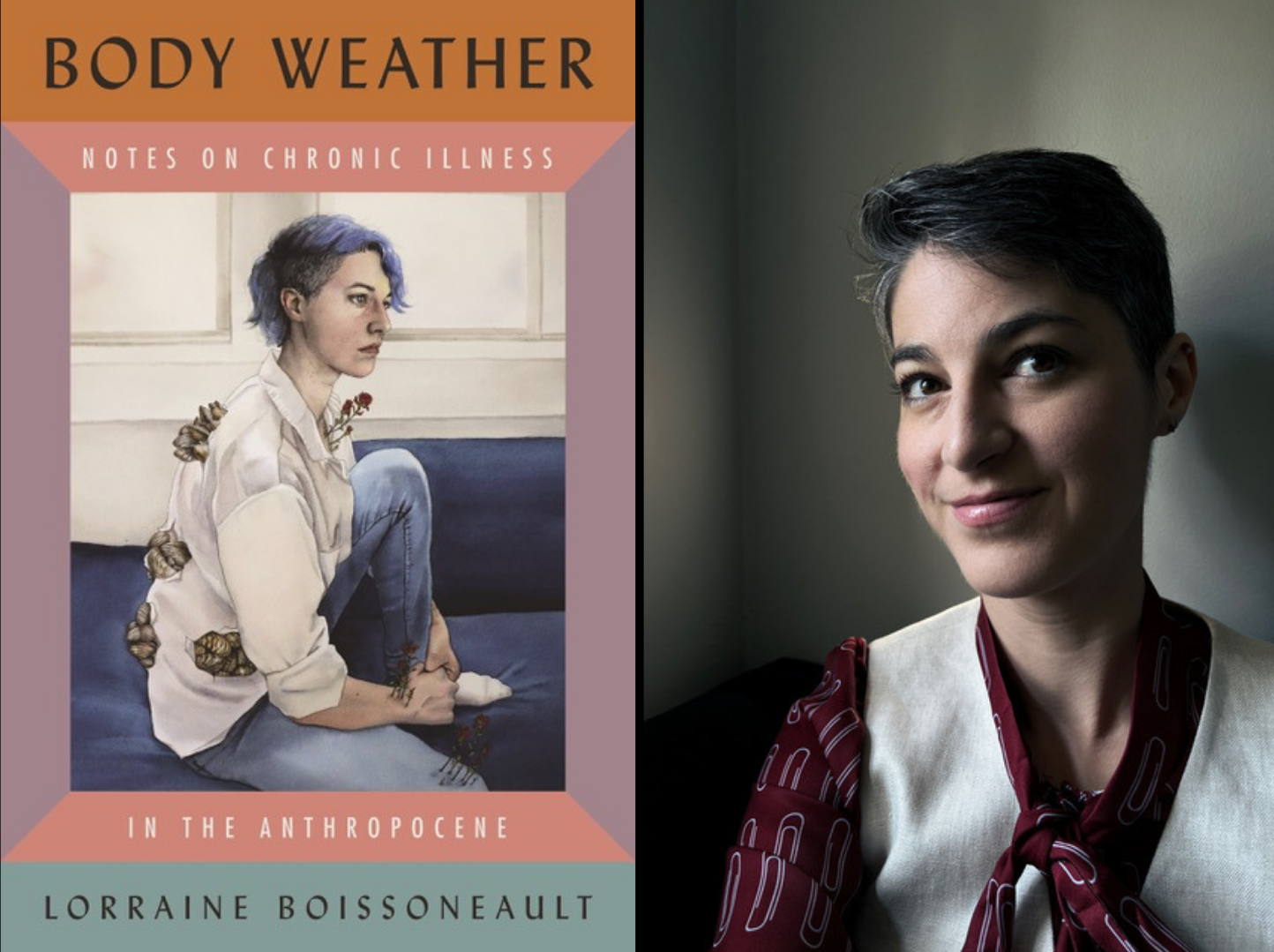
Her book, “Body Weather: Notes on Chronic Illness in the Anthropocene,” was released in April.
I had the privilege of being part of the judging panel for the Lukas Work-in-Progress Awards in 2024, and I remember Boissoneault’s exquisite book proposal. The proposal and her book chapters are sharp examples of “how to toggle” between scenes or personal narrative and digressions into research. Boissoneault said the award helped get her book to the finish line, and funding went toward travel, as well as fact-checking by Wudan Yan, who runs Factual.
Boissoneault generously spent time talking to me recently about her new book, and annotating her award-winning proposal for Nieman Storyboard. Her book proposal was 80 pages long, but we focused specifically on the introductory section before her sample chapters, which remained in similar form to the ones in her book.
***
Body Weather
Notes on Illness in the Anthropocene
By Lorraine Boissoneault
Erika Hayasaki: How did you decide on a title and did you always know this would be the one? Was there ever any discussion about it with your agent or editor?Lorraine Boissoneault: I know it’s not normally the case with books, but the title came before almost anything else. It was such a good organizing principle that once I had it, the rest of the book felt as if it could come together. Both my agent and editor always really liked it.
The subtitle, on the other hand, did end up changing. We added ‘chronic’ before illness, but that was after a lot of back and forth. There was a concern with my publisher that using ‘Anthropocene’ might make it sound too technical or scientific, but I really wanted that as an indicator of the science reporting that’s part of the book, too.
Table of Contents
Overview....................................................................... 3
Chapter Outline............................................................ 10
Sample Writing:
Part One: Temperature—Thyroid................................. 14
Part Two: Storm—Heart............................................... 44
Part Three: Flood—Uterus............................................ 73
Publicity and Marketing................................................ 76
About the Author........................................................... 78
Readership and Comparable Titles............................... 79
How did you decide or know to include a table of contents in your proposal?I’ve included a TOC in all my book proposals to give editors a quick overview of what’s inside. For this one in particular, I wanted to give a sense of where the writing was going and how I was going to execute the ‘body weather’ concept, so having multiple sample chapters showed the way I was making connections between these ideas.
***
An Introduction to Chaotic Systems
Winter came early to Chicago the year I fell sick again. Snow for Halloween and bitter temperatures by November. I drove slick and slushy roads to doctors’ offices, where specialists wound cameras down my stomach and through my intestines, or shone lights at my aching eyes, or sent me into a tunnel of hammering magnets. Phlebotomists drained my veins to fill dozens of vials, and I wondered what would happen to all my blood after it had been spun in centrifuges and smeared across glass slides. Would it be marked as biohazard, burned for being unsafe? If so, unsafe with what virus or bacteria? Nobody seemed to know. Tell us about your choice to begin your proposal here, with you in a scene driving to the doctor — what was important to convey in this first graf, which is interior and in action, instead of explanatory?I wanted to immediately convey that this would be personal and that I could do the work of a memoirist. Having never written in this form before, it felt especially important to prove that I had the literary ability to take readers through my story. This was also an inciting incident for me personally: having more health issues and trying to unravel the mystery of what was wrong.
I watched ice patina the corners of our old windows in my second-floor apartment. The cold gouged deep into our streets, digging fissures that wouldn’t be patched for at least a few years. I learned to live on rice and scrambled eggs till all my clothes hung loose on my limbs. I was always cold and never hungry. Old activities like walking, cooking, and yoga made my elbows and spine and fingers ache. Mild fevers flared then fizzled out. I was prescribed antispasmodics for my stomach, ibuprofen for the fevers, steroid eye drops for the uveitis, differin gel for the arthritis. Only the eye drops helped. This section reminds me of the power of the literary list, and Joan Didion’s packing list. (See examples.) Can you talk about why this collecting these experiences together in this part of the proposal was important?When so many things are happening inside your body at the same time, it can feel like you need pages upon pages to describe all of it. I never wanted to overwhelm (or bore) the reader with my physical experiences, so this list form felt like a concise way to convey all the discomforts and move things forward.
Nothing in my body made sense anymore. No one had a name for the chaos. The winter outside, heavy though it was, felt familiar and knowable from twenty-some years of Midwest experience. It was my anchor, keeping me in place but only by first pulling me. Here is a central tie-in to the theme of Body Weather, and it comes quickly in your proposal. How difficult was it to draw these connections between body and weather? Did you map them out in your mind? How long did this process take?The mapping for each part of the book was actually relatively fast. I made a little outline of the body parts I wanted to talk about, then considered what weather phenomena I could pair with each. But the actual writing was much harder, because I had so many possibilities to explore.
Then, in February, for the span of twenty-four hours, winter’s grip loosened. Merely a fluke, or another sign of our warming world? The strange weather was made all the stranger by clouds of downy white blowing from the dusk sky, falling between the leafless branches of the catalpa trees. It was far too warm for large, lacy snowflakes. This precipitation was not snow, or ice, or the seed puffs of a confused cottonwood. They were feathers.
My husband and I chased the white plumes down the block to Grace Street, trying to find their source. Since when did sunset bring a flurry of quills? Had someone emptied an old goose-down pillow from their bedroom window? We found the culprit perched in the upper branches of a naked tree. A spackle-winged Cooper’s hawk shredded its meal: a pigeon, or maybe a sparrow. From our view on the sidewalk, the only thing visible was the dead bird’s fate. A sharp beak, and blood, and torn feathers falling from the sky. There is a kind of poetry in these sentences-you’ve talked a bit before about the intersection of poetry and journalism. Did you draw from that language to write this and what poets inspired you?The first part of this proposal actually started as a lyric essay that I was trying to write and pitched around a bit. It never found a home, so I was really happy to repurpose it for this. I was so fascinated by the imagery of feathers falling from the sky, while things were happening invisibly in my body. I’ve been really inspired by the work of poets and writers like Ada Limón, Mary Oliver, Joy Harjo, and Naomi Shihab Nye.
Giddy elation momentarily subsumed my perpetual haze of discomfort. The world still contained pockets of the utterly unexpected. A weather forecast would never think to include feathers, even if a hungry hawk reflected some part of our atmosphere. No one could predict what would happen next to my body because no one had yet given my illness a name. Being undiagnosed had been nothing but a painful limbo until I saw that hawk and thought: Medicine might still surprise me. This opening section of your book proposal also serves as an inciting incident. Why structure the proposal in such a narrative format?The goal was to give editors a taste of my writing style and show them I can combine human experience with nature writing. But I also think creative nonfiction should be engaging to read, and I was hoping that this opening would pull an editor in.
***
Nearly three-thousand years ago, Babylonians in the Fertile Crescent looked to the stars to predict the weather. In what some consider the longest attempt at meteorological monitoring ever conducted, scribes chiseled cuneiform into clay tablets for nearly eight hundred years. Their observations would help people prepare for flood or drought, storms or sun.
This “astrometeorology” is one of the earliest known examples of humans scanning the heavens in hope and in fear, recording what they saw to make sense of mysterious patterns. For hundreds of generations, rulers and farmers and curious observers tried to trace a web of meaning from the weather. Greek philosopher Hesiod said that when snails climb up houses, fleeing the light of the Pleiades star cluster, the weather is right for harvesting crops. An ancient Nabataean text noted that the hooting of an owl was the sign of cold or bad weather ending soon. The color of the clouds at sunset and sunrise have long been used as indications of the coming day’s conditions. This section turns into a more sweeping journalistic and explanatory style of language — signaling in the proposal your intended style for this book. Why was it important to quickly include this kind of digression as you drafted this proposal?I didn’t want to continue too long in the first-person narrative, because that wasn’t the type of book I planned on writing. It was really a matter of finding a balance between memoir and reporting, and showing the thematic ways that I’d connect the two pieces. I really liked this example because it shows just how long the human fascination with weather has been a part of our daily lives.
If weather forecast is the warp of our human lives, medicine is the weft. Great line. What was your thinking behind it?Two of the most common conversation starters are asking people how they are, or talking about the weather. I was really happy with this line because it sums up these central concerns of body and environment which shape our daily lives so profoundly. Alongside the earliest attempts at understanding the sky were efforts to codify the body’s maladies. Another series of Babylonian tablets, the Sakikku, offered a diagnostic guide to Mesopotamian healers whose patients might be suffering from dysentery, lung diseases, worm infections, or epilepsy. The descriptions of how these illnesses presented in a sufferer were uncannily accurate; in some cases treatment was even effective.
Our weather and our bodies both demand inquiry and observation in hopes of achieving control. We want to snatch calamity out of obscurity, hide from the hurricane and have surgery before the cancer strikes. We want to know what comes next with enough time to prepare, as if preparation could inoculate us against illness or disaster or grief or death.
But even in the 21st century with immensely powerful computing machines and satellites peering at clouds from above—technology that would have been unimaginable to the Babylonians—we still cannot offer a perfect forecast. Meteorologists don’t know where, exactly, a hurricane will make landfall, or when the first frost will come each fall. Nor can medicine, for all its advances, provide any panacea. With all our drugs and vaccines and tests, we can’t keep someone from catching a cold. Can you talk about the choice to move into second person here ‘our’ and ‘we.’Even though I knew I’d be writing a lot about myself, I wanted to make it clear that I’m posing questions that we all face as humans. The turn here is to illustrate how the issues are more universal.
This isn’t to say our scientists are failures. Instead, it’s a testament to the inscrutability of weather and bodies. Both are chaotic systems, in which the tiniest change of certain conditions will result in dramatically different outcomes. In the popular imagination, this is more often called “the butterfly effect” for the idea that a butterfly flapping its wings in Mexico might contribute to a typhoon in the Pacific. Within someone’s body, it might be the difference of one gene being expressed while another remains silent; exposure to a certain virus at a certain age; the way the world treats us based on how we look. Every little variable plays a role. We simply can’t account for and predict the trajectory of all of them. You’ve mentioned Naomi Klein’s 2023 book, ‘Doppelganger: A Trip into the Mirror World,’ as a structural inspiration. Can you briefly talk about how you learned from that book to delve into moments like this one?I loved that she managed to incorporate so many layers into her narrative about doppelgängers. She considered them in literature and art, in culture and our modern technology. I was very interested in mimicking that layered structure, of bring readers deeper into my subjects with little glimpses of research and interesting connections.
There are things we do know, in aggregate. Increasing levels of greenhouse gases released by the burning of fossil fuels will trap more energy in our atmosphere, and more energy will increase heat and create the conditions for more storms. We know that smoking cigarettes, drinking from lead-lined pipes, and exposure to industrial chemicals can wreak havoc on our health. We know that these harms are spread unevenly across society, most often impacting those who have the fewest resources to cope with bad weather and bad health.
And there are things that we can do to mitigate all these damages: switching to renewable energy, creating resilient infrastructure, offering universal health insurance, promoting disability justice. Researchers will continue learning more about the body and its many vulnerabilities; new medicines will be developed.
But still there will be chaos and unpredictability and suffering. So how do we learn to live with that discomfort? How do we seek refuge from our own bodies, from weather that wraps itself around the world? When you ask these questions, it feels like you are speaking to the potential readers — but how much are you envisioning the editors you are marketing the book to as well?I’m definitely thinking of both, because an editor is also going to be thinking about who will read the book. I want to show that the subjects I’m exploring will have a wide appeal.
***
From winter to spring and on into summer, I followed the hawk. More snow followed the brief break in frigid weather. Heavy wet flakes reappeared till the end of April, but the feathers fell long into summer. The hawk’s chicks grew ravenous with the lengthening days and their lengthening wings. This fierce family rampaged local pigeons and the leporine population. We return to the hawk you leave us off with in the intro. Tell us about the choice to close this loop, and what you wanted to convey to the editors reading the proposal in particular with this section and structural choice.This is the narrative structure I envisioned for the book from the start, looping between personal anecdotes and more observatory reporting. In the proposal, it felt important to demonstrate what that would look like. I also wanted to continue showing I can write about nature and the environment in engaging, eloquent ways.
Headless bunnies appeared on front stoops. Sparrows carved to the bone were left on the sidewalk. I watched feathers fall past my window one June afternoon and ran down the street for a better view. The lip of the roof hid most of the feast, but the hawk’s head bobbed as it chewed. A few weeks later I sat in my office and a hawk swooped from empty space and pinned its talons to my window, blocking the sliver of sky. White feathered legs briefly flared in the western sun as its weight thudded to a halt, a failed attempt to trap some prey.
As I learned the hawk’s appetite, doctors gave me new names for what might be happening to my body. Psoriatic arthritis, they thought, or maybe seronegative rheumatoid arthritis, or possibly ankylosing spondylitis, but those last two seemed less likely than the first. Whatever the precise name, my immune system had become ravenous, attacking my tendons and cartilage, the inner layer of my eyes, my bones. The only visible trace of this fire was the occasional redness and swelling in my fingers, and pitting on my fingernails, and my strange inability to bend my elbows when I first woke up.
Fifty years ago, I might have been treated with injections of gold into my afflicted joints. Instead, I learned to press a needle to the soft skin of my abdomen and shoot a cocktail of cloned white blood cells into my body. The antibodies weakened my immune system, making it less able to attack my joints, but also less likely to defend from other infections. As journalists we learn to write about other people, how did you strengthen your skills in writing about yourself with interiority?I made a point of taking a few classes in memoir and personal essay leading up to this proposal. I’m a big proponent of continuing to learn from other writers as we grow. I also have a lifelong practice of journaling, so I have experience capturing my own interiority, though that’s not so much for public consumption.
For a few summer months, those biweekly jabs held the pain at bay. I swam in cold lakes and visited family and stretched high to pick early apples from an orchard. I watched for the neighborhood hawks.
The reprieve was short. By winter I needed a new drug, one that flowed slowly from an IV into my arm. Even as the temperature dropped, I wore capes of ice draped over my shoulders and back, ice packs strapped to my elbows and knees, compression gloves tightening around my swollen knuckles. Anything to dull the fire under my skin and between my bones. I wished, like the hawks, I could fly to some better roost. But there’s no escaping from one’s own body, or the weather of your home. A lovely line that again draws body and weather together. As you reported this proposal and book, how did you look for those intersections all around you? Did you keep journals? Search weather records?I definitely kept journals, and I spent a while recording the weather every day in my area. I also used climate and weather records from places I’d lived in the past. I tried to pay attention to how the weather made me feel, and record those observations. Even if I didn’t use most of them in the book, they helped me build a practice of paying attention.
***
I’ve been sick for most of my adult life. The earliest symptoms appeared while I was still a teenager, but didn’t earn me any diagnoses until age 23. That was also the year I had heart surgery, which would be followed several years later by knee surgery, then wrist surgery, then abdominal surgery, all to cut or cauterize the wounds my body inflicted on itself. I’ve collected many names for my ailments since that time. Hashimoto’s thyroiditis, supraventricular tachycardia, Celiac disease, small intestinal bacterial overgrowth, endometriosis, interstitial cystitis, uveitis, spondylitis, enthesitis, polyarthritis. I’ve met dozens of women with similar conditions who speak of doctors not knowing what to say or how to help, doctors who accused them of exaggeration or anxiety disorders. Even those who find answers that explain their symptoms are often left with the unbearable weight of being chronically ill, permanently sick. This part of your proposal feels like it signals to the editor that while this is a reported memoir, it also has an important social dimension (like discussions of how women’s health or chronically ill people have been ignored). The next section also moves into social dimensions like climate change. Why is it important, when pitching a book, to help the book buyers understand how your story fits into the larger discussions in the zeitgeist or in our culture? Is there also a marketing element embedded within the literary prose of a proposal?I think by definition a book proposal is a marketing document. Yes, you need to show off your writing ability and prove that you have a strong literary voice (if that’s the genre you’re writing in), but ultimately, the goal is to convince an editor to buy the book. I needed to make the argument that not only is this story bigger than my individual experience, it will also appeal to many other people who struggle with illness or disability or the effects of climate change.
In that same time I’ve watched scientists shout that our planet is changing, that we’ve spent several centuries conducting an unnatural experiment on the atmosphere, that we’re making our home uninhabitable. I’ve seen hurricanes and tornadoes and ravenous fires, hail and ice and landslides and sinkholes. I’ve seen houses in my town destroyed, met people who were struck by lightning, mourned too many untimely deaths. I see in the weather echoes of my body.
“Body weather” started as a term my husband used to describe the fluctuations in how I felt from one day to the next. Like the Babylonians, I began charting the course of the clouds alongside the flow of symptoms in my body. Every day I made my observations: 63 degrees and scattered cumulus clouds, aches in my right hip and fingers; 31 degrees, slate gray stratus clouds and cold rain, heart palpitations and stomach cramps. Sometimes I looked for connections, but more often I recorded simply for the act of naming my experience. This is the world around me today, in body and sky. I might not be able to control or make sense of it, but I can still observe. I can be my own witness.
Body Weather is a book about living with chronic illness in a world undergoing rapid climate change. Although it won’t offer readers a guide for coping or an instruction manual on how to fix any problems, I hope to illuminate the subtle connections between our bodies and our planet, and in doing so, create more openness and compassion towards the disabled and chronically ill. I want to offer space to mourn what we’re losing as we continue degrading the environment, just as I’ve had to mourn what my thirty-year-old body might have been if I didn’t fall sick. I also want to show that we can feel wonder and awe for even the most destructive weather; that same awe can just as easily be glimpsed through disabled bodies. What apocalyptic scenarios so often fail to mention is that there are always survivors who find peace in the new world; even when everything has changed and much has been lost, there are still sources of joy. Here you offer a moment that feels like it could be written on the book’s back cover description. Why is this key for a book proposal, and how did you write it? Some publicists actually ask you to write a section like this answering questions like: ‘If you have one key message or idea from the book, that you want to be sure readers walk away with, what would that message be?’ How important is this kind of section for a proposal?Jacket copy is a good way of thinking about it, because you need to be concise and hook the reader quickly. I think it’s also helpful for the publisher to see that you have the ability to summarize your work and convey the main themes and ideas in a short paragraph. This was a tricky paragraph to write because I was trying to convey the social significance of the book, as well as its emotional tone and thematic arc. But it’s important to have something like this to make your argument in favor of the book even stronger.
Three years into a global pandemic that has left millions dead and millions more newly disabled by the array of symptoms lumped together as Long Covid, it’s more important than ever to show the resourcefulness and resiliency of the chronically ill. We face a future inhabiting a planet in distress, and it will continue to have direct impacts on our bodies. Infectious disease specialists warn that pandemics are increasingly likely habitat destruction and climate change forces wild animals into greater contact with humans. Warmer weather will extend the range of tick- and mosquito-borne illnesses. Wildfires will exacerbate lung disease, floods will trigger the growth of mold and “sick building syndrome,” tornadoes will wreck buildings and cause injuries and impairments. Predicting when or how these things will happen is impossible—the system is too chaotic—but what’s certain is that disasters will inevitably come. This raises the stakes even more, reminding readers that this is not a singular story. Did you also include information about the reporting you’ve done in the past to help sell the book?I don’t think I explicitly stated the kind of reporting I’d done for the proposal, but I think it’s borne out by the narrative (references to Ancient Babylonia, the current issues around women’s health and chronic illnesses, etc.)
But none of us have to navigate this alone. While we may always be trapped in our own bodies and subject to atmospheric forces beyond our control, we can still share what we’ve learned and how we’ve survived. After all, nearly half of all Americans are sick with at least one chronic disease, and more than a quarter manage multiple conditions, as I do. The number of people with disabilities is the largest minority in the country, although membership to the group includes hundreds of different illnesses and disabilities. The readership for this book will be anyone familiar with disease and disability, but also anyone who cares about the climate crisis. Body Weather will tell a personal story of resilience in the face of suffering, paired with science research, history, and a keen exploration of the layered chaos of 21st century life. How much did you work with your agent to shape the proposal? How did you find an agent who understood your own voice and style of storytelling?I met my agent through my Columbia professor, Sam Freedman. She represented my first book, which was on a very different subject in a more traditional narrative nonfiction style. She was really supportive in helping me expand my style in this book, and quickly understood what I was trying to do with it.
Chapter Outline
Although this book requires dividing my illnesses and the elements of meteorology into discrete segments, everything in the body and in the atmosphere is interrelated. My different conditions are wound tightly together in ways that even doctors can’t entirely parse; we know that to fall ill with one autoimmune disease automatically predisposes you to developing more, but no one is entirely sure why this happens. Weather is similarly complex, in that temperature and humidity and geography and chemistry are all necessary components of how the atmosphere functions, and to pull them apart is to ignore that complexity. So even though Body Weather is divided into five parts, those parts will overlap and intersect, with mysteries from one section being answered in another, as more of my maladies make themselves known. The way you lay out the chapters is intriguing — how did you settle on these parts?In some ways, it was relatively straightforward. I had specific medical experiences with certain body parts, so I just pulled from those. But figuring out which weather system to pair with each, and then organize them chronologically, was a little more complicated. A lot of these things were happening concurrently, and I had to disentangle them. I also wanted the pairings to feel interesting, not forced.
The first part will pair “Temperature — Thyroid” to investigate the ways our thyroids affect body temperature, and the way external temperature affects our bodies. How closely did your book follow your chapter outline? How much did the book change after the proposal?The book does follow the five-part structure, which each of the body parts/weather systems staying as they first appeared. I also tweaked the ‘stages of grief’ that I originally listed — for example, I don’t talk about sinkholes at all in the ‘Guts — Landslides’ section. I’ll move between granular details of thyroid hormones and the different autoimmune diseases that impact thyroids, out to the large-scale effects of greenhouse gases on the atmosphere, with stops for many related subjects in between: how other animals regulate their body temperatures, the challenges women face when bringing health issues to doctors, what scientists have discovered about “abrupt climate change,” and the story of settlers who died in Death Valley. This book did require some travel and reporting that costs money. Before you received the Lukas Grant, did you worry about writing a book while working and also having your own health challenges? How did you manage this and what advice do you have for others facing similar challenges who want to write a book?These were absolutely big concerns. I knew I’d be taking some time off from work to write the book, so I’d been saving up a little to cover travel expenses. But then the health challenges ended up being so much more complicated than I expected — multiple surgeries and a few new diagnoses. When I applied for the Lukas Grant, I planned to use most of it for travel-related expenses. In the end, I couldn’t travel as much as I hoped and used a good chunk of the grant for fact-checking. The best advice I have is to be flexible, especially if you’re disabled or chronically ill. We can’t always do the on-the-ground reporting we’d like to do, but there are a lot of excellent resources for talking to people long-distance. It’s just a matter of being creative and knowing your limits.
The second part of the book looks at “Storms — Heart,” covering my experiences with heart arrhythmias, tornadoes, and hurricanes. I’ll describe the experience of having heart surgery at age 23, living in New York City during Hurricane Sandy, and having several close calls with tornadoes in my hometown in Ohio. This section will also talk about the uncertain link between tornadoes and climate change, the newly developed field of “paleotempestology,” and the myths told in Ancient Greece about the origin of the gods and of tempests.
In part three, “Flood — Uterus,” I’ll describe the strange constellation of symptoms I experienced, from ruptured ovarian cysts to repeated urinary tract infections, which ultimately led to me having laparoscopic surgery for endometriosis. This section will expand out even further from my own personal experience to talk more broadly about the many challenges women and trans people face in accessing healthcare. The field of medicine has historically overlooked illnesses that are more likely to impact women, and the genitourinary system has largely been studied only insofar as a means of making sure women are able to have children. Because of this history, women frequently encounter stigma and ignorance, and are required to do research on their own. This level of institutional neglect can equally apply to people whose homes have been flooded, and whose home insurance may not cover those damages. As sea levels rise and heavy rainfall becomes more common in certain parts of the world, more and more people will have to deal with the havoc that water can wreak.
Part four will look at “Landslides — Guts,” building off the research and anecdotes from floods to talk about what happens when the earth becomes overly saturated and collapses, sometimes causing catastrophic damage to roads and buildings. I’ll also discuss my array of digestive issues, from celiac disease to small intestine bacterial overgrowth. Between personal anecdotes and climate research about the risk of landslides and sinkholes, I’ll provide anecdotes about sewage management and the history of city designs, as well as the ways that factory farms contribute to other environmental problems.
The last section, “Fire — Joints,” will focus on my experience with autoimmune arthritis and the way wildfires are upending communities and ravaging forests around the world. I’ll explore the natural history of fire, such as which plants require fire as part of their regeneration process (pyrophytes like buckbrush and manzanita) and how Indigenous people have been harnessing fire for centuries. I’ll dive into the causes for expanding wildfires around the globe, from farmers burning forests in Indonesia to clear land for palm oil plantations, to lightning strikes and other natural causes. This section will look at the way fire transforms landscapes in similar ways to how arthritis can transform the body, making it gnarled or crooked. I’ll also talk about the “ugly laws” that existed in much of the United States to ban the public appearance of people who were deemed unsightly in any way.
In addition to a thematic focus, each section will also include my experience with a specific emotion. The emotions follow the Kübler-Ross model of grieving, with some variations. I’ll cover denial, anger, and depression, but instead of “bargaining,” I’ll explore fear, and instead of “acceptance,” I’ll talk about humility and hope. Each of these emotional undercurrents will be tied not only to my experience of illness, but also to the ways I’ve felt about climate change. How much research and reading went into the book and in the end how much of that did you actually use? How did you make tough choices to restrain yourself when it came to the research digressions?So much research! I read hundreds of articles and a couple dozen books, plus talked with dozens of researchers and patients. It was very hard to keep myself from getting carried away with the research because there were so many angles to take. That was one of the hardest parts of writing, knowing when to stop digging deeper.
Combining my bodily experiences and the plight of the planet is not an attempt to elevate what I’ve experienced as more important than any other suffering; rather, I want to show the ways we are all intimately connected to the physical geography of the Earth. There is no other body that I will ever know so viscerally as my own, but in writing about my experiences of pain and illness, I hope to reflect a shared perspective on how it feels to be sick in the Anthropocene. You wrote a New Yorker piece about your heart, which first mentioned the term ‘body weather.’ How did you place that story and did it help you sell the book? Do you recommend writing essays in the world of the book you may one day write?I worked with an editor that I already knew from when he’d previously been at Atlas Obscura, so he was familiar with my work and process. I don’t know that it had a direct effect on selling the book, but it did prove that there was interest in the subject and that I was capable of writing about myself. I do think it can be useful to write essays on the subject you’re interested in pursuing. You get a little money up front, and you make connections with sources. It’s a good lower-stakes way to develop your ideas.
Homing in on my personal experience will also give me more freedom to explore various tangents: the histories of meteorology and medicine; long-term geological changes on our planet, and social movements that have confronted disability and environmental destruction. That said, I want this story to be a well-contained experience for the reader, with a length around 60,000-70,000 words in total. How many editors did your proposal go to? What was your relationship with your editor like as you moved forward with the book?The proposal went to several dozen editors and ended up being acuired by Joanna Green at Beacon. She was an incredible editor. From the start, she understood my vision, and she helped me develop it more fully. It really felt like a beneficial partnership. Her ideas and support undoubtedly made the book stronger.
***
Erika Hayasaki is an author and independent journalist who teaches in the Literary Journalism Program at the University of California, Irvine. She publishes a newsletter on nonfiction craft and freelancing, The Reported Essay.