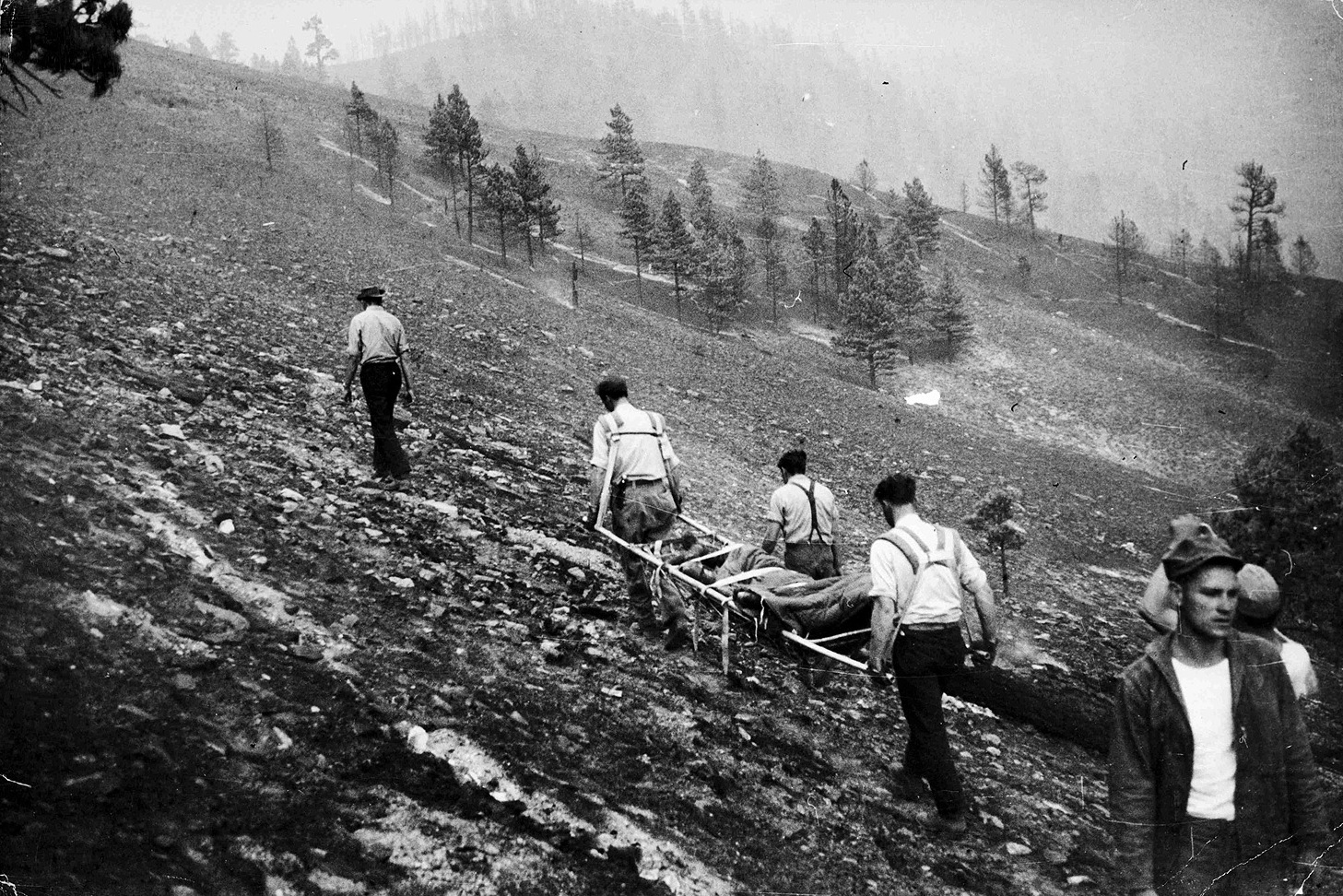
On August 5, 1949, lightning ignited a wildfire on a slope near Mann Gulch, a tributary of the Missouri River in western Montana. A team of 15 smokejumpers parachuted in to fight it. Their foreman’s name was Wagner Dodge.
It was a hot, dry summer, and on this windy day the fire blew up quickly. The firefighters began descending toward the Missouri River. Then the fire jumped from the ridgeline to the bottom of the hill, and the men found themselves trapped between flames chasing them uphill and a slope too steep to run.
The foreman, Dodge, struck a match to ignite the grass around them. He was setting an escape fire — an area free of fuel, a pocket of safety where they could lie in the smoldering ashes as the bigger fire burned around them. But his men, misunderstanding, ran uphill instead. They could not outrun the flames.
Montana author Norman Maclean, who as a teenager had worked for the U.S. Forest Service, wrote a nonfiction book about the tragedy: “Young Men and Fire” (though it’s not as well known as his novel “A River Runs Through It”).
Canadian singer-songwriter James Keelaghan tells the same story in 384 words. Taking a bit of artistic license that might fall outside journalistic rules, he tells it in the first-person voice of Dodge, the sole survivor.
The result is hauntingly, devastatingly good, a masterpiece of brevity. It has all the key narrative elements: character, scenes, dialogue, a narrative arc, and point of view. Listen to the song (I dare you not to cry) and this podcast of James Keelaghan talking about the songcraft. Then read his thoughts on songwriting in the annotation below, in which he shares tips and tools that can be used by narrative journalists.

By James Keelaghan
How did you arrive at the title? Do most song titles come to you at the beginning or end of the songwriting process?It comes from a description in Norman Maclean’s ‘Young Men and Fire’ about one of the survivors tending to another badly burned smokejumper at the top of Mann Gulch. He had no water to give the man — all he had was a can of potatoes, and the water the potatoes was packed in was briny. He said the night was tortuous, because at the foot of the valley ran the Missouri. He thought about how cool the water would be if he could only get some to his injured comrade. That image of the cold Missouri water inspired the title.
My name is Dodge. But then you know that
Why (and how) did you choose to begin the story song this way? Did it come to you immediately, on the first draft? Or did it take rounds of revision?It’s kind of a trad ballad standard. ‘My name is…’ You can find hundreds of examples. I’m comfortable with it as a form. I’m pretty sure it was the first line I wrote. I wanted the song to be in his voice, so I thought I should introduce him right off the bat. The second part of the line suggests that either the person he’s talking to is someone he knows, or that his name is well-known enough that he is known to the person who has come to visit him. Or that at least the person can read it off the medical chart.
They think I’m blind, that I can’t read it
But I’ve read it, every word, and every word it says is “death”
So, confession—is that the reason that you came?
Who is the ‘you’ in this scene? I’m imagining a priest. Was there one? Or is the ‘you’ directed at the listener?In my mind it was a priest. I honestly don’t know what Dodge’s religion was or whether he was a religious man, but it’s not out of the realm of possibility that a chaplain visited the dying in the hospital. There, too, it could be another forestry worker come to visit him, hoping that he would admit on his death bed that it was his actions that killed the rest of the crew.
Get it off my chest before I check out of the game
Since you mention it, well, there’s thirteen things I’ll name
Thirteen crosses high above the cold Missouri waters
You mentioned one reader who questioned the math — fifteen jumpers, thirteen crosses. Can you explain that riddle here, and how you decided to address it? (Also, wasn’t one of the crosses later replaced with a Star of David?)In 2001 one of the crosses, for David Navon, was replaced with a Star of David. Sixteen smoke jumpers left the base, but one of them got sick before they jumped, so only 15 smoke jumpers left the plane. They were joined by the ranger from the Merriweather Station, a man named Jim Harrison. That brought their numbers to 16 again. For reasons of narrative, I didn’t want to spare time in the song to explain that the ranger joined the group. Three survived: Dodge, Rumsee, and Sallee. There were 14 minus three casualties. That made me have to do a little sleight of hand in that last verse where I say ‘none but two survived.’ My literary fiction is that Dodge doesn’t count himself, just the other two crew members.
August ’49, West Montana
This verse has to establish a lot of backstory. And there’s always more backstory than appears in any story. How did you decide what to put in...and what to leave out?I was thinking of the structure of the verses this way: One verse to set up the story. One to get them onto the fire. One to have the fire blow up. One for the retreat. And one to sum up. I wrote the first verse in ultimas res (ed. note: starting at the end of the story, like in medias res but later) and wound up at the same place, obviously, at the end. Given a tight template like that, you quickly discover which things are simplest to explain and which take longer. This is why I approach the ‘story songs’ by retelling the story to anyone in my life who will listen. That telling and retelling helps to condense the story and focuses on telling it with as little explanation as possible. I had five verses to tell the story, because that’s what I had recorded with the band in the studio. When we went into the studio — to record a whole album, not just this song — I only had the full band for a few days. I had the first verse so I knew the chord progression, the melody, and the rhythm of the lyrics and the rhyme. I sang the same verse five times with the band and that was the audio template that I sang the final version into. Over the 10 days of recording I wrote the rest of the song — when things were slow for me in the studio.
The hottest day on record, the forest tinder-dry
Lightning strikes in the mountains
I was crew chief at the jump base; I prepared those boys to fly
At the drop zone C-47 comes in low
Feel the tap upon your leg that tells you to go
This seems like the kind of detail few people besides smokejumpers would know. How did you learn it?It was in Maclean’s ‘Young Men and Fire.’ I also came across it in Stephen Ambrose’s ‘Band of Brothers.’
See the circle of that fire down below
Fifteen of us dropped above the cold Missouri waters
I gauged the fire — I’d seen bigger
So I ordered them to sidehill and we’d fight it from below
We’d have our backs to that river
We’d have it licked by morning even if we took it slow
But the fire crowned, it jumped the valley just ahead
The words ‘sidehill’ and ‘crowned’ are active verbs and very specific to wildland firefighting. The uninitiated reader might not understand what it means, but you explain them in a subsequent clause. Were you consciously writing for two kinds of listeners?I wanted the actions of the firefighter to be intelligible to the listeners. A crown fire is a specific type of fire. It’s when the fire is burning in the tops of the trees. Anyone who has lived near a place where there are forest fires will undoubtedly have heard the term crown fire. Crown fires spread much more rapidly than a fire that’s burning on the ground because they can throw lit debris ahead and to the sides of the fire front. That type of fire begins to generate its own wind and carries the ‘torches’ in all directions, so the fire grows exponentially.
There was no way down; we headed for the ridge instead
Too big to fight it, we’d have to fight that slope instead
This is what I think of as a ‘defining moment,’ an internal realization that changes the outcome of the scene or story. Do you have another term for, or way of thinking of, this kind of narrative element? How do you ‘find’ it in a story with many dramatic moments?I haven’t thought of it like that before. I don’t have another term for it. It was a literal turning point. They can’t continue down the valley, so the only way out is up, and now it’s a literal race between the fire, the men, and the slope. The slope is going to try to defeat them in two ways. In order to get up the slope fast, side-hilling is out. It’s a straight assault on a very steep slope that in the best of times would wear you out, let alone trying to run it. Secondly the fire, when it hits that slope, is going to burn faster because of the angle of the slope. The landscape, the environment and time are conspiring against them.
Flames one step behind above the cold Missouri waters
Sky had turned red, the slope was boiling
Two hundred yards to safety, death was fifty yards behind
This is so specific (and arresting). How did you come to know this?In Maclean’s book there is a description of one of the men looking down the slope and describing the fire as coming up the canyon at X miles an hour and having a flame front X feet high. I imagined being near the top of that slope, the rocks at the top where you might have the chance of getting out of the fire’s way, hence the 200 yards to safety. But the fire is so close behind you that it’s going to be a near thing. I wanted to show the near impossibility of reaching that safe spot.
I struck a match to waist-high grass, running out of time
I vaguely recall reading somewhere that this may have been the first use of an ‘escape fire’ — an attempt to exhaust the fuel ahead of the wildfire and create a dead zone where firefighters could take refuge. Do you know if this is the case?It’s not likely that it was the first time, but possibly the first time it was recorded in official documents. Maclean himself mentions a passage in an old western novel where the main character does something similar. In Australia they scoff at the idea that it was the first time it was used, and they know a thing or two about fire. I think it’s just too dubious. What is for sure is that Dodge, at the board of inquiry would have described what he did and why he did it. Was it some piece of old lore that worked its way up from his subconscious, I don’t think we’ll ever know for sure.
Tried to tell them, step into this fire I’ve set
We can’t make it; this is the only chance you’ll get
This is what I’d consider in-scene dialogue. Is it external or internal?It’s equally effective either way, and kind of left to the reader to interpret. But I was wondering, as you wrote the song, whether he was screaming it in his head or aloud, at his crew. In my mind he’s screaming it at his crew. They either didn’t hear or misunderstood.
But they cursed me, ran for the rocks above instead
This line slays me, every time. It’s the pivotal moment, when they each make a choice that determines their fate. Again, what was your thought process of distilling such gravity and emotion into so few words?The whole situation they are in means they only have seconds to think. There is no room for a brooding internal dialogue. Those four lines cannot be wasted. He has to light the fire, give the shortest explanation, not get the message through, and then make his own decision. The whole thing happened in moments. I could see taking a whole verse to explain it. It wouldn’t suit the immediacy.
I lay face down and prayed above the cold Missouri waters
And when I rose, like the phoenix,
In that world reduced to ashes, there were none but two survived
I stayed that night, and one day after.
Carried bodies to the river, wondering how I’d stayed alive.
Thirteen Stations of the Cross to mark their fall.
I’ve had my say; I’ll confess to nothing more.
And I’ll join them now, those that left me long before.
This is an effective dénouement to the narrative. But technically, he didn’t die just then. What did the rest of his life look like? When and how did he die?In fact, he does die just then. Dodge did not go into hospital and was not injured at all in the Mann Gulch fire. He died five years after the fire, of Hodgkins Lymphoma. He was 38 years old. This song is indeed him speaking from his deathbed — but it’s five years after the fire.
Thirteen crosses high above the cold Missouri waters.
Thirteen crosses high above the cold Missouri shore.
You stood near this spot once, as a teenager on a backpacking trip. What was it like then? And what is it like now, remembering that moment, when you were young and probably never imagined you’d write this song?It’s a place that inspires silence. It’s wild, it’s rugged. But as a kid I don’t think I was in their heads. That had to come later.
***
Kim Cross is a New York Times best-selling author of What Stands in a Storm and In Light of All Darkness. She teaches feature writing for Harvard Extension School’s master’s program in journalism, The Larry McMurtry Literary Center in Texas, and the Sawtooth Writing Retreat in Idaho. Find her at @kimcross, on a mountain bike, or in a trout stream.
Subscribe to Storyboard
Get insights into the craft of journalism and storytelling in your inbox, delivered on Fridays.