For a journalist, Elliott Smith could seem like a subject as seductive as he was elusive.
Smith was a brilliant singer-songwriter whose lyrics are, by turns, lyrical, dryly funny and shattering. But his life — with its thicket of nuances and quotidian details that add up to something bigger — can be overshadowed by the looming myth of the tortured artist, an image of Smith that’s only grown since his tragic death in 2003.
Journalist Jamie Fisher worked for years on her new biography of Smith, “Nobody Broke Your Heart: An Intimate Biography of Elliott Smith,” which is both a lengthy dive into Smith’s life and a work that renders him refreshingly human-sized without diminishing his art.
Fisher is no stranger to capturing music, as readers can see in her profile of composer Nicholas Britell, covered here in Nieman Storyboard. But this was a challenge in a very different key, encompassing years of work that included 140 interviews.
The resulting book has drawn praise from publications across the country, including Smith’s home state of Texas and adopted hometown of Portland, Ore. Booklist’s review says, “Fisher achieves the rarest feat in music biography; she conjures Smith’s presence rather than merely mourning his absence.”
“Nobody Broke Your Heart” is striking when describing Smith’s music; of “Angeles,” Fisher writes, “[t’s] biting but so beautiful you can find yourself listening to it over and over, like a moth dashing itself against a light.” But it’s equally vivid when sketching the family, friends, musicians and others who found themselves spinning in Smith’s orbit, often revealing their own personalities and quirks rather than using them merely to dutifully provide quotes. (One such profile reveals that a future music-label founder was sent to chaperone his sister to a punk-rock show; he fell so deeply into the scene he dropped out of school months later.)
“I’ve sometimes described the book as a long-ish biography of one person but a fairly economical biography of 40,” Fisher told me.
Fisher agreed to annotate an excerpt from the book for Nieman Storyboard. Her answers have been edited for length and clarity.
‘Nobody Broke Your Heart’
Chapter 11: ‘Go By’
By Jamie Fisher
Published August 2026 (Dutton)
The first time Béatrice saw Elliott was in November 1998, at La Cigale in Paris. It was one of the first concerts she had ever attended. “I never had much money, and I never went out much,” she says. She was twenty-eight. Trevor Pyle: How did the idea for this book come to you, and how did it get off the ground?Jamie Fisher: It was the pandemic, I was in New York City during the thick of it, and I really had nothing but empty time in the afternoons. I’d walk around the park to clear my head, listening to music, and increasingly I found myself listening to Elliott. His songs attract that sort of concentrated attention; they reward repeat listening, and they reward deep listening, in a way that’s rare in popular music. So it was sort of like being stuck on a desert island with a single text and reading as deep as I could.
From there, the short answer is that I became interested in learning more about his life and the way he worked and realized how little was out there. His family hadn’t spoken with biographers. Most of his friends, collaborators, and significant others hadn’t either. And as someone who’s been working as a fact-checker now for ten years, I suddenly became aware that I had the tools to do this, and the sustained interest and patience a task like this would require.
Because Elliott doesn’t have a print archive, you really need to rely on oral history if you want to write meaningfully about his life. I spoke with 140 people in the end, and a lot of the process was trying to find them, but just as much was waiting for them to be ready and helping them feel comfortable. There’s nothing about Elliott’s relationship with the media that would have made them feel confident in the process.
I’m very grateful to Dutton for taking the book on, and with as much enthusiasm as they did, because for a long time it seemed like it would be impossible to sell a biography of Elliott. One agent suggested it should be a podcast. Another told me there simply wasn’t enough to write about and I should consider writing a long article.
From childhood, she was quiet and very shy, taking the world in. As an adult, living in Paris, she would listen to the radio and tape pieces of songs, bits of news — “a perfume but made of sound,” she says, some bottled essence. Since Elliott Smith is no longer with us, it’s necessary to meet him through people who knew him. But you don’t just treat these people as bridges to learn more about a musician … they often get small, vivid biographies. How deliberate was that approach, and why did you take it?I really appreciate the way you put this! Yes, it was entirely deliberate. I had been reading biographies and thinking about what happens to the people who aren’t the central subject — how a biographer might talk for three hours to someone’s lover and ultimately share a single sentence, or reduce people generally to talking heads. And I thought that was a very limited way to look at the world. We don’t exist in isolation; we are the people we love, and even the people we tolerate at the edges of our lives. I’ve sometimes described the book as a long-ish biography of one person but a fairly economical biography of 40.
More broadly, the kind of longform journalism I’ve always admired — I think about work by people like Rachel Aviv, or Patrick Radden Keefe — takes the time to build small, vivid portraits. Overall I borrowed from some of the conventions of magazine profile-writing to build reported scenes that animated the book and kept it flowing. It’s easy to write biography as facts on a page. I wanted to take readers into a world.
That was when she heard “Say Yes” for the first time, in the spring of 1998. She bought “XO” when it came out, the other records soon after. “I remember ‘Christian Brothers’ was the song that really did me in,” she says. When she heard it, she laughed, like a scientist making a discovery. “It was the perfect song,” she says, “at least for me.” Time and time again, you recreate people hearing Smith’s music and their striking reactions to particular songs or moments. What was it like listening to these songs through their ears? Did it change your feelings toward Smith’s music?Something I was aware of going in is how often we write about the past as though certain aspects of it were inevitable, whether we’re considering a tragedy or the reception of an album. As much as I could I wanted to try to occupy the time I was writing about. And as a writer I think I’m naturally just very curious about the different ways we take the world in and interpret it. That’s one of the broader themes of the book, how so many perspectives can collide and intersect.
I wanted the music to feel fresh, to help the reader approach it with new ears. And I wanted to capture, through these little moments, some of what makes Elliott’s music so enduring for millions of people, because there may be common elements but if you ask someone why they listen, you’ll always get a different story.
Some of my favorite conversations were with drummers, because their perspective was always so unique (it’s possible I just spoke with particularly creative drummers). Scott McPherson, who played in the ‘Figure 8’ touring band, compared Elliott’s earliest solo work to a typewriter where certain keys were missing, because his percussion toolkit was so limited, and it made me think about those songs in a completely different way. And Glenn Kotche of Wilco told me he always personally ranked Elliott as one of the great drummers, someone who played to serve the song as much as (songwriter) Mo Ryan did. It’s an underappreciated aspect of his musicianship, his drumming.
In April of 1999, Béatrice took a train to see Elliott play in Bourges, a late stop on his European tour. “It was fairly spontaneous,” she says. “I’m not a very spontaneous person, but here you go.” In Bourges, she made friends with François, a superfan who planned to see him in Paris. Elliott Smith is a musician who still inspires fervor, debate and exploration among his fans. What were your feelings pursuing a biography of someone who has been — and will continue to be — obsessed over to the degree he is?Oh it was nerve-wracking! Much more so with the parts of his life that were relatively well documented, like his experience on the Oscars. I worried I wouldn’t be able to contribute meaningfully to that chapter in particular, but in the end I spoke to enough people that I was able to find new angles, ways to tell the story that didn’t feel rote. I never wanted anything in the book to feel like something you could have gotten from a Wikipedia page.
And of course the other thing that comes with obsession is knowing that anything you say will be hyper-analyzed. I tried not to think too much about what the Internet would say and focus instead on writing the book I thought I needed to write, something that reflected the person I’d found and the many people in his life. Anything else would have been dishonest.
In Paris, he offered to drive her to the next show, in Ghent. It seemed like a bit much, but the ticket was free, and she accepted.
While she was waiting after the show for her ride home, Elliott recognized her from the week before in Bourges. He still remembered her name. They talked as people lined up for autographs, even though she felt uninteresting, with nothing really to say. “Ultimately, I thought that I’d give him something back, something like his songs,” she says. She had just started to read books in English and tentatively translate them into French, and write English poetry of her own. She took out one of the notebooks she carried with her, full of poems, and tried to copy one down, standing in the wind. Eventually, she just tore out the page and gave it to him. I’m struck by the intimacy of the memories people shared with you. Were these always on the surface, or did you have any approaches to eliciting them?Oh gosh, it really varied! With someone like Béatrice or Rose Melberg or Tammy Watson, the memories were very tender and close to the surface, and they came easily. With conversations like those, I just tried to listen as much as I could and drink everything in. Béatrice in particular was very generous with her time, and she has a novelist’s eye for detail. The excerpt here was distilled down from several years of correspondence with her, along with pages of her poetry; there was an abundance, and I put off writing this chapter as long as I could because I wanted so badly to do it justice.
With someone like (Smith’s high school friend and collaborator) Garrick Duckler, his memory of the eighties and nineties was really prodigious, and essential to the book, but they were also colored by loss and sometimes bitterness, and as we talked, his own understanding of the past began to change. Sometimes he would tell me the same story again months or years later, and the valence was entirely different. We talked about that, we both found it interesting. (I think unsurprisingly, since Garrick is a psychoanalyst.)
Then there were people in Elliott’s life whose memories had been profoundly affected by grief and anger, and it took a long time for us to move past the knowledge of what came later and salvage some of the softer memories. Because the hard memories are just as true, it’s just that they aren’t the whole spectrum. Sometimes I had to piece together what those relationships would have felt like at the time, like a fossil reconstruction, based on conversations with other people, or photographs and recordings that documented a kind of intimacy people weren’t able or willing to revisit. I made a note to myself at one point a couple years in: I feel like I’m excavating past the bitterness sometimes.
We talked earlier about building small, vivid portraits, and some people didn’t want that, for any number of reasons. (Musician and onetime romantic partner) Joanna Bolme, for example, was very private when it came to her own story and her internal world, and I wanted to respect that, even as we talked several times about her memories of Elliott. She shared what she felt comfortable with.
And of course because it’s been so long, there are also people who wanted badly to remember more than they did and couldn’t. His sister Ashley Welch wishes her memories were clearer. What’s stayed with her predominantly are emotions, how she felt at different times in her life, and I would ask other people who were around if there were memories they had of Elliott and Ashley. Some of them surprised her.
Something Béatrice and I often talked about is how much it matters to talk with everyone you can, not just the more prominent tentpoles in Elliott’s life. The intimacy of Béatrice’s memories is a good case study in this: she was only there for a snatch of time, but her eyes were so wide, and they took in so much. You can learn something from everyone, even people who knew Elliott briefly.
Later he told her that his first thought was that she might have left her number there, and that his second thought was fear that the poem might be bad. “And then he felt bad for thinking that,” Béatrice says, with a little laugh.
He explained that he had to go, started to walk away, and then asked if he could kiss her. Then he placed a soft kiss on her cheek. “I think everyone was surprised, including himself,” she says. “It was just a very gentle gesture, unexpected, from a human being to another human being. It felt protective, even as he knew absolutely nothing about me.” I have seen you, the kiss said. In this sentence, did Béatrice reach the ‘I have seen you’ conclusion, or did you draw it from all you learned?That’s all Béatrice. I tried hard never to put words in anyone’s mouth. I tried not to get inside Elliott’s head, either, unless I knew for a fact that he had been thinking or feeling a certain way in that moment.
And that should have been the end of things. But François followed Elliott to London, and at a party there, Elliott asked him for Béatrice’s number. Then he bought a ticket for the Eurostar back to Paris. The tour had just ended; Jackie remembers encouraging him to do it. “I knew he liked her, but he needed a pep talk,” she says. “He could be shy.” Everyone on the tour bus had been gently teasing him. “Wow, a sign of life!” Sam joked. Elliott called Béatrice from the train, already on his way there. “He jumped straight in, not even knowing whether or not I would be able to meet him,” she says. “Rash is the word he used to describe it, with the famous Elliott grin.”
There were a few people in Elliott’s life who have never talked to biographers and didn’t break that trend with me. One of them is the musician Sam Coomes, who was one of Elliott’s closest friends. So he shows up in little moments like this, traded down a line: a memory Elliott shared with Béatrice, who shared it with me.
Neither of them was prepared, or had any expectations. “The thing was that I was living with someone,” Béatrice says. She was a little baffled but curious. “So we met, and we just went to a bar, then another that first night. We talked until the bars closed, and that’s when he asked, ‘Are you busy tomorrow?’ ” He was supposed to stay for three days. He stayed for two weeks.
They lived ordinary lives then, walking through the city, returning library books, sitting at cafés; she remembers him wiping all the butter off a tartine with a paper napkin. Walking up the ramps in Montmartre, slick with rain, he tripped and dropped his crepe. “One of the small disasters,” he told her, smiling, rueful. They went to see Rufus Wainwright, and he became part of their shared vocabulary, a running joke. At bars, when they were tired of talking, when the noise was too much, they would sit together writing sentences back and forth. She calls them “written conversations.” Once they were batting words back and forth — crepe, coconut, pidgin, pigeon — and Elliott suddenly wrote, I will not repeat my mistake. She never knew what the mistake was. She never asked.
So many human moments here! The dropped crepe, the butter scraped off the tartine (Béatrice was appalled!), the image of the two of them just sitting silently writing in the bar, trading words, and then the mystery of that line… These were the sorts of memories I loved to hear, because they captured something we’d never seen. It’s much easier to write about Elliott as an idea than as a person.
More than anything, there was language. They played with words, came up with secret codes — creating a whole universe, she wrote in a poem later, with its lingo and its rules / within the span of a few days. “We also had different names for each other, like kids,” she says. He was Henry and Hank and h; she was Frankie and Fran and Francis. He loved talking about Quasi, writing down all their lyrics for her. He knew each song by heart. “He really looked up to Sam,” she says. “Elliott talked a lot about him.”
She played with images and sounds, making him laugh. They came up with a man for all seasons — “the spring fella,” Elliott proposed, “the summer hombre,” and then Béatrice suggested “the fall guy,” and he started giggling. “I didn’t even know it was an actual expression,” she says. “It had him laughing for five minutes straight.”
He showed her the lyrics to “Stickman,” in the notebook he carried with him everywhere, and as dark as the song is, he was smiling when he did it, pleased with the list of colors and emotions in one stanza: “lonely makes me blue / envy turns me green.” Between his early bands, solo career and bootlegs, Elliott Smith was incredibly prolific. Did you have a system for keeping track of his music and lyrics to draw on?Yes, haha. The phase of the book where he’s simultaneously making solo music and releasing albums with Heatmiser was a logistical challenge for me, leaving room to talk about the composition and release of multiple albums per chapter and putting together a thoughtful analysis…
Besides my interview files and files where I kept notes on structural ideas for particular chapters, I also kept a file for every one of Elliott’s albums, making notes on the music and lyrics. Because I had come in with more knowledge than the typical fan has, and because I’d kept up with what had been written about his work before, in the press and in various books, I tried to prioritize new information (like draft lyrics or demos I had access to) or an analytical perspective I hadn’t seen before. But I also wanted the book to feel inviting to readers who didn’t know anything about Elliott going in.
So it was a line I walked, wanting the way I wrote about his music to feel accessible, but not wanting his more involved fans to feel like they were getting a rehash of what they already knew. Some of that comes down to language, and refusing to use more academic terms: I can tell you that ‘Waltz #1’ is in Lydian mode, but I don’t think that tells you anything about how the song feels, or what the lyrics do. I wanted to capture a feeling.
At its earliest stages this was going to be a book that explored Elliott’s life through themes in his lyrics. So there was an outline I had with a chapter called ‘Pitseleh’ about his relationships. Once his family and people like Neil Gust and Joanna Bolme began speaking with me, I knew I had an obligation to make something broader, because it wasn’t at all clear that this kind of access would be possible again. But the bedrock of it was always that I had spent quite a long time thinking about his lyrics, particular words and wordplay, literary devices that he developed and authors who influenced him, from Freud to Dostoevsky, and I thought there was a lot that hadn’t been said. Lyrics aren’t poems, but so much can be gained by treating them with that kind of attention and care.
“Music was his voice, but words really attracted him,” she says. Every day, they would sit in the park or at the bar and read a short story together. “When he read my poems — and he did read them all, one by one, evening after evening — sometimes he’d pause and say a word or a sentence out loud, like something he’d taste,” she says. “That was at the root of the best moments we had, playing with words.” He’s still the only person who’s read them all. In the poems she wrote about their time together, years later, she calls out words from their games like a litany, a spell: superman, the fall guy, the green game, moonriver. It was a joke, the way she would ask him to sing that song, how he would ask her back and she would always refuse, and then it wasn’t really a joke at all anymore, shorthand for I love you and other words they couldn’t say. Sometimes he ended his emails with Moonriver.
She remembers the way he would slowly roll his head in the morning to wake up, the little patterns in the way he talked, his gestures. How important it was for him to talk about his dreams — games of pool played with her boyfriend, worries that he would beat Elliott up, all vividly recounted. She remembers him taking off his coat to shelter her on a rainy day, and when she protested that he would have nothing on, he said, “Well, I’m not running around naked, am I?” and she laughed. He said he felt alive. He bought her roses every night.
They read a book of short stories by Mike McCormack, picking a new story every day. “He noticed I was always skipping one, and it was called ‘The Terms,’” she says. “I told him maybe he wouldn’t like it, so of course he read it, and I remember he was quiet for a long time, and he said, ‘It’s like Charlie and me.’ ” Whenever he talked about his childhood with her, it all seemed so fresh. “It’s like those Texas years were constantly playing in his mind,” she says. “That was a constant, constant hum behind everything he did.” One striking aspect of this book, which this paragraph refers to, is Smith’s difficult childhood in Texas. It’s something he talked about and referred to, but what kind of reporting did it take to uncover details to portray that fraught period in his life?Everything about Elliott’s early life was under a veil. He talked about his time in Texas with a deliberate vagueness — he did want people to know the emotional truth of it, how it felt for him, but he talked very little about the specifics publicly.
I spoke with both sides of his family about what they remembered from that time, with childhood friends who were present, and with people who knew Elliott throughout his life and remembered the way he talked about those years with them, because that did change with time. He was verbally and physically abused by his stepfather, Charlie Welch, which Charlie later acknowledged and apologized for in a letter around 1998. But as Elliott got older he started to talk about memories of sexual abuse he wasn’t sure existed, and which Charlie has always denied.
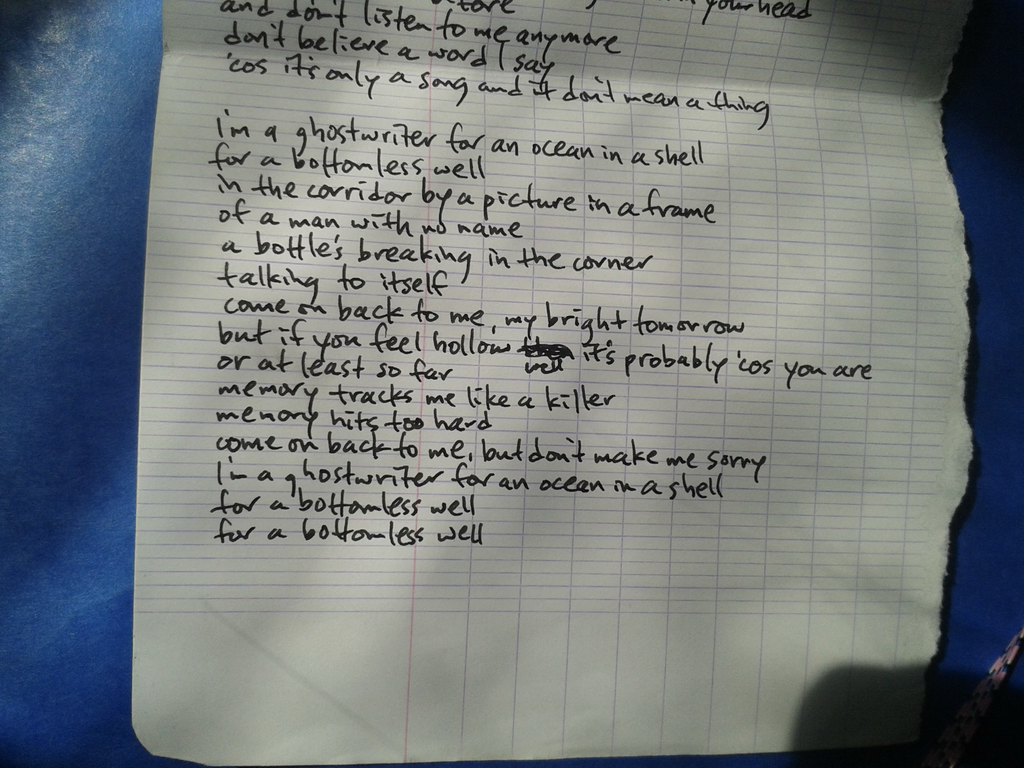
This caused Elliott a lot of internal torment, trying to understand whether he could trust himself, and it’s something that he worked out in published songs (something like ‘Needle in the Hay’: ‘you say you know what he did / but you idiot kid / you don’t have a clue’) and in draft lyrics and unreleased recordings, like ‘A Silver Chain.’ One of the sadder documents I had was a page of lyrics from the last few years of his life, written on the back of a sheet with instructions for self-hypnosis. He was trying to see if there were memories he had buried and could coax back, something that could help him resolve the question for himself one way or another.
The chapter on his childhood is the first chapter of the book, and it was written last. I wanted to understand as much as I could about that part of his life before writing about it, and sometimes the more revealing conversations only came late in the process. I wanted to come to a decision about how much to share, the distinction between dutiful reporting and gratuitous detail, and I also didn’t want to pretend to know things I didn’t. That was important to me throughout the book.
He talked about feeling ugly, said that Charlie had made fun of his face and he could never let it go. Béatrice doesn’t know why he was so convinced it was true. “I’ve never seen someone with such a changing face,” she says. “He was extremely expressive, and he changed from moment to moment, like an actor.” On his second day in Paris, he said, “I tried to wash my hair for you, but then it looked funny.” “It’s still in my ears, that sentence,” she says. “It made me sad.” She would tease him gently — “I think you’ve got very pretty ears,” she told him one night, and he smiled. “In the end,” she says, “to make him understand, I just told him, ‘I like to look at you.’” How did you learn about Béatrice and her role in Smith’s life — and vice versa? What was the process of meeting and learning from her like?I think the first time I’d learned about her was a Reddit post that mentioned Elliott’s ‘Paris girlfriend,’ the inspiration for ‘Place Pigalle,’ having a public Facebook page. I read the poems she’d posted there and looked through the photographs she’d shared — pages from his notebook, a spaceship he’d folded for her, silly doodles and notes they’d written on receipts and Rufus Wainwright ticket stubs. And I knew from those artifacts and from the details she shared in those poems that she was real, that she really had known him, and I sent her a message. At that point I didn’t even know her name.
We corresponded for two years over email, talking about Elliott and the process of writing the book and about our lives, and finally I was able to visit her in Paris, in Place Pigalle, where she’d met Elliott. We didn’t know until the last minute whether the meeting could happen because she’s still with the partner she was seeing when she was dating Elliott and certain things are delicate. But since I was visiting the UK anyway, I thought I’d book the flight. While I was there I visited some of the small landmarks in Place Pigalle that Béatrice had described to me, certain bars and venues and the street lined with guitar shops where Elliott bought a new acoustic twenty-five years before and started to write.
I talk at the end of this chapter about that meeting, the experience of finally speaking with her in person. But it was a fascinating thing, talking with someone after years of knowing their voice only in writing. A little like meeting your favorite musician in person — there’s an intimacy you have, but the intimacy is in another medium. But there they are, talking instead of singing.
Béatrice was a student of Elliott’s life as much as I was, and it felt like we were investigating together; she’d just been at it a lot longer than me, and there was so much I was able to learn from her. She would prod me with questions and I’d have questions for her back. It was a give and take. I think broadly I considered everyone I talked to as a collaborator. We were all trying to figure out the puzzle of this tremendously gifted and complex person, twenty years on.
He had come to Paris without a guitar, and went to a street lined with guitar shops and bought a Yamaha. He wrote “Place Pigalle” a few days after they met. One night, he slid his notebook across the table so she could read it. A look — you know, it’s killed many men / and I’ve been all of them / inside a week. She didn’t know what to say. “A bit at a loss for words, almost embarrassed,” she says. “I do remember joking that I had never killed anyone.”
There were a few moments like this when I got to hear how famously romantic lines like this affected the people they were about. Joanna Bolme told me about hearing ‘Say Yes’; JJ Gonson told me about realizing she had inspired at least part of ‘Pitseleh’; Amity told me, of course, about ‘Amity.’ None of them reacted quite like you’d think they would! I loved Béatrice’s reaction to that stanza.
He talked about recording in Paris, words she was careful not to believe, and then he said he was supposed to buy a place, that it could be anywhere. He wanted to take her with him to America, even as he conceded that she would probably hate it there. She had no passport; his face fell. He agonized. Would she wait for him? What should they do? for the first time i think a thin plume of faith then started to billow, she wrote. “we should have smothered it”
On his last day in Paris, he wrote out names and addresses and phone numbers in her notebook so she knew where to find him. She was quiet, wearing his coat. He wished she didn’t have a boyfriend, he said, and held her.
as long as you were standing here, and kept me in your arms,
and we could not let go — i believed you
because your eyes were shining
and because “last” could still mean two different things.
He copied down all her poems the night before he left.
***
Almost all of Elliott’s love songs touch on his belief that he wouldn’t be around very long. “Pitseleh” opens on an image of a boy staring down the barrel of a gun. In “Say Yes” he’s surprised to find himself around “the morning after,” and it’s a line about his fears of being discarded, but also his certainty that eventually he’d discard himself. The optimism in the song is fragile. “I don’t feel afraid to die,” he sings in “Lost and Found.” “She was here, passing by.” Then it fades into “Stupidity Tries.” How much did you listen to Smith’s music while working on this book?All the time. It was part of the soundtrack of my life already, listening to his songs on walks and runs, but now I was also working more methodically through the bootlegs than I had before as a casual listener; there were several hundred I had access to. You could learn a lot about his mood on particular nights, or hear passing mentions that clarified how songs had been written, or come across a lyric he was still working with, and you’d never know until you listened that you might find little secrets there. Kind of like a blind box.
The album files I mentioned earlier were on my phone, so if I heard a lyric in a new way while I was out on West 87th, I could stop in my tracks and write it down. I remember where I was when I understood ‘Tomorrow Tomorrow.’ I remember where I was when I realized that parts of ‘Can’t Make a Sound’ were about Béatrice. And I had another file where I just noted exchanges he had with the audience during shows, funny or sad or illuminating in some way. He wasn’t often comfortable in interviews, and there’s a looseness to the way he speaks onstage that’s special, a window into his full person.
There are love songs about love already lost, full of resignation and regret — “Waltz #1,” “I Didn’t Understand,” “Oh Well, Okay.” There’s “Clementine,” about a relationship the speaker worries is already over, that he’s the only one who doesn’t know it: “what if she thinks so but just didn’t say so?” “Waltz #2” is a different kind of love song, exhausted, brave, resolving to love someone he can never understand, even as he doesn’t know how much more of life he can take.
“Go By” is more than a love song, but the opening stanza — “spending all your time with some girl you’ll never get to know,” a white sail torn and drifting off, its promise to “leave you even if” — is about a kind of instability he took for granted. Then there’s “Place Pigalle,” with its delicately ventured wish: “he wants all the more to bring her away / out of this temporary half-holiday.”
In a way, love in the face of doubt and death and impermanence is the most moving kind of love there is. Even defeat in the face of it. What has the response to the book been so far, both among general readers and people who knew Elliott Smith?Overwhelmingly positive. I’m so amazed, this is my first book so I had no idea what to expect. You always hope readers will receive the work with the intention you brought to it, but once you’ve written something it’s entirely out of your hands! I’ve gotten so many messages from fans who told me this is the book they’ve been waiting for; from people who struggle with some of the same things Elliott struggled with and told me how much it meant for them, that they never felt judged; from people who have never gone through those struggles but felt, as one reader told me, they could feel their empathy ‘widen.’ That said, I really only read the messages people send to me because it seems like a bad idea to go trawling through Goodreads, haha.
A number of the people I spoke with for the book won’t read it anytime soon, and other people told me they probably won’t read it, because of how demanding the emotional toll would be or because of the strangeness of reading about yourself on the page. But my sources who have read it told me it’s meant a lot to them, and thanked me for doing it. They’ve seen a one-note version of Elliott presented to the world for decades now, and even if it’s impossible to fully convey a human being on the page, I tried to show as much as I could.
***
Trevor Pyle was a newspaper reporter in the Pacific Northwest for more than 20 years, and is a communications officer for a regional nonprofit.
Subscribe to Storyboard
Get insights into the craft of journalism and storytelling in your inbox, delivered on Fridays.