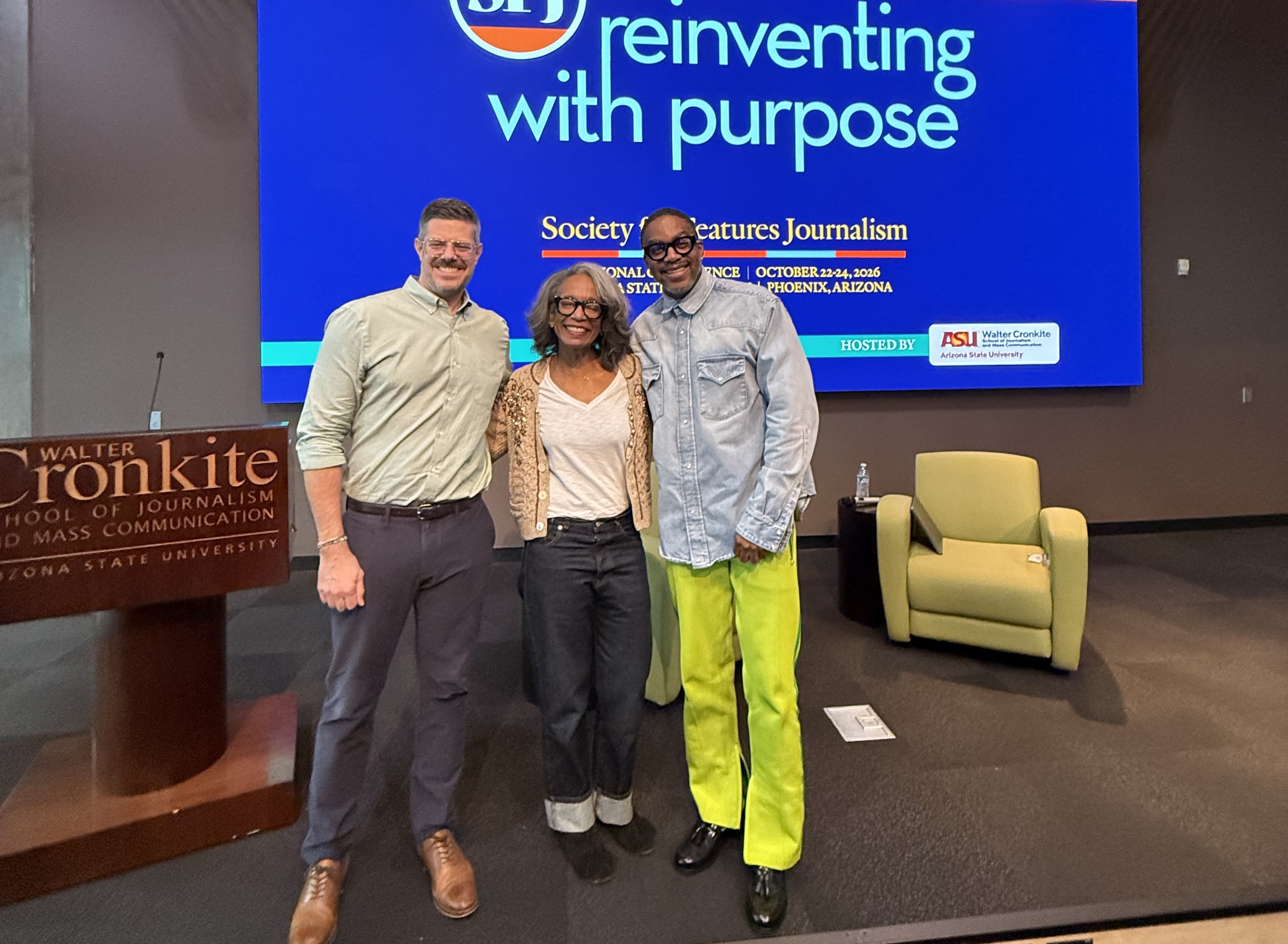
Before winning the Pulitzer Prize for Criticism in 2006 — the first and only time the prize has been awarded for fashion criticism — former Washington Post critic Robin Givhan says she began not as a style expert, but rather as a shy reporter who found confidence in the ultimate statement accessory: a notebook.
“I knew nothing about fashion,” she told an audience at the Society for Features Journalism conference in Phoenix, Ariz. “Having a notebook and being given a license to be a curious cat was heaven.”
This was encouraging for me to hear, as someone befuddled by haute couture and intimidated by the pace and flux of the fashion industry. A key insight from her talk: Any kind of criticism must be grounded in reporting.
“My editor told me, ‘Just report, don’t review,’” she said. The more she reported, the more she came to see fashion as a lens through which to examine culture, power, and personality in the heart of the nation’s capital.
“I think coverage of fashion really helps you see the world with greater nuance and clarity,” she said. “I think it helps you see people in greater detail.”
Givhan, now a contributor to publications including The New York Times, Vanity Fair, and Vogue, was inducted into the SFJ Hall of Fame during the October conference at Arizona State University’s Walter Cronkite School of Journalism and Mass Communication.
For her Pulitzer Prize win, the board praised her “witty, closely observed essays that transform fashion criticism into cultural criticism.” In one such essay, she famously dressed down Vice President Dick Cheney for his underdressed appearance at a gathering of world leaders to commemorate the 60th anniversary of the liberation of Auschwitz.
Surrounded by dignitaries dressed in formal funereal dress coats, the Vice President wore “the kind of attire one typically wears to operate a snow blower,” Givhan observed, noting that the weather was no excuse, given his attire at the previous week’s snowy inauguration in Washington, D.C., when he was sworn in wearing a proper overcoat and no hat.
Some might argue that Cheney was the only attendee with the smarts to dress for the cold and snowy weather. But sometimes, out of respect for the occasion, one must endure a little discomfort.
In another prize-winning essay, she nodded at Secretary of State Condoleezza Rice’s all-black ensemble and the power it projected as she greeted troops at Wiesbaden Army Airfield. Her calf-length coat, short skirt, and knee-length boots with an impractical heel made her look “as though she was prepared to talk tough, knock heads, and do a freeze-frame ‘Matrix’ jump kick if necessary.”
There is undeniable authority in her long black jacket with its severe details and menacing silhouette. The darkness lends and air of mystery and foreboding. Black is the color of intellectualism, of abstinence, of penitence. If there is any symbolism to be gleaned from Rice’s stark garments, it is that she is tough and focused enough for whatever task is at hand.
Givhan’s attention to telling details — the coat’s seven gold buttons and band collar, the dominatrix heel of the boots — reminds me of the “status details” Tom Wolfe described as a key element of The New Journalism. A man’s watch… a woman’s shoes… these carefully curated accoutrements say a lot about a person’s character.
And characters are the heart of feature writing.
“What features taught me is that no matter what the story is, it’s always about the people,” Givhan said. In Washington D.C., that means the people running our country.
Givhan has praised former first lady Michelle Obama’s “full-length, draped, shimmery yellow shirt dress with a pair of gold, holographic thigh-high boots” during a book-tour interview with Sarah Jessica Parker, who in contrast “looked like an elfin wallflower in an eggplant-colored sequined dress.”
She has also criticized the first lady for wearing casual shorts while descending Air Force One after a family trip to the Grand Canyon National Park.
“Ultimately, the first lady can’t be — nor should she be — just like everyone else,” she wrote. “Hers is a life of responsibilities and privileges. She gets the fancy jet. She has to dress for the ride.”
Givhan has also used fashion as a lens through which to see news events in an interesting way. She wrote about masks as “a source of reassurance, a weapon and a point of contention” in “The twin masks of protests and raids, fear and truth.” She described orphaned garments found in the wake of a natural disaster in “After the Texas flood, clothes that make a stranger cry for a neighbor.”
Fashion, she says, is a defining element of our culture that speaks to our societal values. If we can glean personality insights from asking “What’s on your summer reading list?” why not also ask, “What’s new in your closet?”
“Fashion helps us define what beauty looks like. It helps us define gender roles. It helps us define what wealth and status look like, and in doing so, it teaches us who and what we value,” Givhan said. “And if we’re not really looking at that critically, we sort of allow the algorithms to take over, and we’re not really making conscious, thoughtful decisions about who we elevate and why.”
During the Q&A, Givhan was asked to identify something she was currently wearing that said something about her.
She looked down at the copper-colored rhinestones and beads catching the light from her Sacai cardigan, and replied, “I love a few daytime sparkles.”
***
Kim Cross is a New York Times best-selling author of What Stands in a Storm and In Light of All Darkness. She teaches feature writing for Harvard Extension School’s master’s program in journalism, The Larry McMurtry Literary Center in Texas, and the Sawtooth Writing Retreat in Idaho. Find her at @kimhcross, on a mountain bike, or in a trout stream.
Subscribe to Storyboard
Get insights into the craft of journalism and storytelling in your inbox, delivered on Fridays.