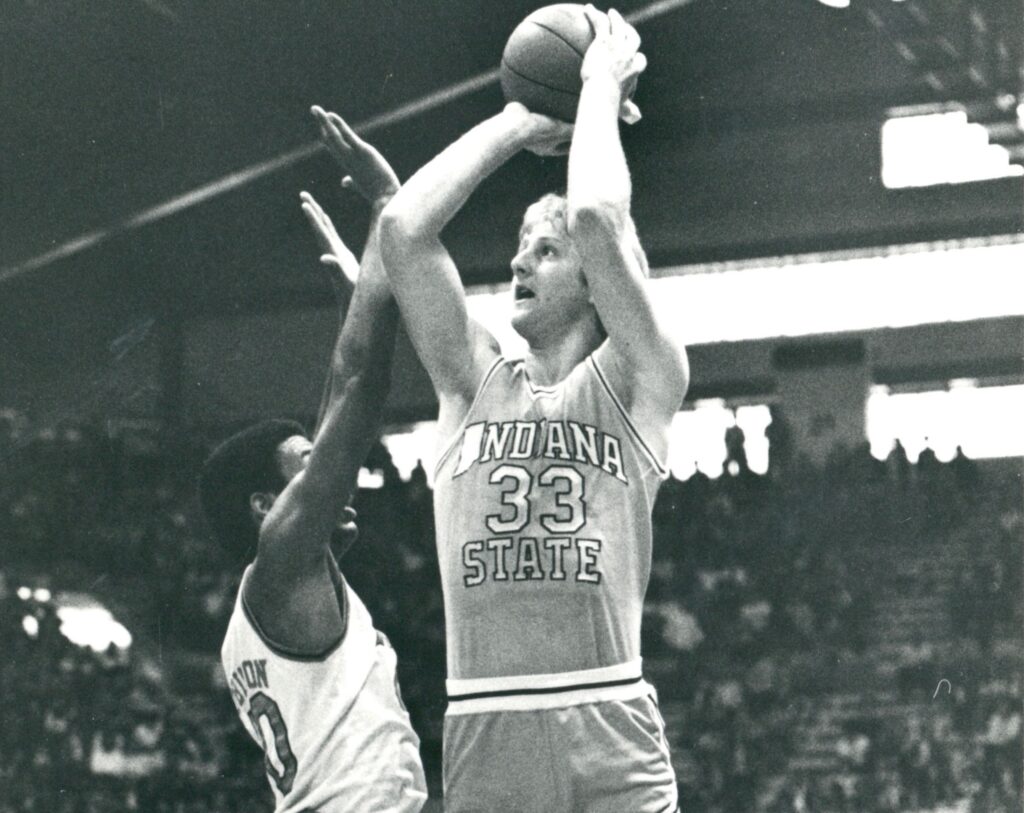
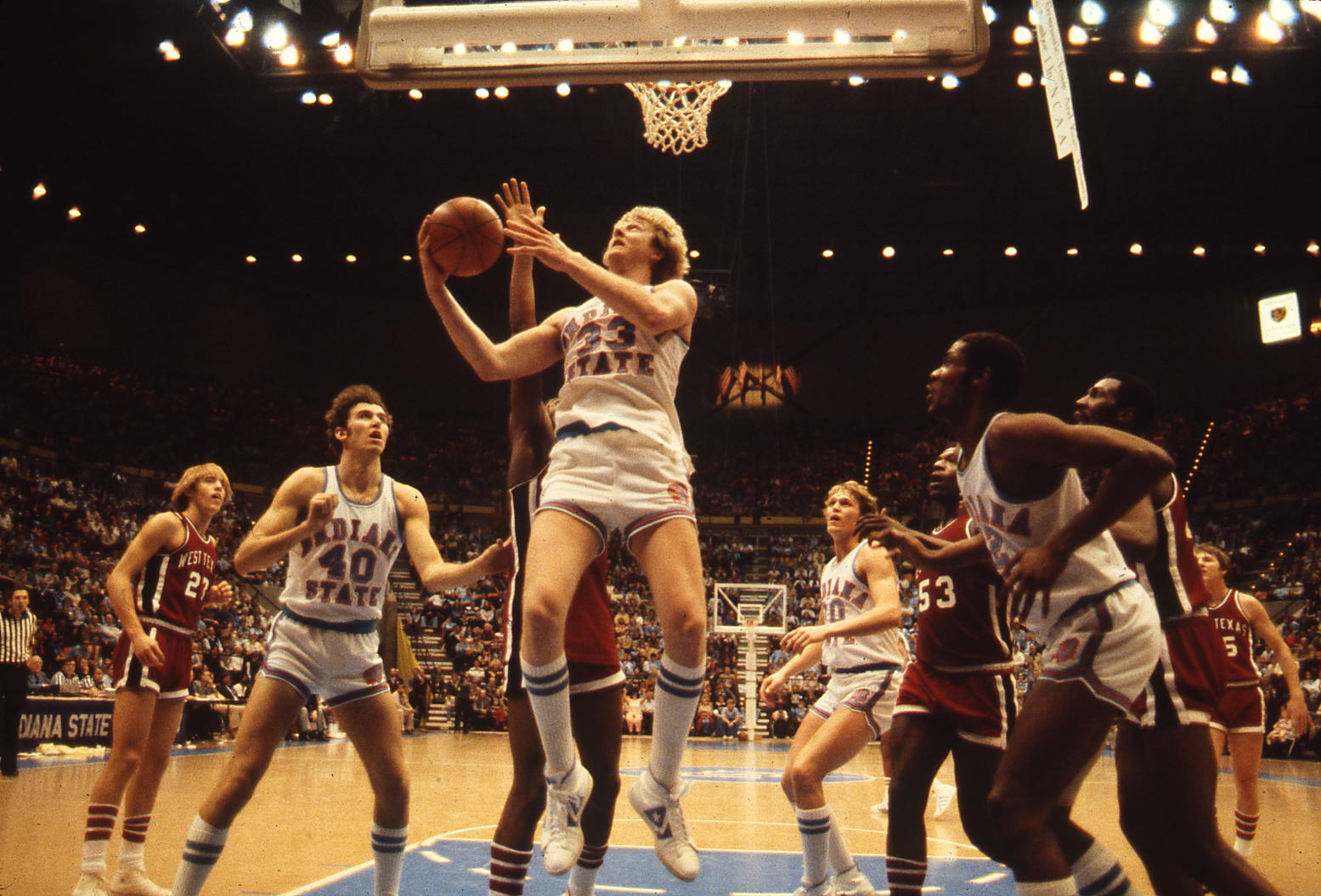
Larry Bird versus Magic Johnson. March 26, 1979. The NCAA Men’s National Championship was the final college game for the two rising basketball stars, and everyone in the country watched. The rivalry narrative built up over days leading up to the game, and it was quite a compelling one.
In reality, the men hardly knew each other, only meeting once before the game and barely speaking to one another. Author and journalist Keith O’Brien called this a “disingenuous narrative” and set out to tell the story in a different way: starting with the Boston Celtics legend’s origin story from high school to early college.
“When you change that perspective, what you get is a really, completely different story,” O’Brien said. “And maybe more important than that, you get a completely different cast of characters.”
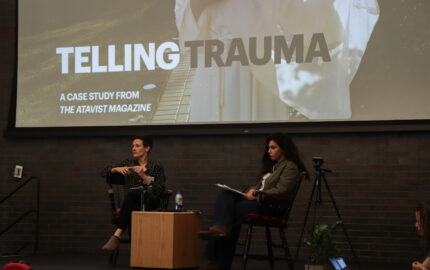
O’Brien, an award-winning author and journalist whose work has appeared in The New York Times Magazine, The Atlantic, and Rolling Stone, spoke at Boston University’s Power of Narrative conference in March about his bestselling book “Heartland” and shared lessons from his reporting process about the importance of showing up.
1. Investing in the story
At first, O’Brien tried to reach Bird through his agent. It was no surprise, though, that Bird did not want to participate; he is a notoriously private person, rarely doing interviews or projects unless he has some control over it. But — as Patrick Radden Keefe pointed out in his keynote earlier that day — access to the person centered in your story shouldn’t make or break the narrative.
O’Brien didn’t necessarily need Bird’s participation for the story. He wanted to tell a “compelling human narrative.” Perhaps Bird would have told a completely different story about those early years than the people around him that shaped his future career. To get those outside voices, he collected phone numbers and started calling around.
In the first few rounds, nobody answered him.
“I need to invest in the story,” O’Brien said. “If people aren’t calling me back, maybe what I need to do is just go to French Lick. And so that’s what I did: bought a plane ticket, got a rental car and booked a room at the Best Western on the edge of town. And then before I left with those numbers and those addresses that I knew were right, I reached out again … and it was then that people started getting back in touch with me.”
He interviewed Bird’s childhood best friends, mentors, and family friends, meeting them everywhere from the local McDonald’s to people’s kitchens. O’Brien’s decision to travel to French Lick was pivotal for his story, gaining the trust and respect from residents who wouldn’t otherwise bother to return his phone calls.
2. Interviewing every witness to a scene
Reporting on scenes that you didn’t witness firsthand can require a lot of research and specific type of reporting and interviewing. O’Brien makes it a point to talk to every person who was in the scene he wants to write about. If he knows that five people were in the room, he will speak to every person who was there, even if they don’t ultimately end up in the story.
Since he reported on events between 1973 and 1979, he understood memories can erode over time or someone could have a clear memory of events that never happened. That is precisely why he talks to every witness: to get the fullest sense of the truth in the commonalities.
“If you talk to all five people, you’re going to get different details, different memories, and somewhere in the overlap of those memories, you know the truth likely resides,” he said.
For this story, he had to track down witnesses and relied on relationships he already built in town to access those people. In one instance, he was trying to track down one of the owners of a bar that Bird’s father, Joey Bird, frequented in the 1970s. The bar was long gone, but the owner could often be found in the town’s American Legion Bar.
O’Brien stepped into the bar on a weekday afternoon and 40 pairs of eyes turned to him straight away. He had to introduce himself and his intentions immediately.
“There was no slow rolling this: sit down quietly at the bar, order a drink, start to mingle. Between the door and the bar, I’m almost defensively saying who I am and why I’m here,” he said. “Within a couple minutes, everybody wanted to talk to me.”
The person O’Brien wanted to reach was not there, but he got in touch with him through the phone behind the bar and interviewed him right then and there.
3. Searching physical records
One of the important figures in Bird’s life that O’Brien identified was his father. Joey Bird was a well-known person in town but struggled a lot; a few months after his son graduated high school, he took his own life.
O’Brien heard that his long battle with drinking came as a result of his time in the military during World War II and the Korean War. But he had to verify the claims himself. It took months to find the eldest Bird’s military records, and O’Brien said he learned a lot about Joey and Larry Bird in these records that he likely couldn’t find anywhere else.
He learned that Joey Bird enlisted in the Navy for World War II at 17 years old with a seventh grade education. He was a messman who likely didn’t go into battle and got in trouble for going AWOL during basic training and drinking on a ship. But he did see fighting a few years later in Korea, where he was an Army soldier and engaged in combat during one of the bloodiest battles of the conflict.
“Joey Bird has seen things and maybe done things that would shape him later,” O’Brien said. “I’ve learned something about my subject from these records. I’ve learned something that I think my subject himself might not even know about his own father. All of this is informative to my narrative.”
Once O’Brien was in French Lick, he stopped at the public library frequently, going through town records, yearbooks, and newspaper clippings. O’Brien said there are records in libraries that can’t be found anywhere else — not through interviews and not online. In the French Lick library, there was an entire section dedicated to Larry Bird.
The library’s records went as far back as when Joey Bird was growing up and in the war. He was looking for letters or notes soldiers often submitted at the time. Just when O’Brien’s patience was waning after looking in the archives for hours upon hours, he finally found something in March 1951.
“This wasn’t a note in a little notes column, it was on the front page, and it was a first person account that Joey Bird had written back to home about that winter in Korea. I mean, an incredible thing, right?” he said. “Libraries are critical to the work that we do.”
4. Risking time and resources for important material
O’Brien had embedded himself in the small town of French Lick (population: 2,000), interviewing multiple people every day and becoming a regular at the American Legion Bar. But there was one person he still couldn’t get a hold of who was essential for the story: Bird’s high school coach, Jim Jones.
Jones coached most young basketball players in town during the ’60s and ’70s. He taught Bird how to hold a basketball and shoot layups. He would come to Bird’s home to wake him up and take him to practice before school. “Were it not for Jim Jones, Larry Bird … might not have become the person he became,” O’Brien said.
In the weeks he was in French Lick, he could not get a hold of Jones. He thought about taking a gamble during the final days of his trip: Should he drive to Jones’s home an hour outside of French Lick and risk losing time if he didn’t answer? O’Brien believed Jones was so crucial for the story, he decided to make the drive.
He pulled into Jones’s driveway, prepared with a handwritten note card in case no one was home, and was relieved when he saw cars in the driveway. He knocked on the door and his wife answered. After a few moments, Jones came to the door and wordlessly let O’Brien through.
They talked for the next three hours in Jones’s kitchen about Larry Bird and the 1970s. When O’Brien thought they were finishing up, Jones showed him a custom Larry Bird championship-style ring and a letter from Bird to Jones, thanking him for all he’d done.
“I knew two things for certain,” O’Brien said. “First was, I had this story, whether Larry Bird was talking to me or not. I had it. And number two, I knew that I was not a stranger in this place anymore. I belonged here.”
***
Emilia Wisniewski is a general assignment reporter and engagement editor at the Concord Monitor in New Hampshire. She previously worked at Boston.com and The Boston Globe as a correspondent where she covered local politics, business, health, and environment.
Subscribe to Storyboard
Get insights into the craft of journalism and storytelling in your inbox, delivered on Fridays.