Sign up for the Nieman Storyboard newsletter, delivered every Friday in your inbox.
***
Dear Storyboard community:
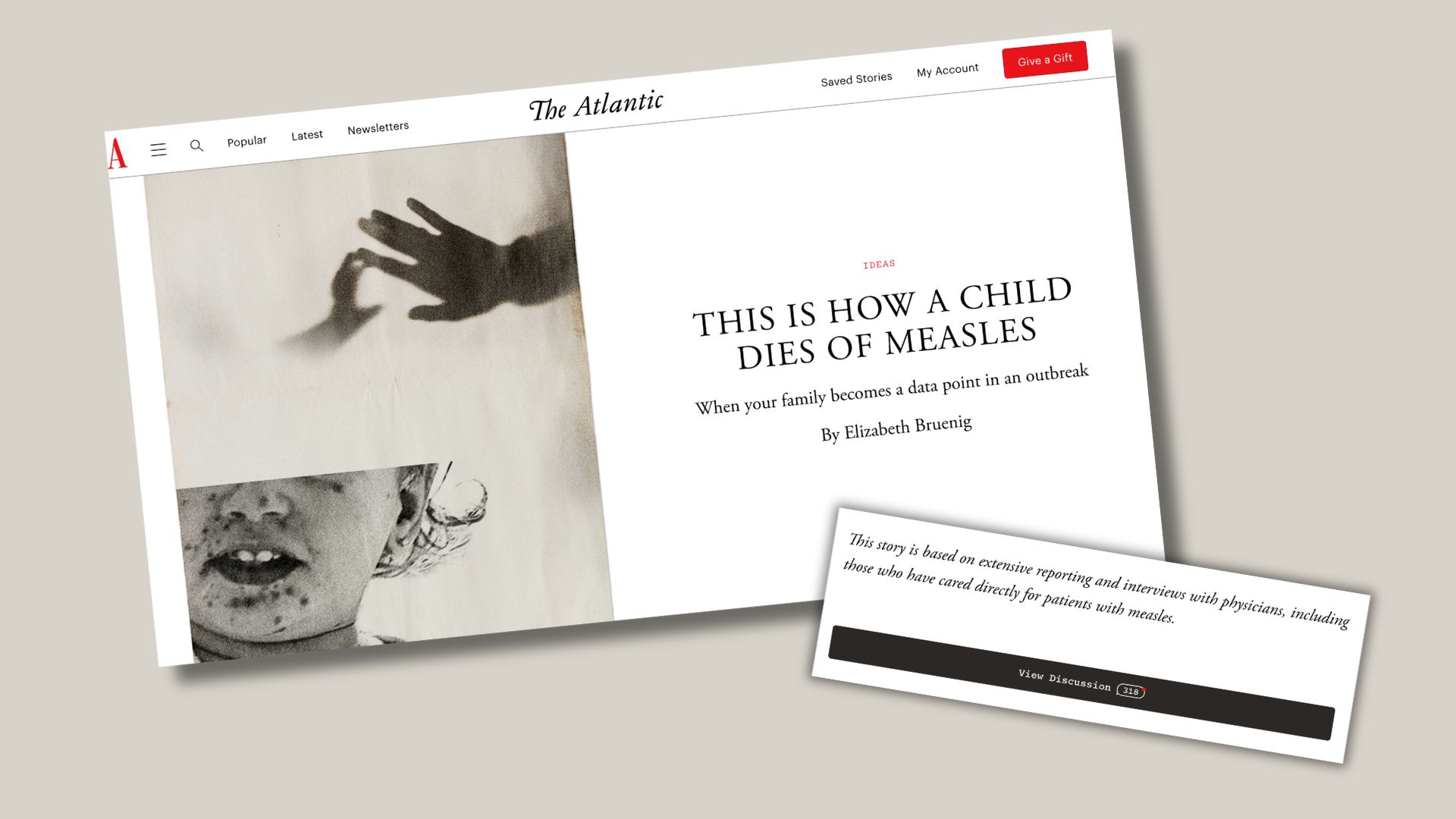
While I was away last week, my colleague at Nieman Lab, editor Laura Hazard Owen, raised some excellent questions about an essay in The Atlantic by Elizabeth Bruenig, “This Is How a Child Dies of Measles.” Writing entirely in the second person, Bruenig tells the story of a mother whose two unvaccinated children get measles after attending a birthday gathering — and then writes in horrifying detail about how one of the children dies. An excerpt:
It’s a classic kids’ party: Tears and lemonade are spilled; mud and cake get smeared into the rug; confetti balloons are popped one by one, showering elated children in rainbow-paper flakes. Sunbeams through the windows illuminate floating dust motes—and, imperceptibly, microdroplets of mucus carrying the measles virus, expelled from an infected but asymptomatic child who is hopping and laughing among the others. Your daughter breathes that same air, inhaling the virus directly into her respiratory tract.
The essay was based on reporting and interviews with doctors, but it was not a real case study. As Owen writes:
When I initially read Bruenig’s story, I was stunned: An Atlantic staff writer’s unvaccinated child had died of measles in the 2020s, and now she was writing about it? At the end of Bruenig’s piece, though, there’s an editor’s note: “This story is based on extensive reporting and interviews with physicians, including those who have cared directly for patients with measles.” That was the point when I sent a gift link to my mom group: “as far as I can tell this piece is fiction. What do we think about this choice? I am very conflicted!!!” My conflict stemmed from my concern that, though the piece was heavily researched, it was not a true story. I wondered if the key people whose minds might be changed by it — people who don’t vaccinate their kids — would brush it off as fiction, or fake.
Further adding to the confusion, Owen reports that The Atlantic’s initial press push didn’t make it clear the piece was a fictionalized account, and the disclaimer was added at the end after it was published.
The second person POV has been used in both fiction and nonfiction, but it’s not typical, which means editors and writers must take even greater care to not confuse readers. Editor Whet Moser reminds us of the classic 1997 Outside magazine feature written as a hypothetical in second person, “The Cold, Hard Facts of Freezing to Death,” by Peter Stark. (You can read our breakdown of that story in the Nieman Storyboard archive.)
As a reader, my first assumption about the second person point of view might be that the journalist is trying to protect the identity of someone who needs to remain anonymous. Or there is another reason, as seen in Tom Junod’s 2015 Esquire story, “The Lethal Presidency of Barack Obama,” in which Junod employs the second person to get inside the mind of the president, and then make a direct appeal to him about the use of drone strikes.
Given the questions arising from the Atlantic piece, it’s important for writers and editors to understand what readers might expect and assume from a story, especially when these pieces are shared across social media as a headline and link without context. The Atlantic publishes journalism and fiction, as well as essays that mix opinion and reporting — so what does it mean when a story is categorized under “Ideas”? Would the essay have been less ambiguous if it were a New York Times Opinion piece, or if the subhead (“When your family becomes a data point in an outbreak”) had not been positioned directly above Bruenig’s byline?
Send me a note (editor@niemanstoryboard.org) and let me know what you think. You can read Owen’s full Nieman Lab story and interview with Bruenig here.
***

This week on the Nieman Storyboard podcast, I spoke with journalist Tricia Romano about how she constructed her critically acclaimed oral history of the Village Voice, “The Freaks Came Out to Write: The Definitive History of the Village Voice, the Radical Paper That Changed American Culture,” which involved conducting more than 200 interviews about the famed New York City alt-weekly.
“The genius of an oral history is that, if it’s done well, it looks effortless. Even if it’s not your words, you’re creating something. It’s like a big giant slab of stone that you have to carve out, with only what you’ve got [from interviews].”
[ Follow us in Apple Podcasts, Spotify, or your favorite podcast app. ]
Links of note
- “When a great character doesn’t make the cut.” Science journalist Christian Elliott takes us behind the scenes of two reporting assignments about prairies and ecological restoration, in which Erin Irish, a biology professor at the University of Iowa, was an important source — but didn’t end up being featured as a character in either story. Elliott explains why it didn’t work out, and then includes a Q&A with Irish in his newsletter (thereby proving that every great character can still get their moment in the spotlight).
- Columbia Journalism School and the Nieman Foundation for Journalism have announced the 2026 shortlists for the J. Anthony Lukas Work-in-Progress Prizes, the J. Anthony Lukas Book Prize, and the Mark Lynton History Prize. The Lukas Prize Project, established in 1998, honors the best in American nonfiction book writing. Get the full list here.
- In other awards news: Finalists for the 46th Los Angeles Times Book Prize were announced Wednesday. Here’s the full list, with awards for biography, audiobook production, and more.
- Let’s close the week with a small bit of inspiration from author Jami Attenberg: “There’s always five minutes to write. There’s always a way to sneak it in. On the bus or the train, at the cafe when you’re standing in line for a coffee, at the grocery store when the person in front of you has an extra-full cart. At the end of your lunch break, at the beginning of your lunch break, all the way through your lunch break. In the movie theater before the previews start and you urgently need to capture a specific vision, or the doctor’s office when you feel like disassociating from the moment. While you’re waiting for the dry cycle to end, the hum of the machine your soundtrack. Right before you shut out your lights at the end of the night.”
Keep making time, and keep sharing your stories,
Mark Armstrong
Editor
Nieman Storyboard
Follow the Nieman Storyboard Podcast
On Bluesky: @niemanstoryboard.org
Subscribe to Storyboard
Get insights into the craft of journalism and storytelling in your inbox, delivered on Fridays.