Sign up for the Nieman Storyboard newsletter, delivered every Friday in your inbox.
***
Dear Storyboard community:
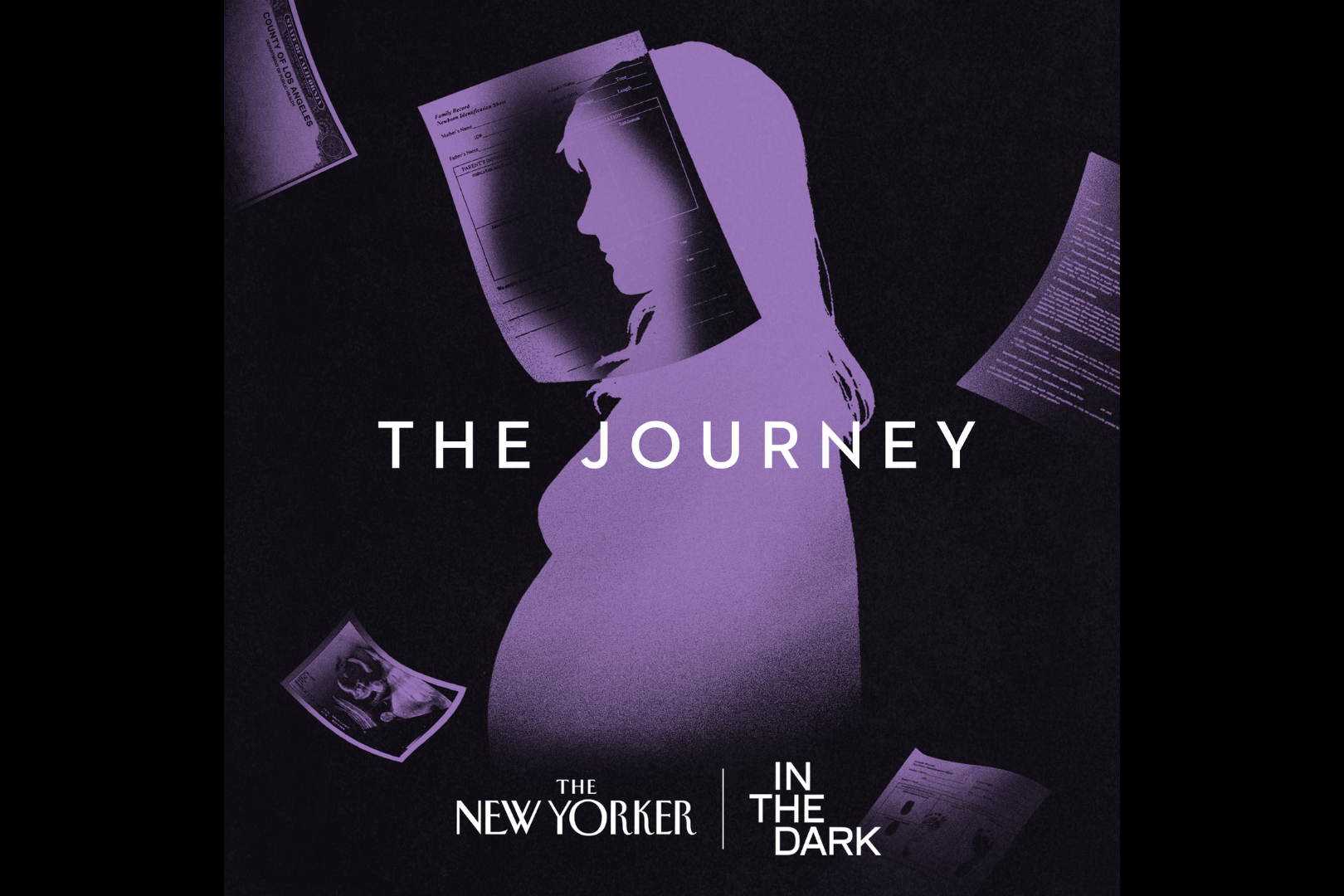
Last week The New Yorker debuted the seventh season of its award-winning investigative podcast, “In the Dark,” titled “The Journey.” Hosted by New Yorker staff writer Ava Kofman, it expands on a story she first reported and published in February about a woman in Texas who agreed to carry a child for who she believed was a wealthy couple in Southern California seeking a sibling for their daughter.
She soon discovered she wasn’t the only woman who was a surrogate for the couple — they eventually obtained dozens of children through surrogates. The FBI began investigating the family after one child was taken to the hospital with head injuries.
The almost unbelievable story unfolds from there, but a print magazine longform feature and a five-episode podcast series have very different structures. So how does the adaptation take shape? Alison MacAdam, a 2014 Nieman Fellow who served as story editor on the project, told us about her process:
Structure is always a crazy puzzle. You’re sorting through reporting questions, character arcs, plot points, aha! moments, accountability questions, and so much more, and you try to fit it into a shape that sounds effortless to the listener. But it is chaotically iterative and effortful.
In this case, Ava’s original magazine story provided a good starting point, with the POV of one surrogate. We could have chosen a different way into Episode 1 — for example, a true-crimier opening with the police discovering all the kids in the mansion — but we liked the idea of hearing the narrative of a surrogate before these crazy facts are known. Hearing her initial excitement and sense of purpose, and how that falls apart. And we wanted to play with the idea of the individual morphing into a collective: one isolated surrogate learns she’s one of many.
And then — for a multi-part series — you need to construct episodes that are individually satisfying, with their own arcs, but also leave the listener wanting to know more. So, for example, the latter half of Episode 1 zooms in on a second surrogate, but we leave her narrative hanging, unresolved, and return to it later. Focus is really important in audio: If you introduce a new character, angle, situation, you need to either be all in, or promise the listener you’ll come back to it. You can’t really tuck details in or “flick at them,” as some reporters say.
To return to your original question: A multi-episode audio story and a magazine piece don’t have to be massively different, structurally; some of the differences are more about the medium than the structure. But I’d say a five-part series is perhaps like five, separate print pieces... but with bits left dangling.
And for more on Kofman’s work, check out our 2021 story annotation of her reporting for ProPublica, "The Broken Front Line,” in which she embedded with EMTs during a winter COVID surge that overwhelmed Los Angeles hospitals.
Links of note

- Remembering Annie Dillard: The Pulitzer Prize-winning novelist died Tuesday at age 81. Now is the time to read Alexander Chee’s 2009 essay for The Morning News on taking Dillard’s writing class at Wesleyan: “Narrative writing sets down details in an order that evokes the writer’s experience for the reader, she announced. This seemed obvious but also radical—no one had ever said it so plainly to us. She spoke often of ‘the job.’ If you’re doing your job, the reader feels what you felt. You don’t have to tell the reader how to feel. No one likes to be told how to feel about something. And if you doubt that, just go ahead. Try and tell someone how to feel.”
- The National Book Foundation has announced its 2026 National Book Awards longlist for nonfiction, with 10 titles chosen from 727 books submitted. Finalists will be announced Oct. 6, and winners will be announced at the 77th National Book Awards Ceremony on Nov. 18. Get the full list here.
- The “sequence” approach to story structure: Author Matt Bell breaks down a process that he first learned from Paul Joseph Gulino’s book “Screenwriting: The Sequence Approach.” Rather than thinking of a screenplay or book as having three acts, Gulino suggests breaking story progression down even further into “sequences.” “I think it’s massively helped me with pushing through what might be the major problem of most early novel drafts I’ve seen—mine and other people’s—which is that the middle often becomes a baggy slog where not enough happens even as many, many pages go by.”
Keep outlining, and keep sharing your stories,
Mark Armstrong
Editor
Nieman Storyboard
Follow the Nieman Storyboard Podcast
On Bluesky: @niemanstoryboard.org
Subscribe to Storyboard
Get insights into the craft of journalism and storytelling in your inbox, delivered on Fridays.