Sign up for the Nieman Storyboard newsletter, delivered every Friday in your inbox.
Editor’s note: I am away this week, so we’re excited to feature a guest newsletter from journalist, author, and Storyboard contributor Kim Cross. — Mark Armstrong
***
Dear Storyboard community:
Atlanta-based artist Daniel Troppy has always worked in visual media: painting, photography, and sculptures from found objects. Following the death of his brother, painter Darrell Troppy, Daniel turned to words. “When my brother passed away, that’s when I started to write,” he told me. “And I am not a writer. I wasn’t an artist with words. But writing saved me.”
In grief, he found catharsis in writing tiny true stories — defining moments, memories, micro-narratives — each paired with a black-and-white photograph with the mood and grain of film. Written with telling detail and brevity, the stories averaged 100 words.
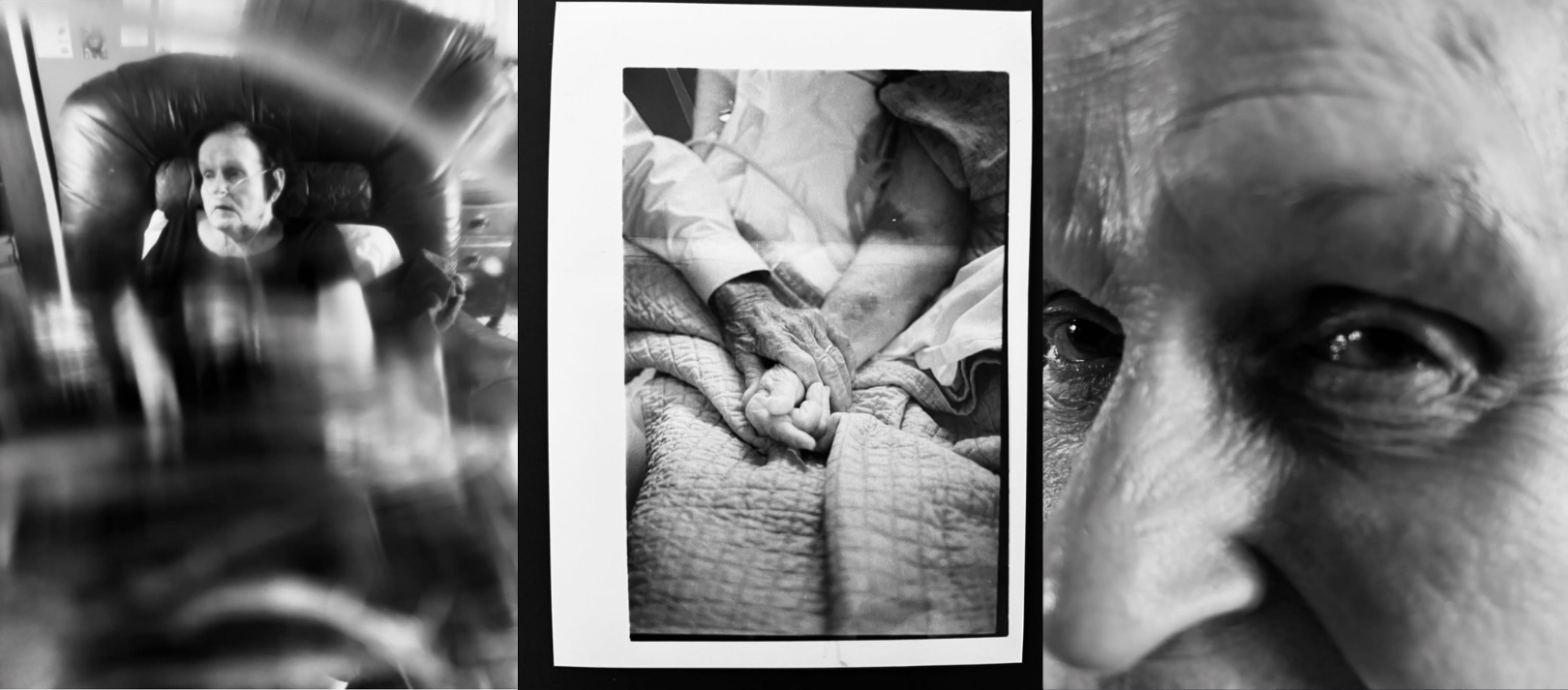
Instagram became his gallery. Amid the selfies and funny cat videos, his silver gelatin prints stood out like an art exhibit in a circus: An empty swing set that echoed William Eggleston’s untitled Memphis tricycle; an old woman pushing a walker through a hallway lined with portraits; a wrinkled hand with an IV line; thinning hair in curlers.
The images were arresting, more concerned with a mood and a moment than technical precision. The writing used specific details to avoid cliché. But what was this? Journalism? Art? Documentary? Visual memoir? A serial narrative unfolding in real time?
“They’re love letters,” Daniel told me. “Each story captures a small moment in time. A visit. A question. A memory. A feeling. I wanted to use my photography skills and write these short stories to document my parents’ end-of-life journey.”
It was all so raw and intimate, I felt uncomfortable — and moved. Brave and unflinching, Daniel pressed the shutter in moments that might have caused me to look away. They pulled me into a world I felt I shouldn’t be privileged to see, like Sally Mann’s family portraits. There was a touch of documentary, á la Walker Evans’s “Let Us Now Praise Famous Men,” but this photographer wasn’t an outsider. He was part of the scene, invisible but present. Shooting not only with permission, but love.
I recently interviewed Daniel about his process for my newsletter, The Waterproof Notebook. As a writer of narrative nonfiction, I’m always looking to learn from other storytelling genres — especially those that convey a story with a narrative arc in a short-form format. And social media, for better and worse, remains a place for stories to reach an audience.
Instagram increasingly feeds us influencer sludge more than posts by people we follow. But it remains a good place to practice writing short-form stories set to a sequence of images or videos.
Neil Shea, a longform writer for National Geographic and other publications, called Instagram “one of the world’s most successful general interest magazines.” He’s been using it to tell short-form stories for more than a decade. “Soon after I began experimenting within the app’s creative constraints, something strange happened—I found I loved writing short,” he wrote on Storyboard in 2015. “Beneath the selfie surface, Instagram provided a powerful, unexpected, and mostly underutilized storytelling tool.” Did that get old after a while? Nope! It looks like he is still going strong at @neilshea13.
I’ve been using Instagram to practice writing short, learn video editing, reveal a peek behind the writing process, and experiment with visual storytelling. A computer scientist told me the algorithm favors Reels that start with a human face, so I’ve been trying that (cringe), with some posts performing better than others. My most viral post is a carousel of 20 portraits of my mother, followed by a painfully honest confession of mixed feelings about inheriting her miniature Yorkie. (Do not stay tuned for more Yorkie content; that one brought out the trolls.)
Do you have a favorite source of short-form narrative inspiration? I’d love to hear from you. Shoot me a message over at kimhcross.com, on Instagram (@kimhcross), or on Substack at The Waterproof Notebook.
— Kim
Links of note
- Hannah Dreier and the staff of The New York Times have been awarded the 2026 Goldsmith Prize for Investigative Reporting for their series “Exposed and Expendable,” about wildfire fighters getting sick and dying young from exposure to poisonous smoke.
- The Poynter Institute is offering a free 75-minute webinar on April 28 (11:30 a.m. to 12:45 p.m. ET) on how to cover ICE enforcement and its impact on children and families.
- Scratch magazine returns: Written by a collective of powerhouse female freelance writers — Latria Graham, Maggie Mertens, Rahawa Haile, and Manjula Martin — this weekly dispatch gets real about the financial realities and survival tactics of those fighting to make a living in publishing.
- The Sunday Long Read True Crime Spotlight newsletter has a new editor: After a wonderful year working with SLR, I’m passing the torch to Shaun Assael, an award-winning author, magazine writer, and producer.
Subscribe to Storyboard
Get insights into the craft of journalism and storytelling in your inbox, delivered on Fridays.
Follow the Nieman Storyboard Podcast
[ Follow us in Apple Podcasts, Spotify, or your favorite podcast app ]