There are many ways to tell a true story, and there’s never just one path to finding the right idea or characters to bring those stories to life.
Once a journalist finds that perfect idea, can they build trust with their subjects to make it happen? “A huge part of my job is demonstrating … that I want to understand their story as well as I can, and that I’m willing to take as much time as necessary to do that,” Washington Post reporter Peter Jamison told Nieman Storyboard in 2023.
From the Storyboard archives, here are seven journalists discussing how they found their story ideas and main characters — and how their subjects trusted them to tell those stories with care and empathy:
1. Showing up for the story: Sarah Schweitzer of the Boston Globe on ‘The life and times of Strider Wolf’ (2016)
Sarah Schweitzer had written stories about young children before, but never as young as five years old. The child, Strider Wolf from New Hampshire, was on the edge of death three years before Schweitzer met him.
When he was two years old, Strider was severely beaten by his mother’s boyfriend, badly tearing his intestines that left a hole in his stomach. He underwent three surgeries in four days and spent three weeks laying in a hospital bed in Maine.
Schweitzer met Wolf when he was staying with his grandparents in Maine, who were between homes and struggling to keep up with the young boy and his even younger brother at their older age. The story is one of triumph over debilitating trauma and unfortunate circumstances.
This is how Schweitzer found the family:
When I’m looking for a story, I’m sort of casting about, so in this instance, court records were one thing I was looking through. I found the New Hampshire Supreme Court opinion rejecting an appeal by Strider’s abuser, his mother’s boyfriend, and I was pretty struck by it. The opinion was lengthy, it was heartbreaking, and I couldn’t help but wonder what had happened since with Strider. I tracked the family down to Oxford, Maine, but I couldn’t find a phone number so I called the local police. The chief told me he was looking for the family, too. It turned out the family had been evicted that week and child welfare workers wanted to make sure Strider and his brother were okay. He said he’d let the family know I was looking for them, and Lanette called me a few days later and agreed to a visit. Looking back, it does feel random, but I find stories often come about from some combination of luck and showing up, and those two things came together here.
2. Building trust with your subject: Christopher Solomon and ‘The Detective of Northern Oddities’ (2017)
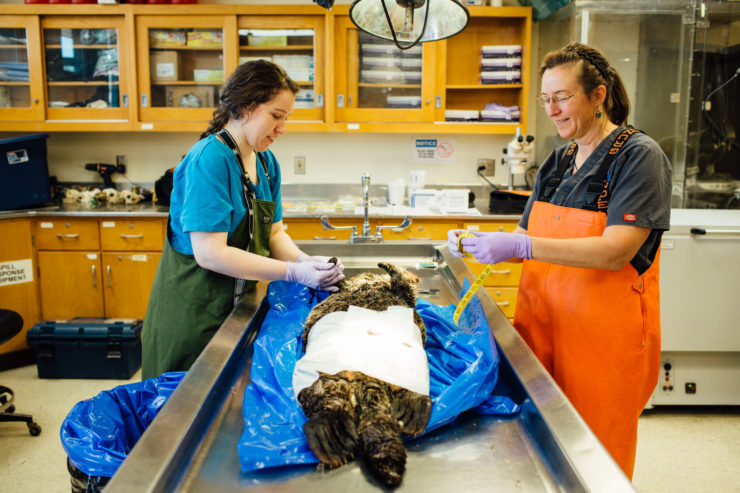
Journalist Christopher Solomon learned about veterinary pathologist Kathy Burek while reporting on a story for the Scientific American. He sent her an email, but she never returned the message.
After forgetting about Burek and that email for a few years, Solomon heard her name again when National Geographic reporter Craig Welch had dinner with Burek and other scientists while doing his own story. Solomon knew he wanted to revisit her and her profession: studying aquatic animals after they die.
Solomon’s story starts off with Burek surveying dead otters and showcasing her offbeat and twisted humor. It wasn’t an easy path to get her to open up to him, though. Burek not only failed to follow up on Soloman’s email, but passed up press interviews for years:
It actually took Burek some time to warm up to me. As often happens with scientists, she had had some bad experiences with reporters in the past; as a result, she’d kept a very low profile in the media for years, almost never appearing in the news. She wasn’t keen to have a story done about her. At the same time, and as with many scientists, she wanted people to pay attention to what is going on up there. She had a message to get out.
A couple of months after they first made contact and they had rapport built, Solomon asked if he could shadow her for a few weeks.
Once I got to know Burek, she turned out to be an amazing person: warm, smart, funny, passionate about her work, quirky and extremely quotable. Basically a writer’s dream. This is often the way it works, isn’t it? Once we knock down the initial barriers between reporter and subject, some fun and meaningful stuff can happen.
3. Following up in the comments: A revealing profile of a family that defied their faith’s edict on home schooling (2023)
Washington Post reporter Peter Jamison wrote a profile on Dan Cox, a lawyer-turned-politician from Maryland leading a movement among Christians toward home school education. Out of the several hundred comments the article received, one stood out to Jamison: someone claiming to have first-hand knowledge of Cox’s home-schooling network.
Jamison reached out to the commenter through the email they used to register with the Post and shortly got a response back from a man named Aaron Beall. He and his wife, Christina, grew up in a home school environment that demonized public education — yet at the time, three of their four children went to public school.
In a two-hour conversation with the parents in a conference room, Jamison learned that the pair were very bright yet did not pursue higher educational opportunities because of their upbringing. Seemingly, they did not want the same for their children.
Here’s what Jamison said about that initial connection with the Bealls:
A huge part of my job is demonstrating to people like Aaron and Christina that I want to understand their story as well as I can and that I’m willing to take as much time as necessary to do that. I like to think that by putting in the work — showing up for those early mornings when school starts, or nights when there are family events on campus; attending a child’s musical on the weekend; sitting and talking for as long as they are willing to talk — I’m “anteing up,” so to speak, showing that I’m committed to the process.
4. ‘Always looking for ideas’: Chris Jones and ‘The Things That Carried Him’ (2015)
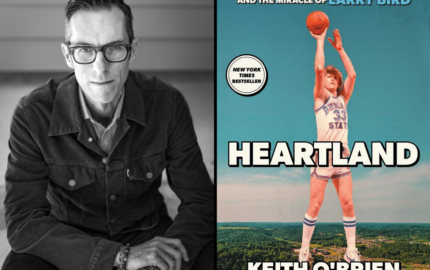
Chris Jones said he felt “beyond driven” to write longer stories with complex themes five years into his career with Esquire. That drive led to him to write the longest piece of his career — a 17,000-word story about a soldier who died while serving in Iraq in 2007.
It started out with reading around different publications, with Jones specifically reading a story from CNN about life at an operating base in Baghdad. One scene about a dead soldier being carried back to the base stood out to him. Then it led to a question: How does a soldier’s body actually get back home?
I’m always looking for ideas, and part of being a magazine writer is constantly looking for stories. And you know, the ideas are often the hardest part. You give a great writer a bad idea, and they’re not going to do anything with it. And you give a good idea to a mediocre writer, and they’re still going to come up with a pretty good story. The idea is so essential.
The story further required permissions from the family of the person he wanted to write about, and from the U.S. military. He felt like it would be difficult to get those two yeses, especially with the military. As it turned out, “like the pitch, it was an incredibly simple process.”
5. Finding the extraordinary: Jesse Katz goes ‘Inside the San Quentin Marathon’ (2016)
Jesse Katz said he felt like a fish out of water when he first started covering crime for the Los Angeles Times in the ’90s. He said the beat made him “develop a lot of skills and tactics, but also a lot of empathy and awareness.”
That came in handy during a visit to California’s oldest prison, San Quentin, some 20 years later. He visited the prison for another story but also learned that the prisoners hold a marathon race once a year. They made a course throughout the facility’s confined space, requiring 105 laps to make 26.2 miles.
I was quite taken by the vibe of the place, the medieval atmospherics there and the juxtaposition of this moldering castle right on this high-end, top-dollar, bayfront property. My eyes opened to San Quentin at that point. Then, when I heard they did a marathon there, it kind of blew my mind. There’s just something about the tension of trying to create distance in a place that is so confined.
While Katz talked to the prisoners and the guards, he regarded the San Quentin marathon course as its own character:
I was really intrigued with the course itself. I was very determined to document each twist and turn and explain the terrain that it navigated. I felt like the course was kind of central to everything — to the tension between freedom and confinement. Without that confinement, there was no zany course, and without the zany course, there was a lot less of a story.
6. Waiting for the right time: Eli Saslow and one Newtown family (2013)
For the Washington Post, Eli Saslow went to Newtown, Conn., shortly after the devastating Sandy Hook Elementary shooting in 2012. He wrote three daily stories in his time there, and most of the parents, understandably, did not want to engage.
Saslow spoke with his Post editor weeks after gun control legislation failed to pass in Congress. They wanted to write about a family advocating for something to change, and how attempts to try have not come to fruition. The timing was ideal, with the shooting still felt around the community but “enough time had passed that you could begin to see it fading in these small and brutal ways.”
Saslow spent days watching TV interviews of the families affected by the tragedy. He particularly took note of a “60 Minutes” program talking with 10 parents. He wanted to find someone active in gun legislation and with other children. After reaching out to a few people, he eventually landed on the Bardens, whose 7-year-old son Daniel died in Sandy Hook:
I explained what I wanted to do. I think it is always best to be pretty upfront about what you are asking for — the amount of time you want to be with them, the kind of story you are hoping to do, etc. They took a little while to think about it. They asked me to send them some other stories I had written. They talked with a PR person who had been advising the families, and then the PR person talked to me. Probably about a week after I called, they said they were up for it, and I flew to Newtown a few days later. Then, in terms of gaining access into their lives, it was mostly a matter of sticking around. I spent probably 12 or 14 hours with them each day when I was there. I sat next to them on the train to Delaware. I went to eat with them. I was there when they woke up in the morning. I stayed at a hotel nearby but spent almost all of my time at their house. Sometimes I was asking questions, but much of the time I was just there, trying my best to fade into their days.
7. Profiling people close to you: A reporter explores the laws and emotional impact of helping her father die (2022)
Esmé E. Deprez took her narrative storytelling skills at Bloomberg Businessweek and applied it to a subject she never thought she would explore: her father, Ron, and his final years battling ALS.
Her 5,000-word profile grappled with not only the relationship with her father while his health declined, but also about the state of medical aid in dying in the United States. In his state of Maine, Ron was one of the first people to take a life-ending drug, only available to those of sound mind with less than six months to live.
She saw the opportunity to write about her father as a way to memorialize him, and a conversation with a senior editor at Bloomberg to follow her along this reporting journey solidified it for her.
Interestingly, she didn’t tell her father that she would be writing this story — and it tore her up inside. She was afraid he would be angry, partly because he kept the severity of his condition away from most people he knew. But she said this after reflecting more:
Ultimately I convinced myself that a bigger part of him would be proud of me — proud that I confronted his death and my grief about it in a very head-on way. I also thought about how he was a policy guy at heart, having devoted his life and career as a public health epidemiologist and consultant to developing and advancing health reforms in his backyard of rural Maine and as far away as West Africa. I think he’d be happy that his story could illuminate the real-world impact of a government policy of growing significance and help shape the way people see and feel about it.
***
Emilia Wisniewski is a general assignment reporter and engagement editor at the Concord Monitor in New Hampshire. She previously worked at Boston.com and The Boston Globe as a correspondent where she covered local politics, business, health, and environment.
Subscribe to Storyboard
Get insights into the craft of journalism and storytelling in your inbox, delivered on Fridays.