Sign up for the Nieman Storyboard newsletter, delivered every Friday in your inbox.
***
Dear Storyboard community:
Confession time: Sometimes I like to fall asleep listening to YouTube videos. I upgraded to YouTube’s premium subscription just to listen to the calming sounds of Bob Ross and “The Joy of Painting” with my phone on sleep mode.
While looking for something new to add to my sleep rotation, I end up discovering YouTube creators like Anna Howard, whose channel “Wild Geese” is full of thoughtful video essays pondering creativity or deconstructing the world of internet self-help.
Howard’s channel introduced me to the concept of “digital gardening,” which is essentially a nonlinear and nonchronological approach to journaling. It encourages us to make room for small observations and discoveries from daily life — without getting distracted by structure, timelines, or storytelling.
Now, I know myself well enough to understand that consuming content about journaling feels similar to buying another expensive new notebook: Both give me the dopamine rush of taking action toward writing, without actually writing anything. But Howard hits on an interesting point, especially for those always looking for original stories to report and write. What if our constant quest to find a “story” is getting in the way of observing what’s in front of us?
Howard points to the essay “Against Narrative” (paywalled), by Rayne Fisher-Quann, who writes about a breakup and the pressure she felt to have a story about the relationship and why it ended:
In real life, at least until we complete the march towards death, the micro-narratives of our lives rarely reach satisfying end. … Applying the structure of a story to our necessarily unstructured lives can be tricky in part because of the inherent friction between the two modes of being; the great appeal of a story, after all, is that it ends. The great injustice of grief or pain or love or feeling at all is that — against all logic, will, or circumstance — it endures.
A couple years ago I became obsessed with Moth StorySLAM champion Matthew Dicks’s book “Storyworthy,” because it suggests some useful daily practices to look for stories in our own lives. (Here I go again with more journaling strategies.) Howard and Quann’s advice serves as a helpful corrective to rushing towards an ending — always start with observing and reporting. Story structure comes from editing and revision. If we jump too quickly to construct the story, we might miss something that doesn’t fit into a tidy narrative.
This week I’m excited to share Storyboard contributor Kim Cross’s recap of a conversation from an expert on observation: Pulitzer Prize-winning fashion critic Robin Givhan, who discussed her career journey at the recent Society for Features Journalism conference — from her early days covering the techno scene in Detroit, to writing cultural, political, and fashion commentary for The Washington Post, and now contributing to publications including The New York Times, Vanity Fair, and Vogue.
When she first started as fashion critic, Givhan said she received invaluable advice: “My editor told me, ‘Just report, don’t review.’”
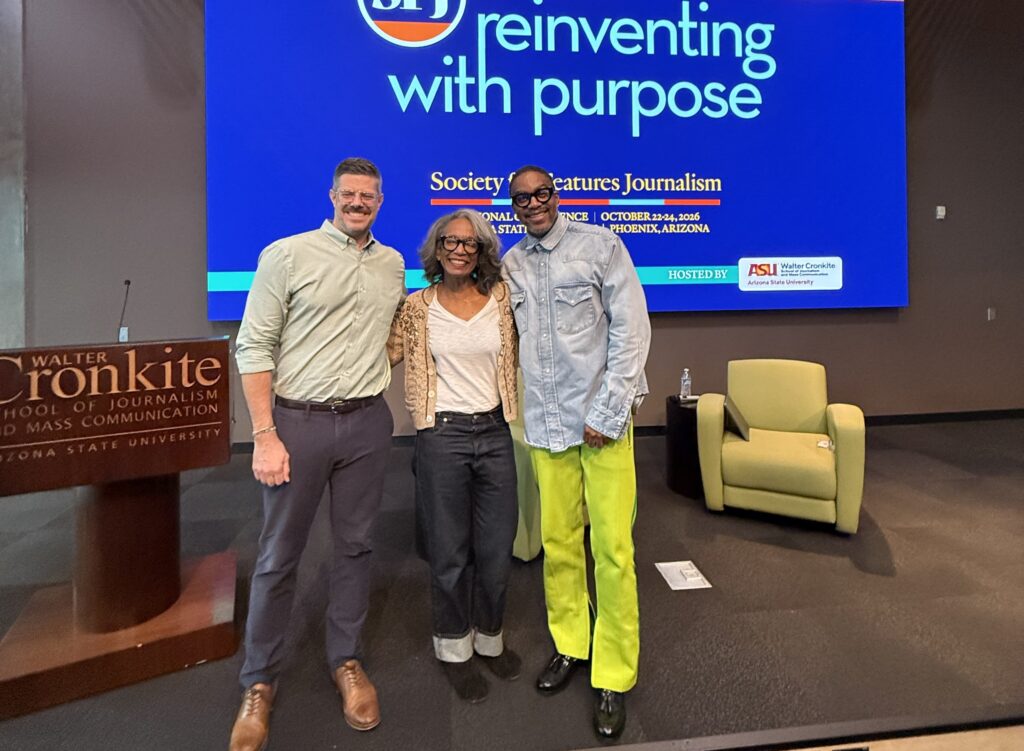
“Fashion helps us define what beauty looks like. It helps us define gender roles. It helps us define what wealth and status look like, and in doing so, it teaches us who and what we value. And if we’re not really looking at that critically, we sort of allow the algorithms to take over, and we’re not really making conscious, thoughtful decisions about who we elevate and why.”
[ Read the story ]
Links of note
- The winners of the 2026 National Book Awards were announced Wednesday night in New York City, and writer Abdelrahman ElGendy won the nonfiction prize for his memoir, “Huna: A Memoir of Revolution, Prison, and Becoming,” about being sent to prison in Egypt at age 17 when he and his father were arrested at a political protest. ElGendy spent six years and three months in prison. He was unable to attend the awards ceremony because the U.S. denied his visitor visa application to attend.
- I first discovered Christine Hyung-Oak Lee’s writing through her 2014 BuzzFeed essay, “I Had a Stroke at 33,” and I’ve followed her work and newsletter ever since. For her latest series on storytelling, Lee looks at the power of metaphor to structure a story: “Let’s say I want to write a book about rebuilding my life after a divorce with a newborn. … Let’s say one of the ways I picked myself back up off the ground that had NOTHING to do with divorce or a newborn was to get…bees. (Yes, really). Let’s say I’m obsessed with honey bees. (Truth). Let’s say I love beekeeping. (Yes, I do). The metaphor would be bees, which seems to have enough threads with regard to a cooperative society, a mother figure, collaborative work, swarming when running out of room, and matriarchy to resonate with the narrative arc of a marriage ending.” Read more in “Metaphor as narrative structure: How to build a novel or memoir without traditional plot.”
- “The Writers We Read When We Forget How to Write.” From The Ringer’s Bryan Curtis, an A-list roundup of journalists and writers sharing work that inspires them and their personal home remedies for writer’s block. From Ta-Nehisi Coates: “Best advice on this came from my first editor, the late, great David Carr — the cure for writer’s block is typing.”
Keep typing, and keep sharing your stories,
Mark Armstrong
Editor
Nieman Storyboard
Follow the Nieman Storyboard Podcast
On Bluesky: @niemanstoryboard.org
Photo by ronyescobarhn, Pexels
Subscribe to Storyboard
Get insights into the craft of journalism and storytelling in your inbox, delivered on Fridays.