Sign up for the Nieman Storyboard newsletter, delivered every Friday in your inbox.
***
Dear Storyboard community:
I just returned from an energizing and inspiring three days in Phoenix for the Society for Features Journalism conference at Arizona State University’s Walter Cronkite School of Journalism and Mass Communication.
We will be sharing dispatches from the conference over the coming weeks, including my own live Nieman Storyboard podcast conversation with New York Times national correspondent Kurt Streeter on the “fine art of hanging out.”
For now, here are a few quotes from panelists that are lingering with me. Perhaps they’ll get you thinking, too.
“Some people who are not part of the dominant group feel like they have to make themselves a little smaller on the page while they’re writing. And I say your only real chance is to make yourself bigger on the page and let them deal with it.”
— Author and essayist Mitchell S. Jackson, whose Runner’s World story on the murder of Ahmaud Arbery, “Twelve Minutes and a Life” (also annotated in Nieman Storyboard), won the 2021 Pulitzer Prize for Feature Writing.
***
“ The news tells us what happened, but the feature stories help us understand what it meant, and what it changed, and what remained.”
— Moni Basu, director of the MFA in Narrative Nonfiction program at the Grady College of Journalism and Mass Communication at the University of Georgia, reflecting on a series of stories she reported for CNN about a young woman, Falone Maxi, who was trapped in the rubble during the 2010 Haiti earthquake.
***
“ The thing that I’ve always told young people is: flattery is everything. So you are reading some great writer, and you want to do what they’re doing. What you do is you take that to your editor, and you say, ‘I really love the way Dan Barry writes about New York, and the way he does this and that. I wondered if you would read this piece and talk to me about it and tell me what you think, because this is really what I’m aspiring to.’ So by asking them to read what you aspire to, you’ve educated them that there is this kind of writing, and then secondarily, you flatter them because [it suggests] you want to know what they think.”
— UGA Professor and Nieman Storyboard contributor Jan Winburn, on the art of connecting with your editors to seek out narrative opportunities in the newsroom.
***
“I always try to go into every situation believing the best of people. And trying to remember that I don’t know what’s going on behind the scenes. I always try to say that I am skeptical, but I’m not cynical. And if there’s anything that I try to hold onto, it’s to not get cynical. With fashion, in particular, you know, I’ve covered it for such a long time. People have said, ‘Does anything still surprise you?’ And I said, ‘I am shocked every single day.’ The day that I lose the capacity to be shocked, that’s the day that I feel like I will have lost my humanity.”
— Robin Givhan, Pulitzer Prize-winning former fashion critic for The Washington Post.
***
“ I just wanted to do a shout-out to copy editors. They have saved my butt so many times. They’re really the unsung heroes of the newsroom. They don’t get a lot of credit, and I think there should be a special award for these human safety nets that save us all the time.”
— Tom Sietsema, the James Beard Award-winning former food critic for The Washington Post, and now correspondent for The Washington Sun.
***
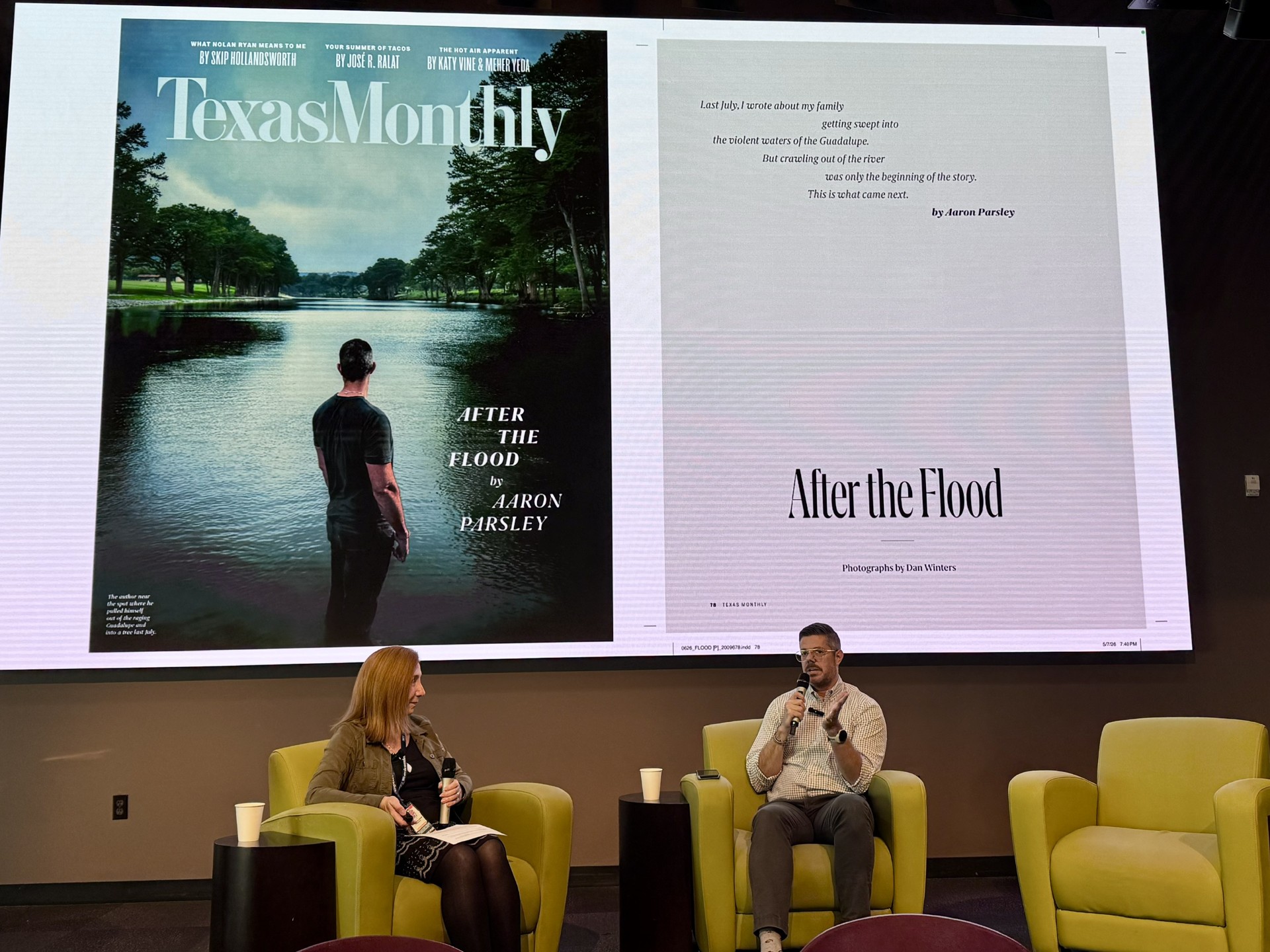
“My purpose was love. I wanted to tell people what I knew to be true, which is that my sister was a hero.”
— Aaron Parsley, senior editor for Texas Monthly, who wrote a powerful and heartbreaking personal account of the devastating 2025 Guadalupe River floods, which took the life of his 20-month-old nephew Clay. Parsley was honored with the 2026 Pulitzer Prize for Feature Writing and has since written and reported on the aftermath in a feature story and podcast for Texas Monthly.
***
Thanks again to everyone at SFJ, including Laura Coffey, Mesfin Fekadu, and Athima Chansanchai, for a wonderful event.
Links of note
- “Ambition isn’t wrong, but you need a hobby. Let me know when you get one, I’m still looking.” Writer Grace Byron answers Naz Riahi’s Rejection Questionnaire, which is a fantastic resource for rethinking how to approach rejection in our writing and reporting work. (Spoiler: It’s a natural part of the process!)
- On status and power: This short essay from leadership coach Casey von Neumann is not about journalism, but it made me think about the great power — and responsibility — that journalists have when it comes to telling other people’s stories. Von Neumann shares an anecdote about a person in power who didn’t realize (or didn’t want to realize) that the dynamic was there. “Acting as though the playing field is level, whether because they believe it is or they wish it were, these people cause more harm than they would if they acknowledged their power and wielded it appropriately.”
- Finally, speaking of editors who constantly look out for us, I want to send a shout-out to author, editor, and playwright Kara Cutruzzula, who’s been editing the Nieman Storyboard newsletter over the past year. She also writes the Brass Ring newsletter, which is full of creative inspiration. As I’ve said before, everybody needs an editor, and I feel lucky to have Kara’s insights and advice every week.
Keep connecting with others, and keep sharing your stories,
Mark Armstrong
Editor
Nieman Storyboard
Follow the Nieman Storyboard Podcast
On Bluesky: @niemanstoryboard.org
Subscribe to Storyboard
Get insights into the craft of journalism and storytelling in your inbox, delivered on Fridays.